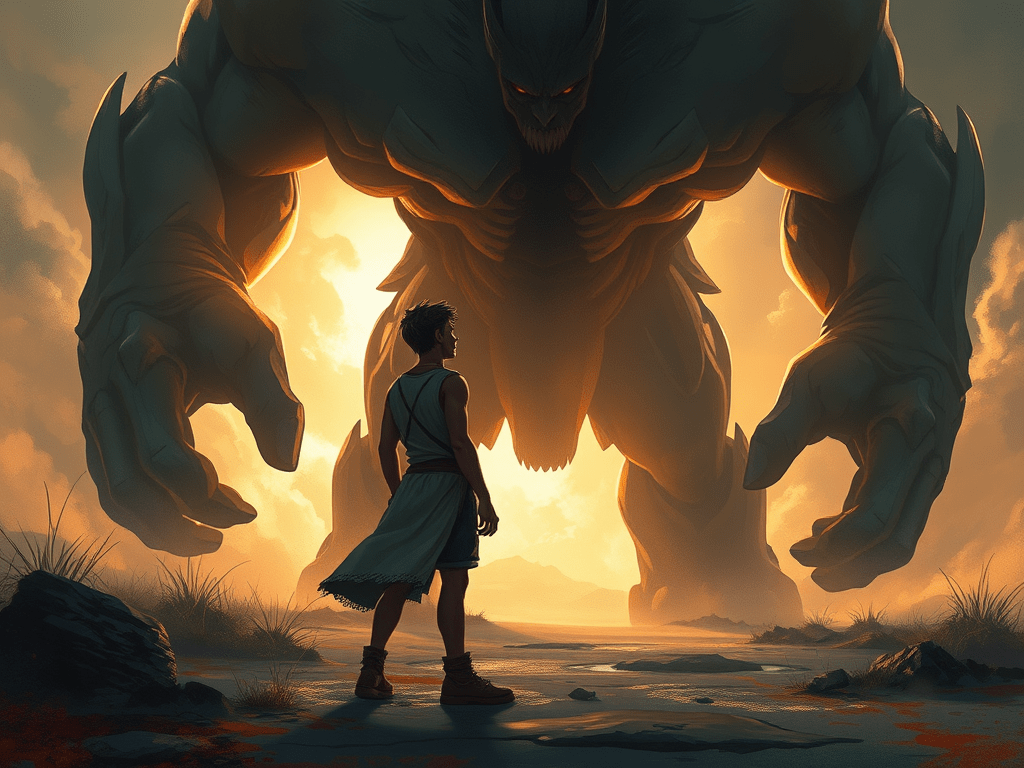
The Story We Keep Telling
Across cultures and centuries, a certain kind of story keeps appearing. A slow tortoise racing a swift hare. A young shepherd standing before a towering warrior. A lone figure confronting someone everyone believes cannot be defeated. The characters change, the setting changes, yet the pattern remains familiar. Someone powerful, confident in past victories, faces an opponent who appears vastly weaker. The outcome seems obvious long before the contest begins. Yet somewhere along the way, the mighty fall.
We usually remember these stories as lessons about arrogance. Pride blinded the strong, we say. But that explanation tells only half the story. The other half belongs to the person standing on the weaker side of the contest. What does it feel like to face someone whose strength seems unquestionable while the world quietly assumes the outcome is already decided?
Standing Against the Odds
Imagine being that person. Across from someone stronger, faster, richer, or more powerful in every visible way. The verdict around you is almost unanimous. Friends hesitate. Observers whisper. Some show concern, others quiet amusement. Even well-meaning advice carries the same message: this is a battle you cannot win.
The underdog is rarely unaware of this reality. He sees the same odds everyone else sees. He understands the gap. If the contest were repeated many times, he might lose most of them. Yet circumstances sometimes leave little room for retreat. Duty, chance, necessity, or simply refusing to step aside can lead someone into a fight they never expected to face.
The Quiet Shift
Something interesting happens before the contest truly begins. At some point the underdog stops calculating the outcome and confronts the possibility of defeat directly. He imagines the loss, the disappointment, the moment when observers nod and confirm what they believed all along. Strangely, once that future is accepted, something begins to change.
Fear loosens its grip. When there is nothing left to protect, the mind becomes lighter. The stronger opponent carries the burden of reputation and expectation. His victories must continue. The underdog carries no such weight. Because defeat is already assumed, he is free in a way his opponent may not be. That freedom sharpens attention. Movements become clearer, decisions simpler, hesitation fades.
Many contests are lost not just because of strength, but because of doubt. But once someone has accepted the possibility of losing, doubt has less space to grow. The fight becomes simpler: respond, adapt, continue.
Strength and Habit
At first the contest usually unfolds exactly as expected. The stronger side dominates, confirming the assumptions everyone carried into the moment. Yet the underdog stays, not because he knows he will win, but because leaving guarantees defeat.
What unfolds next is often subtle. Success has its own quiet side effects. Repeated victories create confidence, and confidence slowly becomes habit. When someone has won many similar battles before, it becomes easy to assume the next one will follow the same pattern. Opponents begin to resemble earlier opponents. Situations begin to feel familiar.
The powerful do not necessarily become weaker. They simply begin to repeat what has always worked. And over time, they stop looking as carefully as before.
The Moment That Changes the Story
When failure disappears from the imagination, small details receive less attention. A slight misjudgment or careless move may pass unnoticed because in earlier contests such moments never mattered.
But if the opponent refuses to leave the field, those small openings can suddenly matter.
The underdog does not become stronger in a single instant. What matters is that he is still present when opportunity appears. He has endured the early pressure, absorbed the doubts, and stayed long enough to notice something others assumed would never arrive.
And sometimes that is enough for the story to change.
When Courage Spreads
Even when victory does not come immediately, something else begins to grow. Each battle removes a little more fear and adds experience. Someone who once felt uncertain becomes battle-tested. Loss stops feeling like an ending and begins to resemble preparation.
People notice that spirit. Not the loud confidence that comes from power, but the quieter resolve of someone who keeps returning despite long odds. What begins as a single act of resistance slowly becomes visible to others.
Courage travels quietly. One person stands. Another begins to think the same way. What once looked like an isolated challenge begins to shift the atmosphere of the contest.
When Pride Falls
Stories of the mighty falling appear again and again not because the weak always win, but because strength and certainty rarely remain balanced forever. Success often brings confidence, but repeated success can slowly narrow perception. When certainty becomes too comfortable, it leaves space for the unexpected challenger.
The fall of pride rarely begins with weakness. More often it begins when judgement grows clouded by certainty. And the rise of the underdog rarely begins with sudden strength. It begins when fear slowly leaves the mind.
Perhaps this quiet balance has long been captured in a few simple lines from Goswami Tulsidas Ji in the Ramcharitmanas:
“जाको विधि दारुन दुख देही, ताकी मति पहिले हर लेहीं।
जाको विधि पूरन सुख देहीं, ताकी मति निर्मल कर देहीं।”
 Quiet Reflections