Author: Quiet Reflections

  • How the River Flows

    How the River Flows

    The observation

    A thought has been sitting with me for a while.

    It started with a podcast where an investigator was talking about investigation agencies. He made a rather simple observation: never doubt the capability of an investigation agency; the issue is often not capability, but pressure.

    I don’t remember the exact context in which he said it, but the distinction stayed with me. An organisation can have capable people, technology, information, money, experience and institutional knowledge, and still behave very differently depending on the pressures acting on it.

    Capability and outcome are not the same thing.

    At first, I thought this was simply an observation about investigation agencies. Then I started wondering whether it was actually an observation about systems. A system has capabilities. It also has pressures, incentives, constraints, information, people and history. These things interact. The interaction produces behaviour. Behaviour produces outcomes, and outcomes become feedback for what happens next.

    The system learns. But learning does not necessarily mean improvement. A system can learn to respond better to the problems it faces. It can also learn behaviours that make the underlying problem worse. It can become better at surviving one kind of pressure while becoming less capable of dealing with another.

    Nothing in the word “learning” tells us which direction the system is moving.

    When the system is society

    That made me wonder what happens when the system is society.

    A society has a large pool of human capability available to it: intelligence, creativity, courage, ambition, curiosity, cooperation and craftsmanship. These capabilities exist in people long before any particular institution decides how to use them.

    Yet societies can produce remarkably different outcomes from broadly similar human capabilities. A kingdom had capable people. A modern government has capable people. A company has capable people. The question, then, isn’t simply how capable the people are.

    What does the system do with the capability it has?

    A system can activate some capabilities and suppress others. It can reward certain behaviours and make other behaviours costly. It can direct ambition toward creation, competition, status, security, exploration or consumption. It can make cooperation valuable in one context and individual competition valuable in another.

    The capability remains, but what changes is how it gets expressed.

    Pressure matters. Incentives matter. Constraints matter. Information matters. Character matters. History matters. And so does the feedback produced by everything the system has already done.

    The people inside the system

    But there is another complication.

    The people inside a system don’t necessarily understand the system they are part of. A king understands some part of his kingdom. A bureaucrat understands some part of the government. A business leader understands some part of the market. A consumer understands some part of the economy. Each operates with a model of reality, and that model may be right, wrong, or right for a while and then become wrong.

    Yet the action taken from that model becomes another input into the system.

    The actor is simultaneously observing the system and changing it.

    We therefore get a smaller loop inside the larger one:

    reality → perception → belief → action → changed reality

    A person doesn’t need to understand the whole system for their actions to affect it. A consumer doesn’t need to understand monetary policy for credit to change consumption. A business doesn’t need to understand culture for its incentives to influence behaviour. A government doesn’t need to understand every individual for a policy to change the conditions under which millions of people act.

    Each actor responds to what is immediately visible. The aggregate of those responses becomes something much larger.

    How behaviour becomes culture

    And this is where culture starts becoming interesting.

    A response that works gets repeated. What gets repeated becomes familiar. What becomes familiar becomes expected. What becomes expected starts becoming normal. And what becomes normal begins shaping institutions. Those institutions then become part of the environment in which the next generation operates.

    People create the system. The system shapes people.

    Culture, then, may be less like something a society simply possesses and more like something it continuously produces. What a society says it values matters. But what its system repeatedly rewards may matter just as much. What does it make easy? What does it make difficult? What behaviour allows someone to rise? What behaviour gets ignored? What behaviour gets copied?

    Over time, the answers become part of the character of the system. Not through one decision, but through repetition.

    The system responds to itself

    I can see this mechanism particularly clearly in the modern consumption economy.

    A person wants something. Demand creates an opportunity. A business responds. Financial mechanisms make the purchase easier. Advertising creates new associations and desires. Social signalling gives the object another meaning. The consumer responds again. The business learns. The financial system adapts. Other businesses follow. Expectations change. What was once unusual becomes normal.

    Eventually, the product is no longer just a product. It can become identity. Possession can become achievement. Consumption can become a way of communicating status, belonging or aspiration.

    None of this requires someone to have designed the entire system. Each participant can simply be responding to the incentives immediately in front of them. Yet the aggregate of those responses creates a much larger pattern.

    The system is learning from itself.

    And once that happens, something interesting occurs. The system begins producing some of the conditions that shape its own future behaviour. The consumer changes the business. The business changes the consumer. The financial system changes both. Culture changes the meaning of consumption, while consumption changes culture.

    There is no obvious beginning anymore.

    It is a loop.

    Which force is moving the system?

    This also made me think about the variables inside a system. We often look for the things that are present: capabilities, incentives, institutions, pressures, people, technology, information. But a variable being present doesn’t tell us how much influence it has at a particular point in time.

    The same system can contain the same variables for years and still behave very differently. One force can gradually become more powerful. Another can become weaker. Something that was previously marginal can become important. Something that once dominated can lose its ability to move the system.

    The variables don’t necessarily disappear. Their relative influence changes.

    What is increasingly able to move the system?

    That question feels more useful to me than simply asking what forces exist. A snapshot tells us what the system is. A trajectory may tell us what it is becoming.

    And perhaps this is where systems become difficult to predict. We are not only dealing with a collection of variables. We are dealing with variables whose influence on one another is itself changing.

    A pressure can strengthen an incentive. An incentive can change behaviour. Behaviour can change institutions. Institutions can change the pressure. The result can strengthen the original incentive, weaken it, or create an entirely new force that wasn’t particularly important before.

    The system keeps changing while we are trying to understand it.

    When the system reaches an edge

    This made me think about what happens when one of these forces becomes too influential.

    A system can push one variable for a long time without anything obvious happening. But the consequences accumulate. At some point, those consequences begin changing the balance of the system itself. The dominant force starts creating pressure against itself. Something that was suppressed becomes more valuable. An incentive that once worked starts producing undesirable behaviour. Institutions that once absorbed pressure begin amplifying it.

    The system starts responding to the consequences of its own behaviour. The dominant force weakens, something else becomes stronger, and the system reconfigures.

    And then it continues.

    It can look like a pendulum.

    But the system doesn’t necessarily know where the ends of the pendulum are. It may discover them by reaching them.

    Perhaps a system doesn’t need to know its boundaries in order to remain within them. It only needs feedback strong enough to respond when it approaches them. And even then, the boundary may not be fixed.

    Technology can change it. Institutions can change it. Demography can change it. The environment can change it. Human behaviour can change it. The system itself can change it.

    So perhaps what we call a boundary is not a line that someone has drawn around the system. It is a region within which the system can continue to operate, reproduce and adapt.

    The system can spend a very long time moving around inside that region. It can approach an edge, cross it, absorb the consequences, reorganise and continue in another configuration.

    The boundary may be real even when nobody knows where it is.

    This also means that a system can appear stable without actually being still. It may be constantly moving, constantly adapting, constantly shifting the relative influence of its own variables. Yet from a distance, it can look remarkably stable because the changes remain within a range that the system can absorb.

    Until they don’t.

    At some point, the system may encounter a pressure it cannot absorb in its current configuration. Something gives way. The system doesn’t necessarily disappear. It may simply become something else.

    Sometimes failure is simply the end of the current configuration.

    When the system is sensitive

    This also gives me a different way of thinking about the butterfly effect.

    A small event isn’t inherently powerful. Its effect depends on the state of the system into which it enters. The same disturbance can disappear, be absorbed, be amplified, or push the system across a threshold.

    The difference is not necessarily in the size of the event, but in the condition of the system receiving it.

    The butterfly is not necessarily powerful. The system is sensitive.

    And that sensitivity can change. A system that absorbs a disturbance today may amplify the same disturbance tomorrow because its internal configuration has changed. A pressure that was once harmless can become destabilising when the system has accumulated enough other pressures around it.

    This makes the butterfly effect less about tiny causes somehow becoming enormous and more about the relationship between a disturbance and the state of the system at that particular moment.

    History as accumulated pressure

    Perhaps this is also why history is so difficult to explain through a single cause.

    A major event can appear to change everything, but the event may simply be the point at which accumulated pressure found an outlet. The pressure may have been building for years, decades or centuries. The event mattered, but perhaps it mattered because of the state of the system when it arrived.

    A different system might have absorbed the same event. Another might have amplified it. Another might have reorganised around it.

    The event may be the trigger, not the whole story.

    This changes the question we ask about historical turning points. Instead of asking only what caused the change, perhaps we should also ask what had been happening in the system before the change became possible.

    What pressures had been accumulating?

    Which variables had been gaining influence?

    Which ones had been losing it?

    What behaviours had become normal?

    What feedback loops had been strengthening?

    Because by the time the visible event arrives, the system may already have travelled a very long way.

    Back to capability and pressure

    And this brings me back to where the thought started.

    Don’t doubt the capability.

    Look at the pressure.

    Capabilities matter, but capabilities alone don’t determine outcomes. The people inside a system operate through incomplete models. Their beliefs influence their actions. Their actions alter the system. The altered system changes their future incentives, perceptions and pressures. Repeated behaviours become norms. Norms become institutions. Institutions shape the environment. The environment shapes the next generation.

    The loop continues.

    Over a long enough period, these interacting loops produce things we give names to: culture, society, institutions, civilization and history.

    None of them necessarily requires a central intelligence. The system can learn without anyone knowing exactly what it has learned. It can adapt without knowing what it is adapting toward. It can remain within some broad boundaries without knowing where those boundaries are. It can overshoot, correct, reorganise and continue.

    And perhaps sometimes it can no longer continue in its existing form.

    I am not sure where this thought ultimately leads. Maybe it is simply a useful way of looking at systems. But it has changed the question I find myself asking.

    Instead of asking only what a system is capable of doing, I find myself asking what the system is continuously being pushed to do.

    And which of those pressures are becoming stronger over time?

    Because perhaps that tells us less about what a system is today, and more about what it is becoming.


  • The Meal, Not the Recipe!

    The Meal, Not the Recipe!

    There is an old saying that there are many ways to skin a cat. Like many old sayings, it has managed to survive long after the world that gave birth to it disappeared. Most of us have never needed to skin a cat, yet the saying continues to find its way into conversations.

    Perhaps because it was never really about the cat.

    One of the quieter joys of travelling across India is discovering how familiar food keeps changing. Walk into ten homes and you may find ten different ways of preparing the same gravy. In one kitchen, onions and tomatoes form the base. In another, coconut does the job. Elsewhere it may be peanuts, sesame, yoghurt, mustard or tamarind. The recipes differ not because one family decided to be different from another, but because generations learnt to work with what the land offered, what the climate encouraged and what experience quietly refined over time.

    Nobody seems particularly bothered by this diversity. We don’t spend much time searching for the one authentic recipe that every household should eventually adopt. Somehow we understand that the meal remains familiar even when the recipe changes.

    It is interesting how easily we accept this in our kitchens, and how reluctant we become to extend the same generosity elsewhere.

    Take work.

    A startup asks very different things from people than a mature organisation. One rewards speed, experimentation and comfort with uncertainty. The other depends upon coordination, consistency and managing risk. We often compare the people without first comparing the problems they are trying to solve.

    Life seems no different.

    What matters deeply at twenty often gives way to different priorities at forty. The responsibilities of a parent are not those of a student. The questions of retirement are rarely the questions of a first job. It would be surprising if the answers remained unchanged while the questions kept evolving.

    Success follows the same pattern.

    Some people optimise for wealth. Others for craftsmanship. Some seek influence, others independence. For many, success is found in raising a good family, enjoying meaningful work, remaining healthy or simply ending the day surrounded by people they care about. These are not necessarily competing ideas. They are often different destinations altogether.

    Yet much of the advice we encounter arrives as though there were only one destination.

    Successful people naturally describe what worked for them. There is nothing unusual about that. Their experience is genuine, their effort undeniable and their insights are often valuable. What quietly disappears, however, are the circumstances that shaped those experiences—the stage of life they were in, the problem they were trying to solve, the risks they accepted and the trade-offs they were willing to make. Remove those from the story and advice can begin to sound far more universal than it was ever meant to be.

    Perhaps that is why advice often feels contradictory. Two people may both have succeeded, yet they may have been answering entirely different questions. One execution need not invalidate another if the destination, the constraints or even the definition of success itself were different.

    Old sayings seem to age rather differently. They rarely prescribe a recipe. Instead, they point towards a direction and quietly leave the execution to whoever inherits the problem. Every generation receives the same broad direction, but discovers its own way of living it. Perhaps that is why they continue to survive while countless methods quietly come and go.

    By the time the meal is over, very few people are thinking about whether coconut would have been better than tomatoes. The family has shared a meal, conversations have lingered a little longer, and everyone has been nourished.

    Perhaps advice is meant to work in much the same way. It can point us towards a direction, but how we arrive there depends on our own kitchen—our circumstances, our strengths, our habits and the ingredients available to us.

    After all, the purpose may be shared.

    The cooking rarely is.

  • Building LoopEngine — Thoughts on Loop Engineering

    Building LoopEngine — Thoughts on Loop Engineering

    A Weekend Lab

    Over the past few weeks, I had been increasingly hearing about something called loop engineering. The phrase kept appearing in discussions around agents, autonomous systems, AI runtimes, and coding assistants. Like many new terms in our industry, it was initially difficult to determine whether this was a genuinely useful abstraction or simply another way of describing ideas that already existed under different names.

    Curiosity eventually won.

    This weekend, I decided to spend some time building a small experimental system to expand my own understanding. The intention was not to build a framework, propose an architecture, or prove any particular thesis. It was simply a small engineering lab—a place to experiment with planning, execution, verification, and feedback loops, and perhaps develop a better intuition for what people actually mean when they talk about loop engineering.

    The experiment eventually became something I started calling LoopEngine.

    As often happens with these kinds of projects, the implementation started asking questions that were far more interesting than the original idea. The difficult problems were not about prompts or model selection. They were questions like: How does the system know whether it is making progress? How does it know when to continue, when to retry, and when to stop entirely? What does failure look like? And perhaps even more interestingly, what does it mean for such a system to become lost?

    Somewhere during that process, I realized that I was no longer really trying to understand loop engineering. I was trying to understand loops themselves.

    From Workflows to Loops

    For the purposes of this experiment, I started thinking about loop engineering as the discipline of designing systems that repeatedly observe, plan, act, measure, and adapt toward an objective.

    The important idea here is not repetition itself. Software has always contained loops. Build systems, CI pipelines, schedulers, retries, event processors, and control systems all loop in one form or another. What felt different here was that the future path of execution was no longer entirely predetermined. Every iteration had the ability to change the next one.

    A traditional workflow usually feels like a sequence of boxes connected together.

    A → B → C → D

    Even many agentic systems today still resemble this pattern. One of the boxes may contain an LLM, but the overall structure remains largely fixed.

    The systems I found myself building increasingly looked like this instead.

    Observe
    Plan
    Act
    Measure
    Adapt
    Repeat

    The difference may appear subtle, but it changes the nature of the system entirely. A workflow executes. A loop continuously decides what should happen next.

    The moment feedback begins altering future behavior, the system starts looking less like orchestration and more like optimization. At least, that is how it increasingly started feeling to me.

    When Feedback Becomes the System

    The example I repeatedly used while building LoopEngine was intentionally simple: build a small Python command-line todo application supporting add, list, and done, with tasks persisted into a tasks.json file.

    The first cycle would usually produce a plan.

    - Create app.py
    - Implement JSON persistence
    - Produce README.md
    - Add command handling

    Actors would execute these tasks, files would start appearing in the workspace, and eventually something resembling a working application would emerge.

    workspace/
    ├── app.py
    ├── README.md
    └── tasks.json

    In one run, the generated application was actually quite competent. It handled argument parsing, persistence, validation, and error handling using only the Python standard library.

    But the interesting part was never the generated code. The interesting part was what happened next. The system would verify its own outputs.

    • Did the files exist?
    • Did the commands execute?
    • Could tasks actually be persisted?
    • Was the documentation complete?

    If verification failed, the next cycle did not merely repeat the previous one. It changed. The planner would focus on the missing pieces. The review stage would identify weaknesses. The next plan would emerge from the failures of the previous attempt.

    Over time, I realized that this iterative behavior was becoming the entire point. The system was not simply generating artifacts. It was continuously refining them through feedback.

    One of the more surprising realizations during this experiment was that these loops increasingly started looking like optimization systems. At first, I thought I was mostly building orchestration mechanisms and planning abstractions, but gradually measurement started becoming the center of everything.

    Without some notion of progress, the loop has no way of distinguishing improvement from movement. It can continue producing plans, generating files, invoking tools, and creating the appearance of activity while in reality simply wandering around the solution space.

    A loop without an honest loss function is therefore not really optimizing anything. It is merely moving.

    For the Python example, the measurements were surprisingly mundane.

    • Does app.py exist?
    • Does README.md exist?
    • Does python app.py list execute?
    • Does tasks.json persist data correctly?
    • Are all required commands implemented?

    None of these measurements are particularly intelligent. Yet together they provide something far more important. They provide direction.

    A refinement loop with poor measurements simply converges confidently on the wrong thing. That idea started appearing everywhere. Perhaps intelligence matters less than feedback than I had initially assumed.

    When Systems Get Lost

    Another interesting realization was that success and failure are not the only meaningful states. There appears to be a third state that feels equally important.

    Lost.

    The loop may continue producing outputs. It may continue generating plans and executing actions. Yet nothing meaningful is improving. The system remains active but no longer appears to be making progress. Recognizing this state felt surprisingly significant. Perhaps long-running cognitive systems need the ability to admit:

    I no longer know how to make progress.

    That seems like a useful capability for both machines and people.

    Determinism and Intelligence

    Around the same time, I found myself increasingly appreciating the Actor Model. This was not a rediscovery. I had previously used actor systems while building desktop applications. But loops made the fit feel surprisingly natural in a way I had not fully appreciated before.

    Actor systems solve a very particular class of problems remarkably well. They provide isolation, supervision, asynchronous coordination, long-running state, and fault recovery. Loops happen to need almost all of these properties.

    Planning became an actor. Execution became a collection of actors. Review became an actor. Verification became an actor. Persistence became an actor.

    As the system evolved, it increasingly started resembling a society of cooperating processes rather than a single application. Another idea slowly emerged during this process.

    The actors themselves may use language models and therefore behave probabilistically. Given the same inputs, they may occasionally produce different plans, different reviews, or different decisions.

    Yet I found myself making the boundaries between actors as deterministic as possible. Every message crossing stage boundaries remained typed and validated. The protocols remained predictable even when the reasoning inside the actors was not.

    Over time, I started thinking about this separation in a very simple way.

    Nondeterminism inside the nodes. Determinism in the wires.

    Or perhaps:

    The graph is deterministic. The nodes are intelligent.

    I may be overfitting patterns from a relatively small experiment, but this distinction increasingly felt important. It allows intelligence to remain bounded and observable.

    It allows systems to remain governable even when parts of them are probabilistic. At some point I also found myself using a simplified mental model:

    Actor
    +
    Reasoning
    +
    Goals
    +
    Memory
    +
    Tools
    =
    Agent

    I do not know whether this framing will ultimately hold, but it has become a useful way for me to reason about these systems. Actors solve systems problems. Language models solve cognition problems. Perhaps agents emerge when the two are combined. Or perhaps this is merely one useful lens among many. Time will tell.

    Towards a Runtime

    As LoopEngine became more sophisticated, another abstraction emerged almost naturally. Something needed to observe the entire system.

    Something needed to decide whether another cycle should run, whether a human should be consulted, whether budgets had been exhausted, or whether progress had stalled.

    I started thinking about this component as a Director. The metaphor that kept coming to mind was filmmaking. Actors perform. The director does not.

    The director observes, allocates attention, evaluates progress, and decides what should happen next. The Director receives intent, progress reports, verification results, review summaries, budget information, and human feedback.

    Yet it does not perform domain work itself. It decides.That distinction ended up feeling surprisingly useful. Another realization followed shortly after. Not everything belongs inside the loop.

    • Budgets do not.
    • Policies do not.
    • Human checkpoints do not.
    • Permissions do not.
    • Termination rules do not.

    These things exist outside the optimization process because they define the boundaries within which optimization is allowed to occur.

    Governance constrains optimization.

    It does not participate in optimization. One of my favorite parts of the experiment ended up being the logs. Every cycle left behind traces: plans, failures, verification results, replanning decisions, and human escalations.

    The loop slowly started telling a story.

    Cycle 1
    Verify: FAILED
    Reason: command incomplete.
    Cycle 2
    Verify: PASSED.
    Decision: STOP.

    The logs made the system feel less like magic and more like a distributed system with cognition. The system was continuously explaining itself through action and feedback. In some strange way, the event stream started resembling observability for reasoning itself.

    Operating Systems for Bounded Intelligence

    The evolution of the project itself also became interesting. It started as a workflow. Then it became adaptive planning. Then optimization. And eventually it started resembling a runtime.

    At some point, I noticed I was spending less time thinking about prompts and more time thinking about runtime concerns.

    • How many model calls remain?
    • Should shell access be allowed?
    • When should a human be consulted?
    • How many cycles without progress should be tolerated?
    • When should the system stop?

    These no longer felt like prompt engineering questions. They felt like operating system questions. Traditional operating systems manage CPU, memory, files, permissions, and scheduling.

    Loop runtimes increasingly seem to manage token budgets, tool permissions, persistence, memory, governance, progress, escalation policies, human checkpoints, and termination conditions.

    I may be completely wrong about this analogy.

    It is entirely possible that these similarities are superficial and that future systems evolve in a very different direction. But the more I worked on LoopEngine, the more difficult it became to ignore the parallels.

    At least for the kinds of experiments I was running, governance, observability, resource management, and supervision increasingly started becoming unavoidable concerns.

    Perhaps we may eventually need something that looks like an operating system for bounded intelligence. Or perhaps we are merely rediscovering old distributed systems ideas under new names. I genuinely do not know.

    A Thought in Motion

    I stopped the experiment not because it failed, but because it had already answered many of my questions and generated even better ones. Perhaps the biggest lesson from this small weekend lab was this:

    • Intelligence itself may not be the hardest problem.
    • The harder problem may be designing the feedback systems, measurements, governance mechanisms, and constraints around it.
    • The more I experimented, the less I thought about prompts and the more I thought about loops.
    • About systems that continuously observe themselves.
    • About systems that adapt.
    • About systems that know when they are succeeding, when they are failing, and perhaps most importantly, when they are lost.

    I started the weekend trying to understand a term. I ended it wondering whether loops, feedback, and bounded adaptation may be a much more fundamental idea than I had initially assumed.

    References

  • Where Does Intelligence Live?

    Where Does Intelligence Live?

    I was working on something recently around reviewing written content. The idea was fairly simple: could an AI system assess writing beyond grammar and structure? Could it identify patterns in thought, originality, reflection, or even the style of reasoning behind an article?

    As part of the process, I decided to test it on my own blog, Quiet Reflections.

    The responses were unexpectedly thoughtful. The AI described some of the articles as reflective, exploratory, and difficult to place into traditional categories. It suggested that the writing felt somewhere between philosophical inquiry and systems thinking. More interestingly, it also noted that the articles did not strongly resemble typical AI-generated writing.

    At first, I simply found the interaction interesting. But then the conversation took an unexpected turn.

    I shared another article from the same blog. This one openly discussed how AI was being used during the writing process. The article itself was not arguing for or against AI. It explored the topic more historically, comparing AI assistance with older forms of collaborative writing humans have always used in different ways: editors, scribes, ghostwriters, dictated letters, refinement through dialogue, and intellectual collaboration.

    This time, the AI changed its assessment. The tone became more cautious. It suggested that once AI entered the process, the intellectual rigor behind the writing became harder to evaluate. The writing itself might still appear thoughtful, but the process now carried more uncertainty. The model aligned itself more closely with a familiar academic concern: if polished language can be generated with dramatically less effort, then where exactly does the intellectual labor happen?

    To be honest, the reasoning initially felt fair. And honestly, this was not even very different from concerns I had explored earlier myself. In another reflection around AI and writing, I had already written about the possibility that over-reliance on AI could slowly weaken the cognitive struggle that writing naturally demands. Writing has always done something deeper than communication. It forces thought to slow down, organize itself, confront contradictions, and wrestle with unclear reasoning.

    That concern still felt valid to me. But something about the AI’s shift in judgment stayed with me for much longer than I expected. The ideas had not changed. The reflections had not changed. The structure of thought had not changed. Only one thing had changed: awareness that AI participated somewhere in the drafting process.

    That contradiction slowly pushed the conversation in a different direction. Partly because of my own cultural background, I kept thinking about how many older traditions relied heavily on oral transmission, memory, recitation, and dialogue long before writing became dominant. In Indian traditions especially, vast bodies of knowledge were carried across generations not through documents, but through the spoken word — through repetition, questioning, and live refinement between teacher and student.

    The measure of understanding was not whether you could produce a text, but whether your understanding held when someone sat across from you and pressed it. So I asked a different question.

    What did intelligence look like before writing became central to civilization?

    Interestingly, it was the AI itself that brought Socrates into the conversation. The model explained how Socrates had expressed hesitation about writing, not because he opposed knowledge, but because he worried that written words could create the illusion of wisdom without genuine understanding. A person could appear knowledgeable simply because information had been captured beautifully in language.

    That changed the direction of the entire inquiry. The more I explored the idea, the more it felt like Socrates was not really protecting writing itself. He was protecting rigor. For him, wisdom did not emerge from polished text alone. It emerged through questioning, contradiction, dialogue, and sustained examination of thought. Rigor, in that world, was not located in the artifact itself. It was located in the struggle behind the artifact.

    That realization quietly changed how I looked at the entire AI writing debate. For centuries, writing effort and thinking effort were tightly connected. Producing coherent work required enormous manual labor: drafting, rewriting, organizing, preserving, refining. Because writing itself was difficult, society slowly began treating visible writing effort as evidence of intellectual rigor.

    That assumption mostly worked. Until now.

    AI suddenly separates the mechanical production of language from the refinement of thought behind it. And that separation creates discomfort because one of our oldest proxies for intelligence begins to weaken. If language can now be generated fluently with little effort, then polished writing alone can no longer serve as reliable evidence of deep thinking.

    But perhaps that also exposes something uncomfortable about our systems. Maybe we were evaluating the residue of thinking more than the rigor of thinking itself.

    Modern systems naturally reward what can be measured visibly: structured outputs, polished documents, fluent presentations, formatted reasoning, citations, completion. These are understandable proxies. Invisible intellectual struggle is much harder to evaluate than visible output.

    But genuine thinking has always been messy before becoming clear. It survives contradiction, reshapes itself under pressure, and stays with uncertainty longer than most systems comfortably allow.

    And perhaps this is where the conversation around AI becomes more interesting than the usual debates around productivity or authenticity.

    If someone uses AI to avoid thinking, the criticism is valid.

    But if someone uses AI to interrogate ideas more rigorously, challenge assumptions, pressure-test weak reasoning, explore contradictions, and continuously refine thought before publication, then something very different may be happening. Ironically, that process starts looking less like mechanical writing and more like the kind of active intellectual examination Socrates valued centuries ago.

    The more I thought about it, the less this felt like a debate about AI. It started feeling like a much older question about where intelligence actually lives. In the manual act of producing words? Or in the invisible struggle of refining a thought until it can survive contradiction?

  • Two Keys

    Two Keys

    A bank locker has always made sense to me as a way of thinking about how things actually work in life — not because it’s a perfect analogy, but because it captures something that most frameworks quietly skip over.

    You have one key. The bank has the other. And no matter how prepared you are, no matter how many times you’ve rehearsed the combination in your head, nothing opens unless both keys turn at the same time.

    There are two ways this goes wrong, and both are quietly maddening in their own way. The first is when you show up fully ready — key in hand, everything in order — and find the bank closed, the manager out, or the system down. You’ve done everything right. It just doesn’t matter today. The second is when the bank calls you in, everything on their side is ready to go, and you get there and realise you left your key at home. Same result. Nothing moves. And in both cases, the thing that failed you wasn’t effort — it was alignment. The two sides simply weren’t in the same place at the same time.

    If you let the metaphor stretch a little, one of those keys is everything you carry — the work you’ve put in, the thinking you’ve sharpened, the preparation that nobody sees. The other key belongs to everything outside you — timing, context, the right person reading the right thing on the right day, a market that’s finally ready, a conversation that happens to go somewhere. You can’t hold that key. You can’t really earn it. You can only keep yours in good shape and hope that at some point, both show up together.

    That part is easy enough to accept. What’s harder is the question that comes after it.

    Because if you’ve been doing the work, genuinely doing it, and the door still hasn’t opened — what are you supposed to make of that? Do you stay on the same path, keep building, trust that the timing will eventually catch up to you? Or do you take the fact that nothing has opened as information — as a sign that maybe this particular door isn’t yours, and it’s time to try somewhere else? There’s no clean answer, and anyone who offers you one quickly is probably not being fully honest with you. If you stay, you might just be early. Or you might be loyal to something that was never going to work. If you move, you might be making a smart adjustment. Or you might be leaving the moment before things would have finally shifted. You won’t know. That’s not a solvable problem — it’s just the actual texture of being in the middle of something.

    People will have opinions, of course. Some will tell you patience is everything. Others will tell you that if it were meant to happen, it already would have. Both can sound convincing, depending on the day and your mood and who’s saying it. But neither of them actually turns the lock.

    The thing that has made this easier to sit with — not easier to solve, just easier to carry — is a small shift in how you think about what your key actually is. For a long time, it’s tempting to think of the idea as your key. The specific thing you’re building, the particular version of the thing you’re trying to make work. But ideas are fragile vessels for timing. The same idea can be exactly wrong in one moment and exactly right in another, and the difference between those two moments might have nothing to do with you. What doesn’t shift like that — what doesn’t go stale or arrive too early or get overtaken by someone else — is the way you think, the depth you’ve built, the quality of attention you bring to problems. That travels with you. That’s the key that fits more than one lock.

    So if one door doesn’t open, you’re not back at the beginning. You’re just standing in front of a different door, with the same key in your hand.

    The Bhagavad Gita has said all of this with more precision than I’ve managed here:

    कर्मण्येवाधिकारस्ते मा फलेषु कदाचन ।
    मा कर्मफलहेतुर्भूर्मा ते सङ्गोऽस्त्वकर्मणि ॥ ४७ ॥

  • How Much of a Roark Can You Afford to Be?

    How Much of a Roark Can You Afford to Be?

    Howard Roark didn’t explain his work. He built, and let it stand.
    That idea sounds clean — until you’re inside an organization.

    You do the work. You solve real problems. You make decisions that hold. And still, things don’t always move. Not because the work is wrong. Because it didn’t travel.

    So you watch. Some people say just enough — frame things a little better, get picked up faster. Not always deeper. Just easier to absorb. And the question shifts. Not is this right? but what works here?

    You can see how you’d do the same. The adjustment isn’t hard. And then you’re in a familiar place — A smart place. You’ve traded some Roark for Keating.

    And once you’ve made that trade — the Keating skills grow. You get better at the room, better at the framing, better at being picked up. More fluent. More visible. Call it the presentable Roark. Enough conviction to seem real. Enough polish to travel.

    And that’s when it gets genuinely dangerous. Because the trajectory looks right. The growth is measurable. The movement is real. The question isn’t whether. It’s how far. And what exactly is being surrendered in the process. Not skill. Not effort. Something subtler. Call it integrity, call it alignment — call it whatever makes it easier to sit with.

    That’s when the real question arrives. Not about success or growth. About limits. If some compromise works — how much is acceptable? If a small adjustment helps — how far does it go? There’s no clean line. Only movement. Slow enough to justify. Fast enough not to notice.

    And somewhere along the line — आधा तीतर, आधा बटेर ।

  • When Pride Falls

    When Pride Falls

    The Story We Keep Telling

    Across cultures and centuries, a certain kind of story keeps appearing. A slow tortoise racing a swift hare. A young shepherd standing before a towering warrior. A lone figure confronting someone everyone believes cannot be defeated. The characters change, the setting changes, yet the pattern remains familiar. Someone powerful, confident in past victories, faces an opponent who appears vastly weaker. The outcome seems obvious long before the contest begins. Yet somewhere along the way, the mighty fall.

    We usually remember these stories as lessons about arrogance. Pride blinded the strong, we say. But that explanation tells only half the story. The other half belongs to the person standing on the weaker side of the contest. What does it feel like to face someone whose strength seems unquestionable while the world quietly assumes the outcome is already decided?

    Standing Against the Odds

    Imagine being that person. Across from someone stronger, faster, richer, or more powerful in every visible way. The verdict around you is almost unanimous. Friends hesitate. Observers whisper. Some show concern, others quiet amusement. Even well-meaning advice carries the same message: this is a battle you cannot win.

    The underdog is rarely unaware of this reality. He sees the same odds everyone else sees. He understands the gap. If the contest were repeated many times, he might lose most of them. Yet circumstances sometimes leave little room for retreat. Duty, chance, necessity, or simply refusing to step aside can lead someone into a fight they never expected to face.

    The Quiet Shift

    Something interesting happens before the contest truly begins. At some point the underdog stops calculating the outcome and confronts the possibility of defeat directly. He imagines the loss, the disappointment, the moment when observers nod and confirm what they believed all along. Strangely, once that future is accepted, something begins to change.

    Fear loosens its grip. When there is nothing left to protect, the mind becomes lighter. The stronger opponent carries the burden of reputation and expectation. His victories must continue. The underdog carries no such weight. Because defeat is already assumed, he is free in a way his opponent may not be. That freedom sharpens attention. Movements become clearer, decisions simpler, hesitation fades.

    Many contests are lost not just because of strength, but because of doubt. But once someone has accepted the possibility of losing, doubt has less space to grow. The fight becomes simpler: respond, adapt, continue.

    Strength and Habit

    At first the contest usually unfolds exactly as expected. The stronger side dominates, confirming the assumptions everyone carried into the moment. Yet the underdog stays, not because he knows he will win, but because leaving guarantees defeat.

    What unfolds next is often subtle. Success has its own quiet side effects. Repeated victories create confidence, and confidence slowly becomes habit. When someone has won many similar battles before, it becomes easy to assume the next one will follow the same pattern. Opponents begin to resemble earlier opponents. Situations begin to feel familiar.

    The powerful do not necessarily become weaker. They simply begin to repeat what has always worked. And over time, they stop looking as carefully as before.

    The Moment That Changes the Story

    When failure disappears from the imagination, small details receive less attention. A slight misjudgment or careless move may pass unnoticed because in earlier contests such moments never mattered.

    But if the opponent refuses to leave the field, those small openings can suddenly matter.

    The underdog does not become stronger in a single instant. What matters is that he is still present when opportunity appears. He has endured the early pressure, absorbed the doubts, and stayed long enough to notice something others assumed would never arrive.

    And sometimes that is enough for the story to change.

    When Courage Spreads

    Even when victory does not come immediately, something else begins to grow. Each battle removes a little more fear and adds experience. Someone who once felt uncertain becomes battle-tested. Loss stops feeling like an ending and begins to resemble preparation.

    People notice that spirit. Not the loud confidence that comes from power, but the quieter resolve of someone who keeps returning despite long odds. What begins as a single act of resistance slowly becomes visible to others.

    Courage travels quietly. One person stands. Another begins to think the same way. What once looked like an isolated challenge begins to shift the atmosphere of the contest.

    When Pride Falls

    Stories of the mighty falling appear again and again not because the weak always win, but because strength and certainty rarely remain balanced forever. Success often brings confidence, but repeated success can slowly narrow perception. When certainty becomes too comfortable, it leaves space for the unexpected challenger.

    The fall of pride rarely begins with weakness. More often it begins when judgement grows clouded by certainty. And the rise of the underdog rarely begins with sudden strength. It begins when fear slowly leaves the mind.

    Perhaps this quiet balance has long been captured in a few simple lines from Goswami Tulsidas Ji in the Ramcharitmanas:

    “जाको विधि दारुन दुख देही, ताकी मति पहिले हर लेहीं।
    जाको विधि पूरन सुख देहीं, ताकी मति निर्मल कर देहीं।”

  • When the Mind Catches Fire

    When the Mind Catches Fire

    There is a phase in life when you go to sleep with a problem — and wake up still inside it. You solve it in dreams, rearrange it in silence, test it before the day even begins. From the outside, it may look like struggle. To you, it feels alive.

    But not all fire is the same. Intensity can come from fear, from anger, or from immersion. The hours may look identical. The inner state is not.

    When fear fuels you, the mind contracts. You think in worst-case scenarios, trying to avoid loss. Even success feels like relief, not fulfillment. When anger fuels you, energy runs high but unstable. You push hard and move fast, but the center remains unsettled, and the outcome carries exhaustion with it.

    Immersion feels different. The mind expands instead of tightening. Conscious and subconscious begin working together. There is pressure, but no inner friction. You are not running from consequences; you are moving toward clarity.

    In that state, learning accelerates. Decisions require less noise. You begin to see structure where others see chaos. Logic and intuition align without argument. Life may look imbalanced for a while — meals irregular, sleep shorter, weight fluctuating. To others, it appears unsustainable. But internally, something powerful is forming.

    Weeks, months, even years later, you understand what that phase built inside you. You respond instead of react. You stay steady under complexity. You handle situations instead of being handled by them.

    The problem that once consumed you fades.

    The fire outside is handled. The flame inside keeps burning.

  • The Segmentation Pyramid: A Lens for Thinking About Complexity

    The Segmentation Pyramid: A Lens for Thinking About Complexity

    Introduction

    We live and work inside systems that are far more complex than they appear on the surface. Conversations move quickly across users, revenue, features, prioritization, strategy, risk, and long-term vision—often within the same meeting. Decks are prepared, frameworks are referenced, thoughtful arguments are made. And yet, despite all that effort, there’s a familiar feeling that tends to follow: I think I understand this now.

    That feeling rarely lasts. In the very next discussion, when the topic pivots slightly, the earlier clarity weakens. The subject is technically the same, but the angle has changed. What felt coherent a moment ago now feels incomplete. Not wrong—just insufficient. Over time, that pattern becomes hard to ignore.

    This piece comes from sitting with that discomfort for a long time and trying to understand why clarity seemed so fragile in the face of complexity.

    The Constant Wrestling and the Search for Something Abstract

    This wasn’t about lack of effort. I spent hours preparing presentations, listening carefully, asking questions, and trying to connect dots. Many discussions were genuinely insightful. People weren’t confused, and decisions weren’t careless. Each conversation made sense on its own.

    The problem was that understanding didn’t accumulate. It reset.

    A discussion about users felt solid until it turned into a discussion about revenue. A feature debate felt resolved until governance entered the picture. Strategy conversations felt coherent until execution details surfaced. Each shift felt like starting again from a new altitude, even though we were circling the same system.

    That led to a long period of searching—not for answers, but for better ways to look. Tools like Six Thinking Hats helped frame perspectives deliberately. Maslow’s pyramid lingered as a way to think about needs and motivation. My own writing over the last few years became a place to test and refine half-formed thoughts.

    Each helped in fragments. None solved the core issue. What I was really looking for was a way to hold multiple viewpoints without losing orientation—a structure that could absorb pivots instead of collapsing under them.

    Context, Asymmetry, and the Applied Lens

    This section is the heart of the idea, so it’s worth slowing down here. The moment this abstraction settled for me came from a place far removed from business: testing.

    As an engineer, the testing pyramid quietly shaped how I thought about quality. At the bottom were unit tests—many of them, fast, cheap, and easy to maintain. Above them sat integration tests—fewer, slower, and more brittle. At the top were end-to-end tests—expensive, fragile, and hard to debug, but still necessary. What made the pyramid powerful wasn’t just the categorization of test types. It was how clearly it showed asymmetry. As you moved upward, effort increased, fragility increased, and feedback slowed. At the same time, each layer clearly showed what it contained and what role it played.

    Because the structure was fixed, you could reason about quality from different angles—speed, confidence, cost, risk—without losing your place. You weren’t redefining the system each time; you were applying a different lens to the same shape. That’s why the testing pyramid worked so well as a communication tool. It aligned teams without long explanations.

    Much later, I realized the same idea applies elsewhere. Take user segmentation. If you arrange users as individuals, small companies, large organizations, and very large enterprises, the pyramid emerges naturally. Individuals form a broad base; very large enterprises sit at a narrow top. The shape captures asymmetry in scale.

    From there, clarity comes when you apply one lens at a time. Apply user count, and the base dominates. Apply revenue, and value concentrates at the top. Apply needs, and simplicity gives way to coordination and governance. Apply complexity, and it steadily increases as you move upward. The structure stays the same; only the perspective changes.

    This also explains why conversations often feel disorienting. When a discussion starts with revenue and someone introduces risk, it can feel like a derailment—unless both are being applied to the same underlying structure. With a fixed context, adding a new lens doesn’t break the conversation; it deepens it.

    In abstract terms, this is what the Segmentation Pyramid enables. It fixes the context, makes asymmetry visible, and provides a stable surface on which different perspectives can be applied. The pyramid itself isn’t the insight. It’s what allows insights to appear without breaking coherence.

    From Stumbling to Structure: Why the Pyramid Emerged

    The pyramid didn’t arrive as a deliberate design choice. It emerged once segmentation and asymmetry were clear. When you arrange entities by scale—individuals, small groups, large organizations, institutions—you naturally get a broad base and a narrow top. The shape isn’t imposed; it reveals itself.

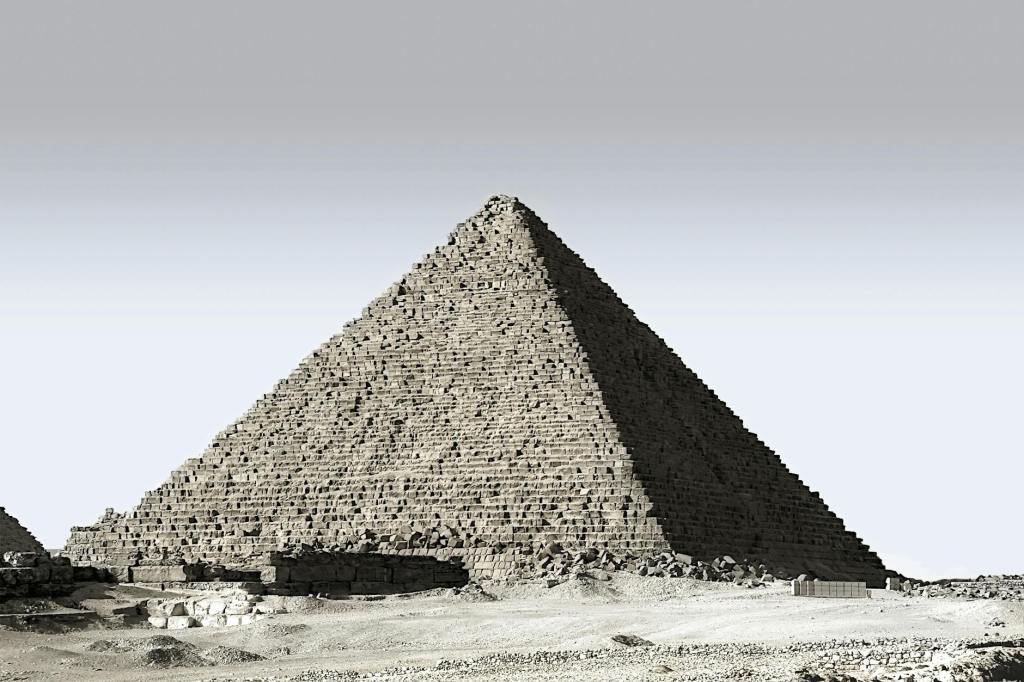
    Looking back, the pyramid had been present in my thinking long before I noticed it. Physical pyramids exist because the shape works: a wide base, a narrowing top, stability through distribution. Maslow’s pyramid applied the same intuition to human needs. The testing pyramid did it for quality.

    What connects these isn’t symbolism. It’s variance. A pyramid lets one variable change smoothly across layers. Look at count, and the base is large while the top is small. Look at complexity, and the direction flips—simple at the base, dense and constrained at the top. The same shape holds both readings.

    Squares suggest uniformity. Stacks suggest equivalence. The pyramid makes difference visible. That’s why it became the natural container once the idea took shape.

    Exploring Examples Across Functions (Tabular Views)

    Ideally, each of the examples below would be drawn as a pyramid. For readability—and because I didn’t want to wrestle with ASCII triangles and text alignment—I’ve used tables instead. The shape stays the same in spirit; the format is just more forgiving.

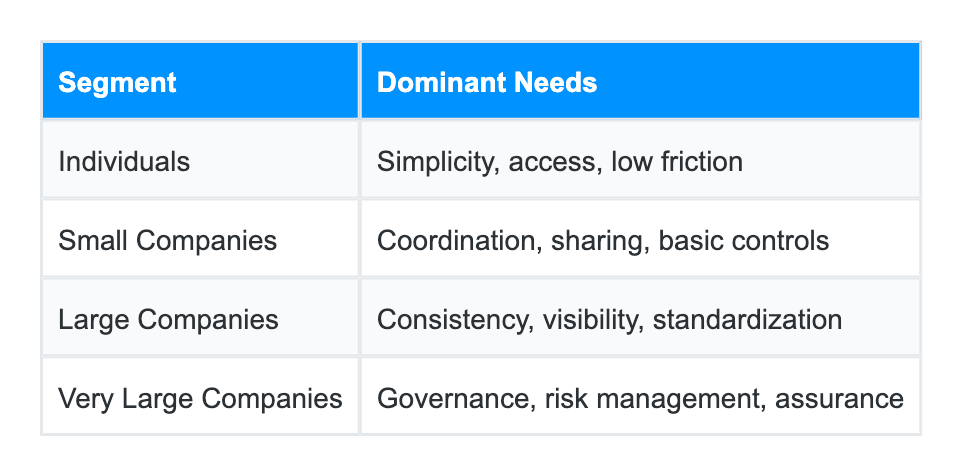
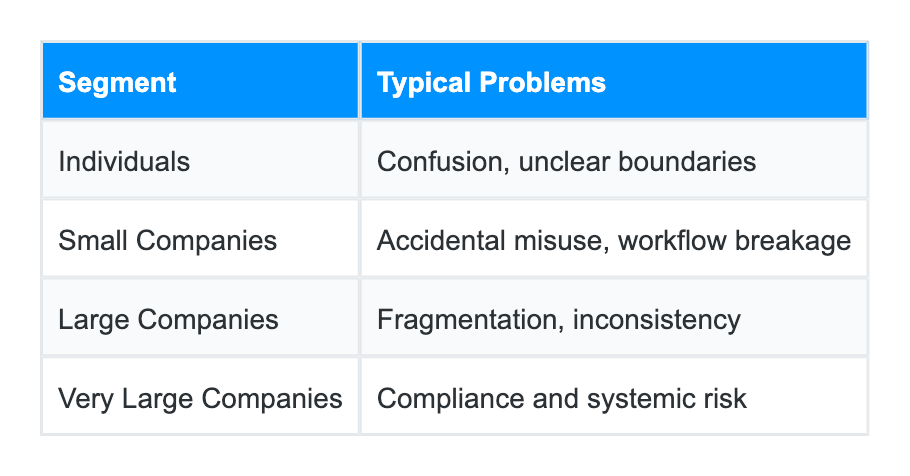
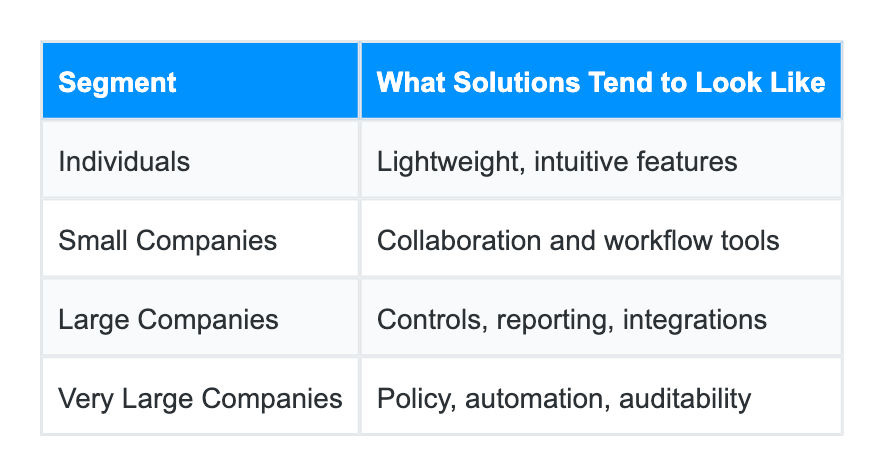
    Example 1: Understanding a Business Through Customer Segments

    Lens: Customer Needs

    Customer Needs vs Customer Segment

    Lens: Problem Space

    Customer Problems vs Customer Segment

    Lens: Solutions / Features

    Customer Feature vs Customer Segmentation

    This framing alone explains why roadmap debates often feel circular: people are optimizing for different segments without saying so.

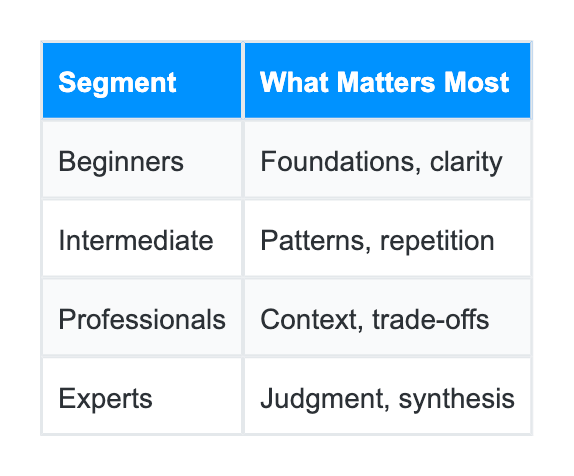
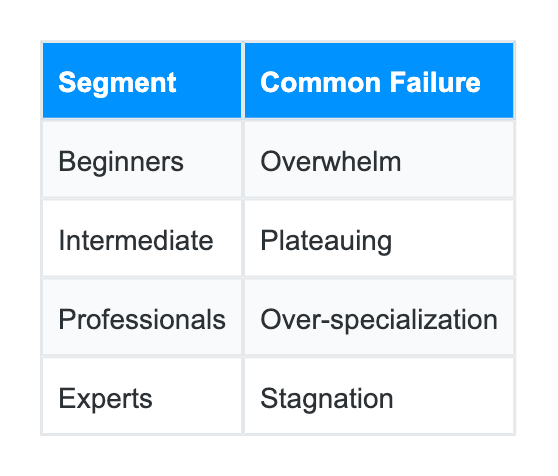
    Example 2: Learning and Skill Development

    Lens: Learning Needs

    Learning Needs vs Learner Maturity

    Lens: Failure Modes

    Learning Failures vs Learner Maturity

    Here, what looks like a content problem is often a segmentation mismatch.

    Conclusion — Documenting a Thought in Motion

    This isn’t a silver bullet, and it isn’t meant to be one. It’s simply a way of thinking that reduced some friction for me while dealing with complexity. Writing it down is less about fixing an answer and more about creating a reference point—something to return to, test, and refine.

    In that sense, this is documentation for myself as much as for fellow journey persons. Capturing a thought allows it to be checked against experience and adjusted as needed. I also expect this lens to break in places—and that, too, will be useful.

    For now, this is just a snapshot of a thought in motion, written down so it can evolve as new challenges appear.

    References

  • Anger, Fear, Mind, & Systems Thinking

    Anger, Fear, Mind, & Systems Thinking

    Decoding Anger

    I started thinking about anger long before I had words for it, mostly because it shows up without invitation, without asking for permission, and without caring whether the situation is simple or complex, fair or unfair, safe or dangerous. Anger arrives fast, almost instantaneously, and when it does, something very specific happens: the mind narrows, thinking slows or disappears, and the body prepares to act.

    Anger, in its original form, was never meant to be moral or immoral. It was meant to be useful. Over millennia, it evolved as a shoot-or-scoot response — an immediate surge of energy designed to protect the self when time was scarce and hesitation was costly. In such moments, thinking was a liability. Analysis took too long. Intuition and reflex mattered more. Anger solved that by suppressing deliberation and pushing the organism into motion.

    In that sense, anger is not a failure of intelligence. It is a biological shortcut — a way to convert threat into action without waiting for certainty.

    Decoding Fear

    Fear, often confused with anger, is something entirely different. Where anger pushes energy outward, fear pulls it inward. Instead of mobilization, there is contraction. Instead of movement, there is stillness. Fear communicates a different message to the system: do not act yet. In many situations, its function is not escape or confrontation, but waiting — letting the danger pass, letting the disturbance move on, and only then shifting quietly toward safety.

    In fear, effort feels costly and visibility feels risky. The body conserves energy, reduces exposure, and minimizes motion. Stillness, here, is not indecision; it is strategy.

    Yet fear, like anger, also suppresses the thinking mind — not because speed is required, but because analysis offers little advantage when the safest option is to remain unnoticed or unmoving. Logic narrows because options narrow.

    Anger and fear move in opposite directions, but they serve a similar purpose. Both exist to protect the self quickly. Both silence deliberation. Both trade long-term reasoning for short-term survival.

    When Anger and Fear Are Misused

    Anger and fear were shaped to be brief. They were never meant to stay. Their usefulness depended on appearing quickly, doing their work, and receding. What feels different today is not that anger and fear exist, but that they linger.

    Anger stretches beyond immediate threat and survives across conversations, hierarchies, and timelines. Fear becomes anticipatory rather than situational. In both cases, the mind remains suppressed longer than it was designed to. What was once a temporary narrowing starts to feel normal.

    This misuse is difficult to notice because things still function. Decisions are made. Actions are completed. From the outside, it can even look effective. But the work is being done with the mind only partially available.

    Over time, reflection feels slow. Pausing feels risky. The absence of thinking is mistaken for efficiency. At that point, anger and fear stop being responses. They begin to shape patterns.

    Symptoms of a Reactive System

    Anger and fear rarely move at random. Anger tends to flow outward — from positions of perceived strength toward vulnerability. It asserts and overrides. Fear moves inward. It drains energy, narrows options, and makes resistance feel costly. One pushes. The other collapses. Together, they shape behavior without needing explanation.

    When these emotions persist beyond the moments they were designed for, they begin to organize the system itself.

    One early symptom is urgency without clarity. Everything feels immediate. Speed becomes a stand-in for seriousness. Pausing feels risky, not because the situation demands it, but because the system no longer trusts stillness.

    Another is completion without understanding. Actions are taken, issues are closed, and attention moves on. The relief of finishing replaces reflection. Over time, the system becomes good at responding and poor at learning.

    Gradually, this way of operating starts to feel normal. Anger lingers. Fear becomes ambient. Thinking narrows. Familiar responses repeat. What once felt decisive hardens into reflex.

    At that point, the system is no longer reacting to events.
    It is reacting to itself.

    Which leaves a question worth holding:

    If anger and fear were meant to be brief responses, what happens when systems are shaped by their prolonged use?

    Taking the Control Back

    If anger and fear can suppress the mind, the question is not how to eliminate them, but how control returns once they appear.

    Meditation and breathing are often described as practices for calmness or relaxation, but their more practical role is different. They are mechanisms for regaining control — specifically, control over how and when energy is spent.

    The mind can generate immense energy, but breath determines its cost. Breath is slow, measurable, and always available. Through breath, the system learns restraint. Through awareness, the mind regains access to itself.

    In this sense, the mind is the source, breath is the regulator, and energy is the currency. Anger and fear are not enemies here; they are arrows. The bow remains constant, but arrows are chosen depending on the situation. The mistake is not in having arrows, but in firing them blindly or repeatedly without awareness.

    Improving the Mind: A Modern Technique (Systems Thinking)

    Once some control over internal states is established, a different question emerges — not about emotion, but about thinking.

    Much of human response is naturally linear, anthropocentric, mechanical, and ordered. We prefer simple causes, clear agents, direct fixes, and immediate results. Not because we are careless, but because complexity is expensive. Cognitive load drains energy, and the mind seeks efficiency.

    But the world increasingly resists this simplicity. Volatility, uncertainty, complexity, and ambiguity are no longer edge cases; they are the environment. In such conditions, linear responses backfire. Local fixes create distant problems. Quick reactions amplify instability.

    Systems thinking does not remove uncertainty. It increases tolerance for it. It trains the mind to hold context, to anticipate second-order effects, and to delay reaction without freezing. In doing so, it quietly upgrades both intelligence and emotional regulation. It reduces the likelihood that fear or anger will hijack decisions in environments where such hijacking is costly.

    Expected Outcome

    At this point, it is tempting to ask about being right. But that turns out to be the wrong question. Outcomes — success and failure, gain and loss — are not fully in our control. Responses are. Training the mind, regulating energy, and expanding context do not guarantee success. They reduce catastrophic errors. They improve entry conditions. They shorten recovery.

    Over time, this matters.

    Much like in investing, where buying right often matters more than selling high, life seems to reward better entries more reliably than perfect exits. Probability does not disappear, but it begins to work differently.

    Closing Reflection

    Anger and fear tend to appear when situations feel dire, when something important is at stake and the window for response feels narrow. In those moments, they arrive as reflex, not choice. That is likely how they were meant to function.

    What has slowly become clearer to me is that the difference is rarely in the situation itself. It lies in how much of it I am able to see, and how much of myself I am able to keep when pressure rises. That is not something I have achieved, and it is certainly not something that changes quickly.

    The word impossible often appears when that control is lost early — when the mind narrows, energy spills, and response collapses into habit. Occasionally, with awareness and training, the same situation looks slightly different. Not easy. Not solvable. Just less final.

    This is not about mastering outcomes or overcoming fate. Much of that remains outside reach. It is about noticing that when responses are a little less reactive, fewer moments are handed over entirely to luck.

    This way of thinking did not arrive as a conclusion. It emerged slowly, by watching patterns repeat — in moments of anger, in moments of fear, and in the quieter spaces where neither was fully in control.

    And perhaps that is enough: to notice, to adjust, and to keep returning attention to what can be trained, while accepting what cannot.