Tag: Decision Making

  • How the River Flows

    How the River Flows

    The observation

    A thought has been sitting with me for a while.

    It started with a podcast where an investigator was talking about investigation agencies. He made a rather simple observation: never doubt the capability of an investigation agency; the issue is often not capability, but pressure.

    I don’t remember the exact context in which he said it, but the distinction stayed with me. An organisation can have capable people, technology, information, money, experience and institutional knowledge, and still behave very differently depending on the pressures acting on it.

    Capability and outcome are not the same thing.

    At first, I thought this was simply an observation about investigation agencies. Then I started wondering whether it was actually an observation about systems. A system has capabilities. It also has pressures, incentives, constraints, information, people and history. These things interact. The interaction produces behaviour. Behaviour produces outcomes, and outcomes become feedback for what happens next.

    The system learns. But learning does not necessarily mean improvement. A system can learn to respond better to the problems it faces. It can also learn behaviours that make the underlying problem worse. It can become better at surviving one kind of pressure while becoming less capable of dealing with another.

    Nothing in the word “learning” tells us which direction the system is moving.

    When the system is society

    That made me wonder what happens when the system is society.

    A society has a large pool of human capability available to it: intelligence, creativity, courage, ambition, curiosity, cooperation and craftsmanship. These capabilities exist in people long before any particular institution decides how to use them.

    Yet societies can produce remarkably different outcomes from broadly similar human capabilities. A kingdom had capable people. A modern government has capable people. A company has capable people. The question, then, isn’t simply how capable the people are.

    What does the system do with the capability it has?

    A system can activate some capabilities and suppress others. It can reward certain behaviours and make other behaviours costly. It can direct ambition toward creation, competition, status, security, exploration or consumption. It can make cooperation valuable in one context and individual competition valuable in another.

    The capability remains, but what changes is how it gets expressed.

    Pressure matters. Incentives matter. Constraints matter. Information matters. Character matters. History matters. And so does the feedback produced by everything the system has already done.

    The people inside the system

    But there is another complication.

    The people inside a system don’t necessarily understand the system they are part of. A king understands some part of his kingdom. A bureaucrat understands some part of the government. A business leader understands some part of the market. A consumer understands some part of the economy. Each operates with a model of reality, and that model may be right, wrong, or right for a while and then become wrong.

    Yet the action taken from that model becomes another input into the system.

    The actor is simultaneously observing the system and changing it.

    We therefore get a smaller loop inside the larger one:

    reality → perception → belief → action → changed reality

    A person doesn’t need to understand the whole system for their actions to affect it. A consumer doesn’t need to understand monetary policy for credit to change consumption. A business doesn’t need to understand culture for its incentives to influence behaviour. A government doesn’t need to understand every individual for a policy to change the conditions under which millions of people act.

    Each actor responds to what is immediately visible. The aggregate of those responses becomes something much larger.

    How behaviour becomes culture

    And this is where culture starts becoming interesting.

    A response that works gets repeated. What gets repeated becomes familiar. What becomes familiar becomes expected. What becomes expected starts becoming normal. And what becomes normal begins shaping institutions. Those institutions then become part of the environment in which the next generation operates.

    People create the system. The system shapes people.

    Culture, then, may be less like something a society simply possesses and more like something it continuously produces. What a society says it values matters. But what its system repeatedly rewards may matter just as much. What does it make easy? What does it make difficult? What behaviour allows someone to rise? What behaviour gets ignored? What behaviour gets copied?

    Over time, the answers become part of the character of the system. Not through one decision, but through repetition.

    The system responds to itself

    I can see this mechanism particularly clearly in the modern consumption economy.

    A person wants something. Demand creates an opportunity. A business responds. Financial mechanisms make the purchase easier. Advertising creates new associations and desires. Social signalling gives the object another meaning. The consumer responds again. The business learns. The financial system adapts. Other businesses follow. Expectations change. What was once unusual becomes normal.

    Eventually, the product is no longer just a product. It can become identity. Possession can become achievement. Consumption can become a way of communicating status, belonging or aspiration.

    None of this requires someone to have designed the entire system. Each participant can simply be responding to the incentives immediately in front of them. Yet the aggregate of those responses creates a much larger pattern.

    The system is learning from itself.

    And once that happens, something interesting occurs. The system begins producing some of the conditions that shape its own future behaviour. The consumer changes the business. The business changes the consumer. The financial system changes both. Culture changes the meaning of consumption, while consumption changes culture.

    There is no obvious beginning anymore.

    It is a loop.

    Which force is moving the system?

    This also made me think about the variables inside a system. We often look for the things that are present: capabilities, incentives, institutions, pressures, people, technology, information. But a variable being present doesn’t tell us how much influence it has at a particular point in time.

    The same system can contain the same variables for years and still behave very differently. One force can gradually become more powerful. Another can become weaker. Something that was previously marginal can become important. Something that once dominated can lose its ability to move the system.

    The variables don’t necessarily disappear. Their relative influence changes.

    What is increasingly able to move the system?

    That question feels more useful to me than simply asking what forces exist. A snapshot tells us what the system is. A trajectory may tell us what it is becoming.

    And perhaps this is where systems become difficult to predict. We are not only dealing with a collection of variables. We are dealing with variables whose influence on one another is itself changing.

    A pressure can strengthen an incentive. An incentive can change behaviour. Behaviour can change institutions. Institutions can change the pressure. The result can strengthen the original incentive, weaken it, or create an entirely new force that wasn’t particularly important before.

    The system keeps changing while we are trying to understand it.

    When the system reaches an edge

    This made me think about what happens when one of these forces becomes too influential.

    A system can push one variable for a long time without anything obvious happening. But the consequences accumulate. At some point, those consequences begin changing the balance of the system itself. The dominant force starts creating pressure against itself. Something that was suppressed becomes more valuable. An incentive that once worked starts producing undesirable behaviour. Institutions that once absorbed pressure begin amplifying it.

    The system starts responding to the consequences of its own behaviour. The dominant force weakens, something else becomes stronger, and the system reconfigures.

    And then it continues.

    It can look like a pendulum.

    But the system doesn’t necessarily know where the ends of the pendulum are. It may discover them by reaching them.

    Perhaps a system doesn’t need to know its boundaries in order to remain within them. It only needs feedback strong enough to respond when it approaches them. And even then, the boundary may not be fixed.

    Technology can change it. Institutions can change it. Demography can change it. The environment can change it. Human behaviour can change it. The system itself can change it.

    So perhaps what we call a boundary is not a line that someone has drawn around the system. It is a region within which the system can continue to operate, reproduce and adapt.

    The system can spend a very long time moving around inside that region. It can approach an edge, cross it, absorb the consequences, reorganise and continue in another configuration.

    The boundary may be real even when nobody knows where it is.

    This also means that a system can appear stable without actually being still. It may be constantly moving, constantly adapting, constantly shifting the relative influence of its own variables. Yet from a distance, it can look remarkably stable because the changes remain within a range that the system can absorb.

    Until they don’t.

    At some point, the system may encounter a pressure it cannot absorb in its current configuration. Something gives way. The system doesn’t necessarily disappear. It may simply become something else.

    Sometimes failure is simply the end of the current configuration.

    When the system is sensitive

    This also gives me a different way of thinking about the butterfly effect.

    A small event isn’t inherently powerful. Its effect depends on the state of the system into which it enters. The same disturbance can disappear, be absorbed, be amplified, or push the system across a threshold.

    The difference is not necessarily in the size of the event, but in the condition of the system receiving it.

    The butterfly is not necessarily powerful. The system is sensitive.

    And that sensitivity can change. A system that absorbs a disturbance today may amplify the same disturbance tomorrow because its internal configuration has changed. A pressure that was once harmless can become destabilising when the system has accumulated enough other pressures around it.

    This makes the butterfly effect less about tiny causes somehow becoming enormous and more about the relationship between a disturbance and the state of the system at that particular moment.

    History as accumulated pressure

    Perhaps this is also why history is so difficult to explain through a single cause.

    A major event can appear to change everything, but the event may simply be the point at which accumulated pressure found an outlet. The pressure may have been building for years, decades or centuries. The event mattered, but perhaps it mattered because of the state of the system when it arrived.

    A different system might have absorbed the same event. Another might have amplified it. Another might have reorganised around it.

    The event may be the trigger, not the whole story.

    This changes the question we ask about historical turning points. Instead of asking only what caused the change, perhaps we should also ask what had been happening in the system before the change became possible.

    What pressures had been accumulating?

    Which variables had been gaining influence?

    Which ones had been losing it?

    What behaviours had become normal?

    What feedback loops had been strengthening?

    Because by the time the visible event arrives, the system may already have travelled a very long way.

    Back to capability and pressure

    And this brings me back to where the thought started.

    Don’t doubt the capability.

    Look at the pressure.

    Capabilities matter, but capabilities alone don’t determine outcomes. The people inside a system operate through incomplete models. Their beliefs influence their actions. Their actions alter the system. The altered system changes their future incentives, perceptions and pressures. Repeated behaviours become norms. Norms become institutions. Institutions shape the environment. The environment shapes the next generation.

    The loop continues.

    Over a long enough period, these interacting loops produce things we give names to: culture, society, institutions, civilization and history.

    None of them necessarily requires a central intelligence. The system can learn without anyone knowing exactly what it has learned. It can adapt without knowing what it is adapting toward. It can remain within some broad boundaries without knowing where those boundaries are. It can overshoot, correct, reorganise and continue.

    And perhaps sometimes it can no longer continue in its existing form.

    I am not sure where this thought ultimately leads. Maybe it is simply a useful way of looking at systems. But it has changed the question I find myself asking.

    Instead of asking only what a system is capable of doing, I find myself asking what the system is continuously being pushed to do.

    And which of those pressures are becoming stronger over time?

    Because perhaps that tells us less about what a system is today, and more about what it is becoming.


  • The Meal, Not the Recipe!

    The Meal, Not the Recipe!

    There is an old saying that there are many ways to skin a cat. Like many old sayings, it has managed to survive long after the world that gave birth to it disappeared. Most of us have never needed to skin a cat, yet the saying continues to find its way into conversations.

    Perhaps because it was never really about the cat.

    One of the quieter joys of travelling across India is discovering how familiar food keeps changing. Walk into ten homes and you may find ten different ways of preparing the same gravy. In one kitchen, onions and tomatoes form the base. In another, coconut does the job. Elsewhere it may be peanuts, sesame, yoghurt, mustard or tamarind. The recipes differ not because one family decided to be different from another, but because generations learnt to work with what the land offered, what the climate encouraged and what experience quietly refined over time.

    Nobody seems particularly bothered by this diversity. We don’t spend much time searching for the one authentic recipe that every household should eventually adopt. Somehow we understand that the meal remains familiar even when the recipe changes.

    It is interesting how easily we accept this in our kitchens, and how reluctant we become to extend the same generosity elsewhere.

    Take work.

    A startup asks very different things from people than a mature organisation. One rewards speed, experimentation and comfort with uncertainty. The other depends upon coordination, consistency and managing risk. We often compare the people without first comparing the problems they are trying to solve.

    Life seems no different.

    What matters deeply at twenty often gives way to different priorities at forty. The responsibilities of a parent are not those of a student. The questions of retirement are rarely the questions of a first job. It would be surprising if the answers remained unchanged while the questions kept evolving.

    Success follows the same pattern.

    Some people optimise for wealth. Others for craftsmanship. Some seek influence, others independence. For many, success is found in raising a good family, enjoying meaningful work, remaining healthy or simply ending the day surrounded by people they care about. These are not necessarily competing ideas. They are often different destinations altogether.

    Yet much of the advice we encounter arrives as though there were only one destination.

    Successful people naturally describe what worked for them. There is nothing unusual about that. Their experience is genuine, their effort undeniable and their insights are often valuable. What quietly disappears, however, are the circumstances that shaped those experiences—the stage of life they were in, the problem they were trying to solve, the risks they accepted and the trade-offs they were willing to make. Remove those from the story and advice can begin to sound far more universal than it was ever meant to be.

    Perhaps that is why advice often feels contradictory. Two people may both have succeeded, yet they may have been answering entirely different questions. One execution need not invalidate another if the destination, the constraints or even the definition of success itself were different.

    Old sayings seem to age rather differently. They rarely prescribe a recipe. Instead, they point towards a direction and quietly leave the execution to whoever inherits the problem. Every generation receives the same broad direction, but discovers its own way of living it. Perhaps that is why they continue to survive while countless methods quietly come and go.

    By the time the meal is over, very few people are thinking about whether coconut would have been better than tomatoes. The family has shared a meal, conversations have lingered a little longer, and everyone has been nourished.

    Perhaps advice is meant to work in much the same way. It can point us towards a direction, but how we arrive there depends on our own kitchen—our circumstances, our strengths, our habits and the ingredients available to us.

    After all, the purpose may be shared.

    The cooking rarely is.

  • Two Keys

    Two Keys

    A bank locker has always made sense to me as a way of thinking about how things actually work in life — not because it’s a perfect analogy, but because it captures something that most frameworks quietly skip over.

    You have one key. The bank has the other. And no matter how prepared you are, no matter how many times you’ve rehearsed the combination in your head, nothing opens unless both keys turn at the same time.

    There are two ways this goes wrong, and both are quietly maddening in their own way. The first is when you show up fully ready — key in hand, everything in order — and find the bank closed, the manager out, or the system down. You’ve done everything right. It just doesn’t matter today. The second is when the bank calls you in, everything on their side is ready to go, and you get there and realise you left your key at home. Same result. Nothing moves. And in both cases, the thing that failed you wasn’t effort — it was alignment. The two sides simply weren’t in the same place at the same time.

    If you let the metaphor stretch a little, one of those keys is everything you carry — the work you’ve put in, the thinking you’ve sharpened, the preparation that nobody sees. The other key belongs to everything outside you — timing, context, the right person reading the right thing on the right day, a market that’s finally ready, a conversation that happens to go somewhere. You can’t hold that key. You can’t really earn it. You can only keep yours in good shape and hope that at some point, both show up together.

    That part is easy enough to accept. What’s harder is the question that comes after it.

    Because if you’ve been doing the work, genuinely doing it, and the door still hasn’t opened — what are you supposed to make of that? Do you stay on the same path, keep building, trust that the timing will eventually catch up to you? Or do you take the fact that nothing has opened as information — as a sign that maybe this particular door isn’t yours, and it’s time to try somewhere else? There’s no clean answer, and anyone who offers you one quickly is probably not being fully honest with you. If you stay, you might just be early. Or you might be loyal to something that was never going to work. If you move, you might be making a smart adjustment. Or you might be leaving the moment before things would have finally shifted. You won’t know. That’s not a solvable problem — it’s just the actual texture of being in the middle of something.

    People will have opinions, of course. Some will tell you patience is everything. Others will tell you that if it were meant to happen, it already would have. Both can sound convincing, depending on the day and your mood and who’s saying it. But neither of them actually turns the lock.

    The thing that has made this easier to sit with — not easier to solve, just easier to carry — is a small shift in how you think about what your key actually is. For a long time, it’s tempting to think of the idea as your key. The specific thing you’re building, the particular version of the thing you’re trying to make work. But ideas are fragile vessels for timing. The same idea can be exactly wrong in one moment and exactly right in another, and the difference between those two moments might have nothing to do with you. What doesn’t shift like that — what doesn’t go stale or arrive too early or get overtaken by someone else — is the way you think, the depth you’ve built, the quality of attention you bring to problems. That travels with you. That’s the key that fits more than one lock.

    So if one door doesn’t open, you’re not back at the beginning. You’re just standing in front of a different door, with the same key in your hand.

    The Bhagavad Gita has said all of this with more precision than I’ve managed here:

    कर्मण्येवाधिकारस्ते मा फलेषु कदाचन ।
    मा कर्मफलहेतुर्भूर्मा ते सङ्गोऽस्त्वकर्मणि ॥ ४७ ॥

  • How Much of a Roark Can You Afford to Be?

    How Much of a Roark Can You Afford to Be?

    Howard Roark didn’t explain his work. He built, and let it stand.
    That idea sounds clean — until you’re inside an organization.

    You do the work. You solve real problems. You make decisions that hold. And still, things don’t always move. Not because the work is wrong. Because it didn’t travel.

    So you watch. Some people say just enough — frame things a little better, get picked up faster. Not always deeper. Just easier to absorb. And the question shifts. Not is this right? but what works here?

    You can see how you’d do the same. The adjustment isn’t hard. And then you’re in a familiar place — A smart place. You’ve traded some Roark for Keating.

    And once you’ve made that trade — the Keating skills grow. You get better at the room, better at the framing, better at being picked up. More fluent. More visible. Call it the presentable Roark. Enough conviction to seem real. Enough polish to travel.

    And that’s when it gets genuinely dangerous. Because the trajectory looks right. The growth is measurable. The movement is real. The question isn’t whether. It’s how far. And what exactly is being surrendered in the process. Not skill. Not effort. Something subtler. Call it integrity, call it alignment — call it whatever makes it easier to sit with.

    That’s when the real question arrives. Not about success or growth. About limits. If some compromise works — how much is acceptable? If a small adjustment helps — how far does it go? There’s no clean line. Only movement. Slow enough to justify. Fast enough not to notice.

    And somewhere along the line — आधा तीतर, आधा बटेर ।

  • When Pride Falls

    When Pride Falls

    The Story We Keep Telling

    Across cultures and centuries, a certain kind of story keeps appearing. A slow tortoise racing a swift hare. A young shepherd standing before a towering warrior. A lone figure confronting someone everyone believes cannot be defeated. The characters change, the setting changes, yet the pattern remains familiar. Someone powerful, confident in past victories, faces an opponent who appears vastly weaker. The outcome seems obvious long before the contest begins. Yet somewhere along the way, the mighty fall.

    We usually remember these stories as lessons about arrogance. Pride blinded the strong, we say. But that explanation tells only half the story. The other half belongs to the person standing on the weaker side of the contest. What does it feel like to face someone whose strength seems unquestionable while the world quietly assumes the outcome is already decided?

    Standing Against the Odds

    Imagine being that person. Across from someone stronger, faster, richer, or more powerful in every visible way. The verdict around you is almost unanimous. Friends hesitate. Observers whisper. Some show concern, others quiet amusement. Even well-meaning advice carries the same message: this is a battle you cannot win.

    The underdog is rarely unaware of this reality. He sees the same odds everyone else sees. He understands the gap. If the contest were repeated many times, he might lose most of them. Yet circumstances sometimes leave little room for retreat. Duty, chance, necessity, or simply refusing to step aside can lead someone into a fight they never expected to face.

    The Quiet Shift

    Something interesting happens before the contest truly begins. At some point the underdog stops calculating the outcome and confronts the possibility of defeat directly. He imagines the loss, the disappointment, the moment when observers nod and confirm what they believed all along. Strangely, once that future is accepted, something begins to change.

    Fear loosens its grip. When there is nothing left to protect, the mind becomes lighter. The stronger opponent carries the burden of reputation and expectation. His victories must continue. The underdog carries no such weight. Because defeat is already assumed, he is free in a way his opponent may not be. That freedom sharpens attention. Movements become clearer, decisions simpler, hesitation fades.

    Many contests are lost not just because of strength, but because of doubt. But once someone has accepted the possibility of losing, doubt has less space to grow. The fight becomes simpler: respond, adapt, continue.

    Strength and Habit

    At first the contest usually unfolds exactly as expected. The stronger side dominates, confirming the assumptions everyone carried into the moment. Yet the underdog stays, not because he knows he will win, but because leaving guarantees defeat.

    What unfolds next is often subtle. Success has its own quiet side effects. Repeated victories create confidence, and confidence slowly becomes habit. When someone has won many similar battles before, it becomes easy to assume the next one will follow the same pattern. Opponents begin to resemble earlier opponents. Situations begin to feel familiar.

    The powerful do not necessarily become weaker. They simply begin to repeat what has always worked. And over time, they stop looking as carefully as before.

    The Moment That Changes the Story

    When failure disappears from the imagination, small details receive less attention. A slight misjudgment or careless move may pass unnoticed because in earlier contests such moments never mattered.

    But if the opponent refuses to leave the field, those small openings can suddenly matter.

    The underdog does not become stronger in a single instant. What matters is that he is still present when opportunity appears. He has endured the early pressure, absorbed the doubts, and stayed long enough to notice something others assumed would never arrive.

    And sometimes that is enough for the story to change.

    When Courage Spreads

    Even when victory does not come immediately, something else begins to grow. Each battle removes a little more fear and adds experience. Someone who once felt uncertain becomes battle-tested. Loss stops feeling like an ending and begins to resemble preparation.

    People notice that spirit. Not the loud confidence that comes from power, but the quieter resolve of someone who keeps returning despite long odds. What begins as a single act of resistance slowly becomes visible to others.

    Courage travels quietly. One person stands. Another begins to think the same way. What once looked like an isolated challenge begins to shift the atmosphere of the contest.

    When Pride Falls

    Stories of the mighty falling appear again and again not because the weak always win, but because strength and certainty rarely remain balanced forever. Success often brings confidence, but repeated success can slowly narrow perception. When certainty becomes too comfortable, it leaves space for the unexpected challenger.

    The fall of pride rarely begins with weakness. More often it begins when judgement grows clouded by certainty. And the rise of the underdog rarely begins with sudden strength. It begins when fear slowly leaves the mind.

    Perhaps this quiet balance has long been captured in a few simple lines from Goswami Tulsidas Ji in the Ramcharitmanas:

    “जाको विधि दारुन दुख देही, ताकी मति पहिले हर लेहीं।
    जाको विधि पूरन सुख देहीं, ताकी मति निर्मल कर देहीं।”

  • When the Mind Catches Fire

    When the Mind Catches Fire

    There is a phase in life when you go to sleep with a problem — and wake up still inside it. You solve it in dreams, rearrange it in silence, test it before the day even begins. From the outside, it may look like struggle. To you, it feels alive.

    But not all fire is the same. Intensity can come from fear, from anger, or from immersion. The hours may look identical. The inner state is not.

    When fear fuels you, the mind contracts. You think in worst-case scenarios, trying to avoid loss. Even success feels like relief, not fulfillment. When anger fuels you, energy runs high but unstable. You push hard and move fast, but the center remains unsettled, and the outcome carries exhaustion with it.

    Immersion feels different. The mind expands instead of tightening. Conscious and subconscious begin working together. There is pressure, but no inner friction. You are not running from consequences; you are moving toward clarity.

    In that state, learning accelerates. Decisions require less noise. You begin to see structure where others see chaos. Logic and intuition align without argument. Life may look imbalanced for a while — meals irregular, sleep shorter, weight fluctuating. To others, it appears unsustainable. But internally, something powerful is forming.

    Weeks, months, even years later, you understand what that phase built inside you. You respond instead of react. You stay steady under complexity. You handle situations instead of being handled by them.

    The problem that once consumed you fades.

    The fire outside is handled. The flame inside keeps burning.

  • The Segmentation Pyramid: A Lens for Thinking About Complexity

    The Segmentation Pyramid: A Lens for Thinking About Complexity

    Introduction

    We live and work inside systems that are far more complex than they appear on the surface. Conversations move quickly across users, revenue, features, prioritization, strategy, risk, and long-term vision—often within the same meeting. Decks are prepared, frameworks are referenced, thoughtful arguments are made. And yet, despite all that effort, there’s a familiar feeling that tends to follow: I think I understand this now.

    That feeling rarely lasts. In the very next discussion, when the topic pivots slightly, the earlier clarity weakens. The subject is technically the same, but the angle has changed. What felt coherent a moment ago now feels incomplete. Not wrong—just insufficient. Over time, that pattern becomes hard to ignore.

    This piece comes from sitting with that discomfort for a long time and trying to understand why clarity seemed so fragile in the face of complexity.

    The Constant Wrestling and the Search for Something Abstract

    This wasn’t about lack of effort. I spent hours preparing presentations, listening carefully, asking questions, and trying to connect dots. Many discussions were genuinely insightful. People weren’t confused, and decisions weren’t careless. Each conversation made sense on its own.

    The problem was that understanding didn’t accumulate. It reset.

    A discussion about users felt solid until it turned into a discussion about revenue. A feature debate felt resolved until governance entered the picture. Strategy conversations felt coherent until execution details surfaced. Each shift felt like starting again from a new altitude, even though we were circling the same system.

    That led to a long period of searching—not for answers, but for better ways to look. Tools like Six Thinking Hats helped frame perspectives deliberately. Maslow’s pyramid lingered as a way to think about needs and motivation. My own writing over the last few years became a place to test and refine half-formed thoughts.

    Each helped in fragments. None solved the core issue. What I was really looking for was a way to hold multiple viewpoints without losing orientation—a structure that could absorb pivots instead of collapsing under them.

    Context, Asymmetry, and the Applied Lens

    This section is the heart of the idea, so it’s worth slowing down here. The moment this abstraction settled for me came from a place far removed from business: testing.

    As an engineer, the testing pyramid quietly shaped how I thought about quality. At the bottom were unit tests—many of them, fast, cheap, and easy to maintain. Above them sat integration tests—fewer, slower, and more brittle. At the top were end-to-end tests—expensive, fragile, and hard to debug, but still necessary. What made the pyramid powerful wasn’t just the categorization of test types. It was how clearly it showed asymmetry. As you moved upward, effort increased, fragility increased, and feedback slowed. At the same time, each layer clearly showed what it contained and what role it played.

    Because the structure was fixed, you could reason about quality from different angles—speed, confidence, cost, risk—without losing your place. You weren’t redefining the system each time; you were applying a different lens to the same shape. That’s why the testing pyramid worked so well as a communication tool. It aligned teams without long explanations.

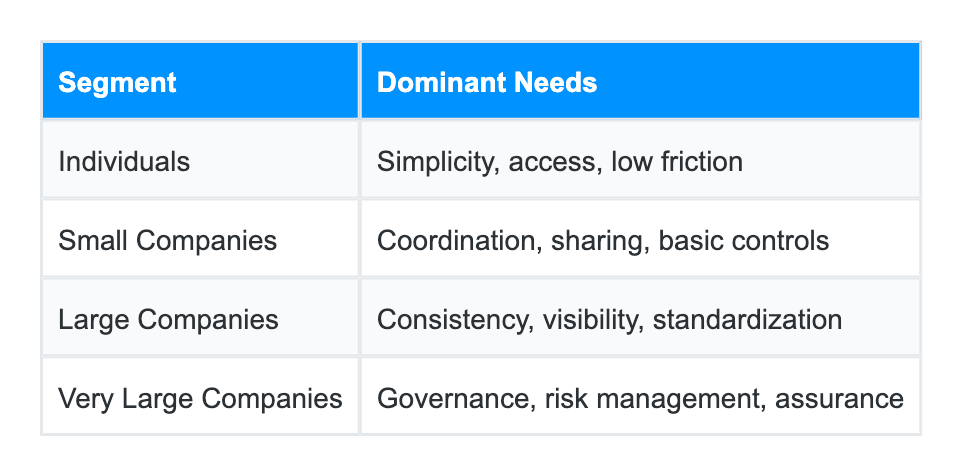
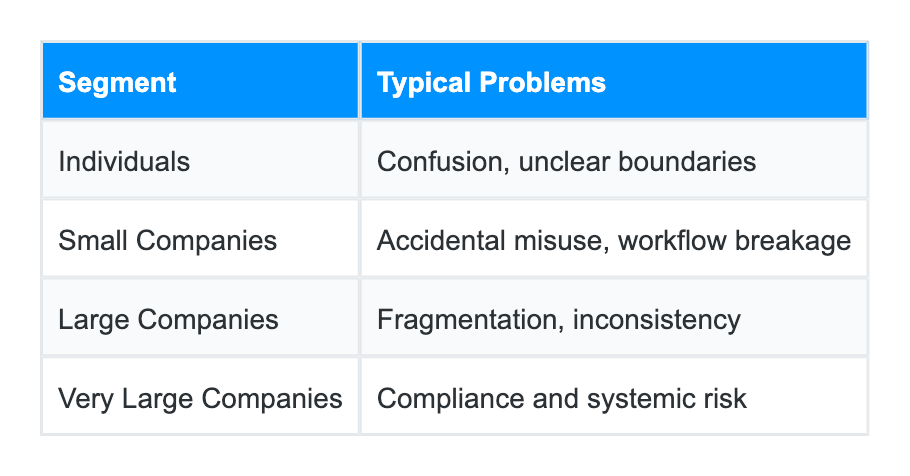
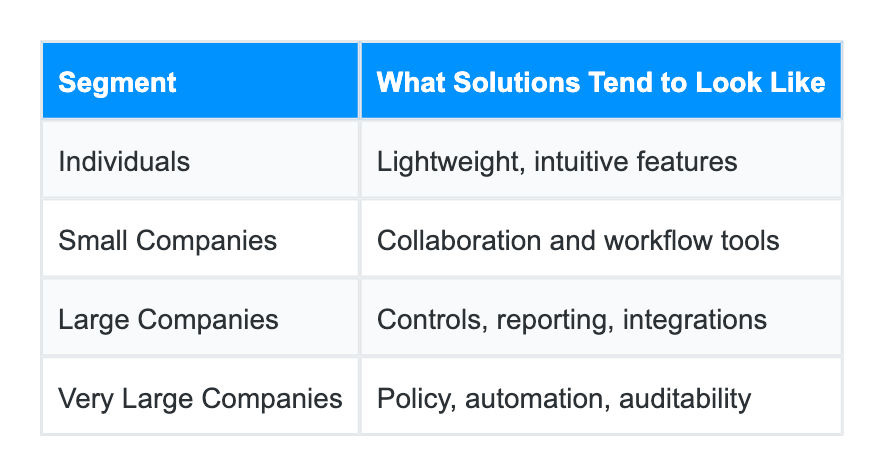
    Much later, I realized the same idea applies elsewhere. Take user segmentation. If you arrange users as individuals, small companies, large organizations, and very large enterprises, the pyramid emerges naturally. Individuals form a broad base; very large enterprises sit at a narrow top. The shape captures asymmetry in scale.

    From there, clarity comes when you apply one lens at a time. Apply user count, and the base dominates. Apply revenue, and value concentrates at the top. Apply needs, and simplicity gives way to coordination and governance. Apply complexity, and it steadily increases as you move upward. The structure stays the same; only the perspective changes.

    This also explains why conversations often feel disorienting. When a discussion starts with revenue and someone introduces risk, it can feel like a derailment—unless both are being applied to the same underlying structure. With a fixed context, adding a new lens doesn’t break the conversation; it deepens it.

    In abstract terms, this is what the Segmentation Pyramid enables. It fixes the context, makes asymmetry visible, and provides a stable surface on which different perspectives can be applied. The pyramid itself isn’t the insight. It’s what allows insights to appear without breaking coherence.

    From Stumbling to Structure: Why the Pyramid Emerged

    The pyramid didn’t arrive as a deliberate design choice. It emerged once segmentation and asymmetry were clear. When you arrange entities by scale—individuals, small groups, large organizations, institutions—you naturally get a broad base and a narrow top. The shape isn’t imposed; it reveals itself.

    Looking back, the pyramid had been present in my thinking long before I noticed it. Physical pyramids exist because the shape works: a wide base, a narrowing top, stability through distribution. Maslow’s pyramid applied the same intuition to human needs. The testing pyramid did it for quality.

    What connects these isn’t symbolism. It’s variance. A pyramid lets one variable change smoothly across layers. Look at count, and the base is large while the top is small. Look at complexity, and the direction flips—simple at the base, dense and constrained at the top. The same shape holds both readings.

    Squares suggest uniformity. Stacks suggest equivalence. The pyramid makes difference visible. That’s why it became the natural container once the idea took shape.

    Exploring Examples Across Functions (Tabular Views)

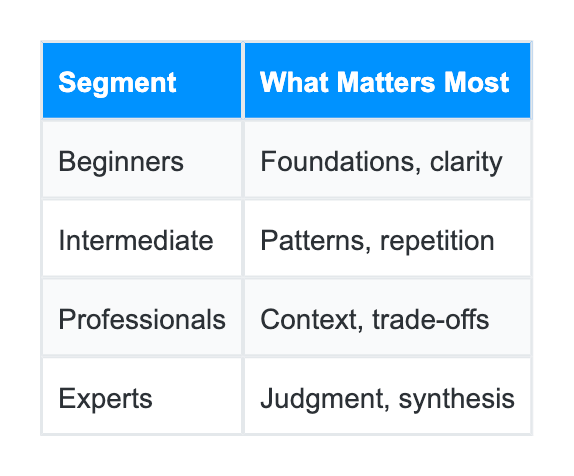
    Ideally, each of the examples below would be drawn as a pyramid. For readability—and because I didn’t want to wrestle with ASCII triangles and text alignment—I’ve used tables instead. The shape stays the same in spirit; the format is just more forgiving.

    Example 1: Understanding a Business Through Customer Segments

    Lens: Customer Needs

    Customer Needs vs Customer Segment

    Lens: Problem Space

    Customer Problems vs Customer Segment

    Lens: Solutions / Features

    Customer Feature vs Customer Segmentation

    This framing alone explains why roadmap debates often feel circular: people are optimizing for different segments without saying so.

    Example 2: Learning and Skill Development

    Lens: Learning Needs

    Learning Needs vs Learner Maturity

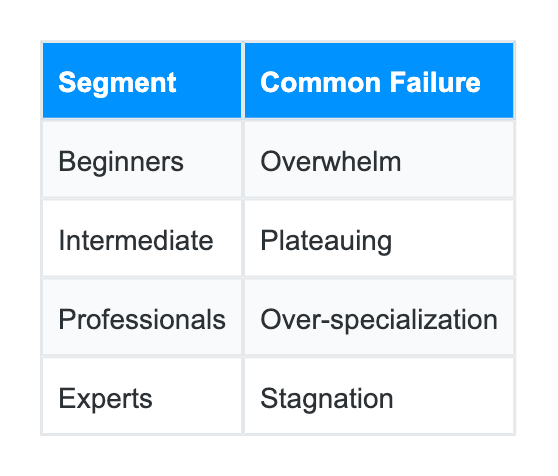
    Lens: Failure Modes

    Learning Failures vs Learner Maturity

    Here, what looks like a content problem is often a segmentation mismatch.

    Conclusion — Documenting a Thought in Motion

    This isn’t a silver bullet, and it isn’t meant to be one. It’s simply a way of thinking that reduced some friction for me while dealing with complexity. Writing it down is less about fixing an answer and more about creating a reference point—something to return to, test, and refine.

    In that sense, this is documentation for myself as much as for fellow journey persons. Capturing a thought allows it to be checked against experience and adjusted as needed. I also expect this lens to break in places—and that, too, will be useful.

    For now, this is just a snapshot of a thought in motion, written down so it can evolve as new challenges appear.

    References

  • Anger, Fear, Mind, & Systems Thinking

    Anger, Fear, Mind, & Systems Thinking

    Decoding Anger

    I started thinking about anger long before I had words for it, mostly because it shows up without invitation, without asking for permission, and without caring whether the situation is simple or complex, fair or unfair, safe or dangerous. Anger arrives fast, almost instantaneously, and when it does, something very specific happens: the mind narrows, thinking slows or disappears, and the body prepares to act.

    Anger, in its original form, was never meant to be moral or immoral. It was meant to be useful. Over millennia, it evolved as a shoot-or-scoot response — an immediate surge of energy designed to protect the self when time was scarce and hesitation was costly. In such moments, thinking was a liability. Analysis took too long. Intuition and reflex mattered more. Anger solved that by suppressing deliberation and pushing the organism into motion.

    In that sense, anger is not a failure of intelligence. It is a biological shortcut — a way to convert threat into action without waiting for certainty.

    Decoding Fear

    Fear, often confused with anger, is something entirely different. Where anger pushes energy outward, fear pulls it inward. Instead of mobilization, there is contraction. Instead of movement, there is stillness. Fear communicates a different message to the system: do not act yet. In many situations, its function is not escape or confrontation, but waiting — letting the danger pass, letting the disturbance move on, and only then shifting quietly toward safety.

    In fear, effort feels costly and visibility feels risky. The body conserves energy, reduces exposure, and minimizes motion. Stillness, here, is not indecision; it is strategy.

    Yet fear, like anger, also suppresses the thinking mind — not because speed is required, but because analysis offers little advantage when the safest option is to remain unnoticed or unmoving. Logic narrows because options narrow.

    Anger and fear move in opposite directions, but they serve a similar purpose. Both exist to protect the self quickly. Both silence deliberation. Both trade long-term reasoning for short-term survival.

    When Anger and Fear Are Misused

    Anger and fear were shaped to be brief. They were never meant to stay. Their usefulness depended on appearing quickly, doing their work, and receding. What feels different today is not that anger and fear exist, but that they linger.

    Anger stretches beyond immediate threat and survives across conversations, hierarchies, and timelines. Fear becomes anticipatory rather than situational. In both cases, the mind remains suppressed longer than it was designed to. What was once a temporary narrowing starts to feel normal.

    This misuse is difficult to notice because things still function. Decisions are made. Actions are completed. From the outside, it can even look effective. But the work is being done with the mind only partially available.

    Over time, reflection feels slow. Pausing feels risky. The absence of thinking is mistaken for efficiency. At that point, anger and fear stop being responses. They begin to shape patterns.

    Symptoms of a Reactive System

    Anger and fear rarely move at random. Anger tends to flow outward — from positions of perceived strength toward vulnerability. It asserts and overrides. Fear moves inward. It drains energy, narrows options, and makes resistance feel costly. One pushes. The other collapses. Together, they shape behavior without needing explanation.

    When these emotions persist beyond the moments they were designed for, they begin to organize the system itself.

    One early symptom is urgency without clarity. Everything feels immediate. Speed becomes a stand-in for seriousness. Pausing feels risky, not because the situation demands it, but because the system no longer trusts stillness.

    Another is completion without understanding. Actions are taken, issues are closed, and attention moves on. The relief of finishing replaces reflection. Over time, the system becomes good at responding and poor at learning.

    Gradually, this way of operating starts to feel normal. Anger lingers. Fear becomes ambient. Thinking narrows. Familiar responses repeat. What once felt decisive hardens into reflex.

    At that point, the system is no longer reacting to events.
    It is reacting to itself.

    Which leaves a question worth holding:

    If anger and fear were meant to be brief responses, what happens when systems are shaped by their prolonged use?

    Taking the Control Back

    If anger and fear can suppress the mind, the question is not how to eliminate them, but how control returns once they appear.

    Meditation and breathing are often described as practices for calmness or relaxation, but their more practical role is different. They are mechanisms for regaining control — specifically, control over how and when energy is spent.

    The mind can generate immense energy, but breath determines its cost. Breath is slow, measurable, and always available. Through breath, the system learns restraint. Through awareness, the mind regains access to itself.

    In this sense, the mind is the source, breath is the regulator, and energy is the currency. Anger and fear are not enemies here; they are arrows. The bow remains constant, but arrows are chosen depending on the situation. The mistake is not in having arrows, but in firing them blindly or repeatedly without awareness.

    Improving the Mind: A Modern Technique (Systems Thinking)

    Once some control over internal states is established, a different question emerges — not about emotion, but about thinking.

    Much of human response is naturally linear, anthropocentric, mechanical, and ordered. We prefer simple causes, clear agents, direct fixes, and immediate results. Not because we are careless, but because complexity is expensive. Cognitive load drains energy, and the mind seeks efficiency.

    But the world increasingly resists this simplicity. Volatility, uncertainty, complexity, and ambiguity are no longer edge cases; they are the environment. In such conditions, linear responses backfire. Local fixes create distant problems. Quick reactions amplify instability.

    Systems thinking does not remove uncertainty. It increases tolerance for it. It trains the mind to hold context, to anticipate second-order effects, and to delay reaction without freezing. In doing so, it quietly upgrades both intelligence and emotional regulation. It reduces the likelihood that fear or anger will hijack decisions in environments where such hijacking is costly.

    Expected Outcome

    At this point, it is tempting to ask about being right. But that turns out to be the wrong question. Outcomes — success and failure, gain and loss — are not fully in our control. Responses are. Training the mind, regulating energy, and expanding context do not guarantee success. They reduce catastrophic errors. They improve entry conditions. They shorten recovery.

    Over time, this matters.

    Much like in investing, where buying right often matters more than selling high, life seems to reward better entries more reliably than perfect exits. Probability does not disappear, but it begins to work differently.

    Closing Reflection

    Anger and fear tend to appear when situations feel dire, when something important is at stake and the window for response feels narrow. In those moments, they arrive as reflex, not choice. That is likely how they were meant to function.

    What has slowly become clearer to me is that the difference is rarely in the situation itself. It lies in how much of it I am able to see, and how much of myself I am able to keep when pressure rises. That is not something I have achieved, and it is certainly not something that changes quickly.

    The word impossible often appears when that control is lost early — when the mind narrows, energy spills, and response collapses into habit. Occasionally, with awareness and training, the same situation looks slightly different. Not easy. Not solvable. Just less final.

    This is not about mastering outcomes or overcoming fate. Much of that remains outside reach. It is about noticing that when responses are a little less reactive, fewer moments are handed over entirely to luck.

    This way of thinking did not arrive as a conclusion. It emerged slowly, by watching patterns repeat — in moments of anger, in moments of fear, and in the quieter spaces where neither was fully in control.

    And perhaps that is enough: to notice, to adjust, and to keep returning attention to what can be trained, while accepting what cannot.

  • Cross-Functional Insights: Applying DuPont Analysis to Accelerate Personal Development

    Cross-Functional Insights: Applying DuPont Analysis to Accelerate Personal Development

    In the world of business, efficiency and profitability are key metrics that determine success. However, what if the analytical tools used to measure business performance could be applied to personal development? This post explores the idea of cross-functional thinking by applying the DuPont analysis, a well-known business efficiency model, to accelerate personal growth.

    Understanding RoE and DuPont Analysis

    What is RoE?

    Return on Equity (RoE) is a measure of a company’s profitability relative to shareholders’ equity. It indicates how efficiently a company is using its equity base to generate profits. The formula for RoE is:

    RoE = Net Income(Profit) / Shareholders’ Equity

    What is DuPont Analysis?

    The DuPont analysis breaks down RoE into three distinct components to provide deeper insights:

    1. Profit Margin: Measures how much profit a company makes for each dollar of sales. It’s calculated as: Profit Margin = Net Income / Sales
    2. Asset Turnover: Measures how efficiently a company uses its assets to generate sales. It’s calculated as: Asset Turnover = Sales / Total Assets
    3. Equity Multiplier: Reflects the company’s financial leverage. It’s calculated as: Equity Multiplier = Total Assets / Shareholders’ Equity

    The DuPont formula combines these components to explain RoE:

    RoE = Profit Margin × Asset Turnover × Equity Multiplier

    This breakdown helps in understanding the underlying factors driving RoE, offering a comprehensive view of a company’s financial health.

    The Concept of Cross-Functional Thinking

    Cross-Functional Applications Cross-functional thinking involves borrowing successful strategies from one domain and applying them to another. This innovative approach can yield unique insights and significant breakthroughs. In this case, we apply the DuPont analysis model to personal growth.

    Applying DuPont Analysis to Personal Development

    1. Skill Mastery as Profit Margin

    Just as profit margin reflects the efficiency of converting sales into profit, skill mastery represents how effectively you convert your abilities and efforts into personal achievements. Enhance your core skills, gain new competencies, and continuously improve your performance. This can be measured by the quality of your work, recognition, promotions, and feedback from peers and supervisors.

    2. Efficiency and Productivity as Asset Turnover

    Similar to asset turnover, which measures asset utilization efficiency, this component evaluates how well you use your skills and resources to achieve personal milestones. Optimize your time management, streamline your workflows, and increase your productivity. This can be demonstrated through project completions, meeting deadlines, and achieving key performance indicators (KPIs).

    3. Network and Influence as Equity Multiplier

    Just as the equity multiplier reflects financial leverage, your network and influence represent your personal leverage. Build and maintain professional relationships, seek mentorship, and actively participate in industry events. Leverage your network to gain opportunities, insights, and support. Assess this by the size and quality of your professional network, opportunities gained through connections, and your industry reputation.

    The Formula for Personal Development

    Combining these components provides a comprehensive formula for personal development:

    Personal Development = Skill Mastery × Efficiency & Productivity × Network & Influence

    By systematically improving each area, you can drive your personal success similarly to how companies drive financial performance through DuPont analysis.

    Practical Steps and Tips

    Skill Mastery:

    • Identify key skills needed for your role and aspirations.
    • Seek training, certifications, and continuous learning opportunities.
    • Regularly request feedback and work on areas of improvement.

    Efficiency and Productivity:

    • Use tools and techniques to manage your time effectively.
    • Set clear goals and priorities.
    • Continuously evaluate and refine your workflows for better efficiency.

    Network and Influence:

    • Attend industry conferences, webinars, and networking events.
    • Join professional associations and online communities.
    • Engage in thought leadership by writing articles, speaking at events, and sharing knowledge.

    Conclusion

    Applying business models like DuPont analysis to personal development can unlock new pathways to success. By thinking creatively about cross-functional applications, you can achieve significant growth.

  • Scaling Software Engineering: A Journey of Continuous Evolution

    Scaling Software Engineering: A Journey of Continuous Evolution

    In today’s world of software development, scaling a team while maintaining quality, collaboration, and agility can be a daunting task. However, by building a well-thought-out structure and continuously adapting it, we’ve successfully scaled our engineering practices. While we leverage agile methodologies, we’ve also tailored them to our unique needs, ensuring we’re not just scaling agile, but scaling software engineering in a way that fits our organization’s vision.

    Our Agile-Driven Structure

    At the core of our scaling strategy is a combination of agile practices and a structure that ensures both autonomy and alignment. We use the Spotify model with modifications to make it work for our context. Our teams consist of developers, product owners, scrum masters, managers, and principle engineers, all aligned with the squad’s goals.

    Managers play a critical role in coordinating and supporting their teams, addressing both technical and interpersonal needs. Meanwhile, principle engineers guide teams on best practices related to architecture and work estimation. The agile teams are responsible for planning and executing work at a regular cadence to consistently deliver results.

    The structure is designed to be flexible yet efficient. Squads typically consist of eight members: six developers, one product owner, and one scrum master. We balance feature development with maintenance to manage tech debt while keeping pace with new features. Each squad focuses on delivering value regularly, ensuring a steady pace while avoiding burnout.

    Proactive Problem-Solving and Continuous Collaboration

    Scaling is not just about executing tasks; it’s about proactively solving problems, collaborating during development, and ensuring alignment before releasing software. This structure empowers us to anticipate challenges and proactively address them, ensuring that we’re not merely reacting to issues as they arise.

    With clear guidelines and regular touch points, we maintain a culture of trust but verify, where code undergoes thorough peer reviews and checks before being released. This practice helps us bake quality into the development process. We also adopt shift-left practices, using GitFlow branching to enforce standards like lints, unit tests, and security checks.

    Fostering a People Centric Culture

    Behind every technical achievement is a team member contributing their best. To support our people, leadership works closely with individual contributors to align their personal aspirations with organizational goals. Our org actively invest in learning and development by offering both time and budget for courses that require time off, and we regularly assess team morale through pulse checks.

    This approach allows us to scale not just software engineering, but also personal growth. Every team member has the opportunity to improve their skills and feel supported in their development journey.

    Building a Culture of Quality and Continuous Improvement

    While we’ve built a robust structure that supports scaling, it’s crucial to acknowledge that mistakes are inevitable — often due to human error rather than flaws in the process. Even the best systems can’t completely eliminate mistakes, especially in a fast-paced environment.

    What we’ve learned is that strong processes and a supportive culture significantly reduce errors and increase our chances of success. Yet, we also understand that no system is perfect. By continuously improving both process and culture, we can minimize errors and learn from them when they occur. Leadership fosters an environment where mistakes are seen as opportunities to learn and evolve, which allows us to adapt more effectively.

    Quality at Every Step

    Ensuring software quality isn’t just about testing late in the development cycle; it’s integrated throughout. Our teams are empowered with a comprehensive testing framework, including unit tests, API automation, end-to-end automation, and manual testing. We’re experimenting with the test automation pyramid to ensure the right balance of testing at each layer.

    Documentation is key to team alignment. We use ADRs, epics, user stories, high-level designs, and README files to ensure everyone is on the same page. As part of our continuous improvement efforts, we’re moving toward a monorepo setup from a multi-repo configuration to improve transparency, ease of maintenance, and documentation accessibility. This shift enhances visibility and collaboration across teams, fostering a more cohesive engineering culture.

    Leadership and Scaling

    As we continue to grow, the role of leadership becomes increasingly critical. Our leadership group operates its own sprint, staying aligned with the teams while proactively addressing challenges, shifting requirements, and team needs. Leadership is deeply engaged in discussions about infrastructure, talent management, and risk mitigation. This collaborative and transparent approach helps us manage scale effectively while prioritizing the team’s well-being.

    The leadership group works closely with the teams, using tools like SWOT analysis and the skill-will matrix to evaluate talent gaps, proactively address risks, and identify opportunities for growth.

    Overcoming Challenges and Growing Together

    While we’ve faced challenges in scaling — such as balancing feature development with managing technical debt or ensuring cross-team collaboration — each obstacle has been an opportunity to refine our processes. For example, we initially found that teams were spending too much time on new feature development, leading to a growing backlog of tech debt. We adjusted by implementing a more deliberate prioritization strategy, ensuring that both new features and debt management were given the attention they deserved.

    As we continue to grow, we must remain agile — not only in our development processes but also in how we adapt our organizational culture. The ability to learn from mistakes and continuously improve is key.

    Conclusion: A Journey of Scaling and Evolving

    Ultimately, our journey of scaling software engineering is one of continuous evolution. We are not static in our approach; we strive to adapt and improve with each iteration. By leveraging agile principles, investing in our people, and maintaining a flexible yet structured process, we’ve built a scalable and adaptable engineering organization.

    Our structure allows us to grow while ensuring that quality, collaboration, and support are always at the forefront. And while we face challenges along the way, we continue to learn and improve — proving that with the right balance of process, culture, and leadership, scaling engineering success is not only possible but sustainable.

    As you embark on your own scaling journey, remember that success lies in continuous evolution — embracing change, learning from mistakes, and investing in both your people and your processes.