
In today’s fast-paced world, decision-making is a constant part of our daily lives. According to various online sources, the average person makes more than 35,000 decisions daily, ranging from mundane choices like what to eat for breakfast to more significant ones like career moves or investment opportunities. With such a high volume of decisions, it’s no wonder that many of us experience decision fatigue, leading to reduced productivity and increased stress.
To navigate this complexity, decision-making frameworks can provide clarity and simplify choices. One such framework is the 2×2 matrix, a versatile tool that breaks down complex problems into manageable parts. By dividing a problem into two contrasting variables with two variations each, the 2×2 matrix helps prioritize tasks, evaluate options, and make informed decisions with greater efficiency.
Problem Statement
The sheer volume of decisions we face daily can be overwhelming, leading to decision fatigue and diminished productivity. With countless options and varying degrees of importance and urgency, finding a structured approach to prioritize and make informed decisions becomes crucial. Traditional decision-making methods can often lead to analysis paralysis, where the complexity of choices impedes effective decision-making.
2×2 Matrix Definition
A 2×2 matrix is a simple yet powerful tool that helps to visualize and categorize different aspects of a problem or decision. By dividing a problem into two contrasting variables on the x-axis and y-axis, each with two variations, the matrix creates four distinct quadrants. This structure allows for a clear and concise representation of the problem, making it easier to analyze and decide on the best course of action. The matrix is structured as follows:
- X-Axis: Represents one dimension of the problem, such as urgency or cost.
- Y-Axis: Represents another dimension, such as impact or effort.
A 2×2 matrix helps you make the right decision at a macro level quickly. Once this decision is made, breaking down the subsequent steps becomes much easier. By swiftly addressing the initial, often most challenging step, the matrix paves the way for a more structured and satisfying decision-making process. This simplicity is the core strength of the 2×2 matrix, providing a clear visual framework that aids in prioritizing tasks and making informed decisions efficiently.
2×2 Matrix-Based Frameworks
The 2×2 matrix can be applied in various frameworks to aid decision-making:
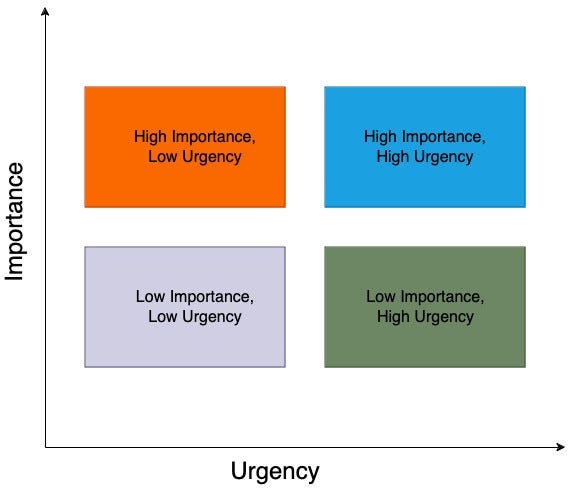
Eisenhower Matrix
Eisenhower matrix prioritizes tasks based on urgency and importance. Tasks are categorized into four quadrants:
- Urgent & Important (Do it now)
- Important but Not Urgent (Schedule a time to do it)
- Urgent but Not Important (Delegate)
- Neither Urgent nor Important (Eliminate It).
Skill-Will Matrix
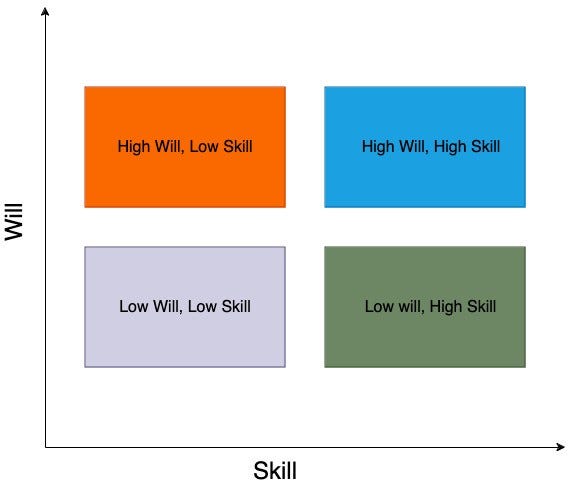
Skill will matrix evaluates team members based on their skills and motivation. It categorizes individuals into four quadrants:
- High Skill & High Will (Competent & Committed)
- High Skill & Low Will (Competent but Unmotivated)
- Low Skill & High Will (Committed but low Competence)
- Low Skill and Low Will (Low competence and unmotivated).
Growth-Share Matrix (BCG Matrix)
Growth share matrix assesses business units or products based on market growth and share. Quadrants include
- Stars (High Growth, High Share)
- Question marks (High Growth, Low Share)
- Cash Cows (Low Growth, High Share)
- Pets (Low Growth, Low Share)

Impact-Effort Matrix
Impact effort matrix balances the impact of initiatives against the effort required. Tasks or projects are categorized into four quadrants:
- High Impact, High Effort (Big Bets)
- High Impact, Low Effort (Easy Wins)
- Low Impact, Low effort (Fill-Ins)
- Low Impact, High effort (Losing Bets)

Applying the 2×2 Matrix in Real Life
Personal Finance Management
Imagine someone deciding between various investment options (stocks, bonds, real estate). Using a 2×2 matrix, they can evaluate these options based on risk and potential return. This helps visualize which options align with their risk tolerance and desired returns, simplifying their investment decisions.
Selecting a Health and Wellness Routine
An individual trying to choose a health and wellness routine might use a 2×2 matrix to assess options based on time commitment and intensity. This helps in selecting a routine that fits their lifestyle and fitness goals.
Evaluating Travel Destinations
When deciding on a vacation destination, a person can use a 2×2 matrix to compare cost and experience quality. This approach clarifies which destinations provide the best value for money and desired experiences.
Product Development Prioritization
A product team can use a 2×2 matrix to prioritize features based on customer value and development effort. This helps in focusing on features that offer high value with minimal development effort, optimizing the product roadmap.
Environmental Sustainability Initiatives
A company aiming to implement sustainability initiatives wants to prioritize projects that offer the best balance between environmental impact and cost. Using a 2×2 matrix, they can evaluate different initiatives based on their environmental impact (low to high) and implementation cost (low to high). This helps identify which projects provide the most significant environmental benefits for the least cost, ensuring resources are used effectively.
Online Learning Engagement
An educator or institution looking to enhance student engagement in online courses can use a 2×2 matrix to evaluate learning materials based on engagement level and interactivity, aiding in the selection of the most effective course designs.
Conclusion
The 2×2 matrix is a powerful tool for simplifying complex decisions. By breaking down problems into two contrasting variables with two variations each, it provides a clear and manageable way to prioritize tasks, evaluate options, and make informed choices. Whether in personal life or professional settings, applying the 2×2 matrix can help navigate decision-making more efficiently and reduce overwhelm.
Next Steps
To start leveraging the 2×2 matrix, choose a current decision or project and create your own 2×2 matrix. Plot your options, evaluate their positions, and use the insights to guide your decisions. By regularly applying this framework, you can streamline your decision-making process and improve productivity.
 Quiet Reflections