Category: Technology & Systems

  • How the River Flows

    How the River Flows

    The observation

    A thought has been sitting with me for a while.

    It started with a podcast where an investigator was talking about investigation agencies. He made a rather simple observation: never doubt the capability of an investigation agency; the issue is often not capability, but pressure.

    I don’t remember the exact context in which he said it, but the distinction stayed with me. An organisation can have capable people, technology, information, money, experience and institutional knowledge, and still behave very differently depending on the pressures acting on it.

    Capability and outcome are not the same thing.

    At first, I thought this was simply an observation about investigation agencies. Then I started wondering whether it was actually an observation about systems. A system has capabilities. It also has pressures, incentives, constraints, information, people and history. These things interact. The interaction produces behaviour. Behaviour produces outcomes, and outcomes become feedback for what happens next.

    The system learns. But learning does not necessarily mean improvement. A system can learn to respond better to the problems it faces. It can also learn behaviours that make the underlying problem worse. It can become better at surviving one kind of pressure while becoming less capable of dealing with another.

    Nothing in the word “learning” tells us which direction the system is moving.

    When the system is society

    That made me wonder what happens when the system is society.

    A society has a large pool of human capability available to it: intelligence, creativity, courage, ambition, curiosity, cooperation and craftsmanship. These capabilities exist in people long before any particular institution decides how to use them.

    Yet societies can produce remarkably different outcomes from broadly similar human capabilities. A kingdom had capable people. A modern government has capable people. A company has capable people. The question, then, isn’t simply how capable the people are.

    What does the system do with the capability it has?

    A system can activate some capabilities and suppress others. It can reward certain behaviours and make other behaviours costly. It can direct ambition toward creation, competition, status, security, exploration or consumption. It can make cooperation valuable in one context and individual competition valuable in another.

    The capability remains, but what changes is how it gets expressed.

    Pressure matters. Incentives matter. Constraints matter. Information matters. Character matters. History matters. And so does the feedback produced by everything the system has already done.

    The people inside the system

    But there is another complication.

    The people inside a system don’t necessarily understand the system they are part of. A king understands some part of his kingdom. A bureaucrat understands some part of the government. A business leader understands some part of the market. A consumer understands some part of the economy. Each operates with a model of reality, and that model may be right, wrong, or right for a while and then become wrong.

    Yet the action taken from that model becomes another input into the system.

    The actor is simultaneously observing the system and changing it.

    We therefore get a smaller loop inside the larger one:

    reality → perception → belief → action → changed reality

    A person doesn’t need to understand the whole system for their actions to affect it. A consumer doesn’t need to understand monetary policy for credit to change consumption. A business doesn’t need to understand culture for its incentives to influence behaviour. A government doesn’t need to understand every individual for a policy to change the conditions under which millions of people act.

    Each actor responds to what is immediately visible. The aggregate of those responses becomes something much larger.

    How behaviour becomes culture

    And this is where culture starts becoming interesting.

    A response that works gets repeated. What gets repeated becomes familiar. What becomes familiar becomes expected. What becomes expected starts becoming normal. And what becomes normal begins shaping institutions. Those institutions then become part of the environment in which the next generation operates.

    People create the system. The system shapes people.

    Culture, then, may be less like something a society simply possesses and more like something it continuously produces. What a society says it values matters. But what its system repeatedly rewards may matter just as much. What does it make easy? What does it make difficult? What behaviour allows someone to rise? What behaviour gets ignored? What behaviour gets copied?

    Over time, the answers become part of the character of the system. Not through one decision, but through repetition.

    The system responds to itself

    I can see this mechanism particularly clearly in the modern consumption economy.

    A person wants something. Demand creates an opportunity. A business responds. Financial mechanisms make the purchase easier. Advertising creates new associations and desires. Social signalling gives the object another meaning. The consumer responds again. The business learns. The financial system adapts. Other businesses follow. Expectations change. What was once unusual becomes normal.

    Eventually, the product is no longer just a product. It can become identity. Possession can become achievement. Consumption can become a way of communicating status, belonging or aspiration.

    None of this requires someone to have designed the entire system. Each participant can simply be responding to the incentives immediately in front of them. Yet the aggregate of those responses creates a much larger pattern.

    The system is learning from itself.

    And once that happens, something interesting occurs. The system begins producing some of the conditions that shape its own future behaviour. The consumer changes the business. The business changes the consumer. The financial system changes both. Culture changes the meaning of consumption, while consumption changes culture.

    There is no obvious beginning anymore.

    It is a loop.

    Which force is moving the system?

    This also made me think about the variables inside a system. We often look for the things that are present: capabilities, incentives, institutions, pressures, people, technology, information. But a variable being present doesn’t tell us how much influence it has at a particular point in time.

    The same system can contain the same variables for years and still behave very differently. One force can gradually become more powerful. Another can become weaker. Something that was previously marginal can become important. Something that once dominated can lose its ability to move the system.

    The variables don’t necessarily disappear. Their relative influence changes.

    What is increasingly able to move the system?

    That question feels more useful to me than simply asking what forces exist. A snapshot tells us what the system is. A trajectory may tell us what it is becoming.

    And perhaps this is where systems become difficult to predict. We are not only dealing with a collection of variables. We are dealing with variables whose influence on one another is itself changing.

    A pressure can strengthen an incentive. An incentive can change behaviour. Behaviour can change institutions. Institutions can change the pressure. The result can strengthen the original incentive, weaken it, or create an entirely new force that wasn’t particularly important before.

    The system keeps changing while we are trying to understand it.

    When the system reaches an edge

    This made me think about what happens when one of these forces becomes too influential.

    A system can push one variable for a long time without anything obvious happening. But the consequences accumulate. At some point, those consequences begin changing the balance of the system itself. The dominant force starts creating pressure against itself. Something that was suppressed becomes more valuable. An incentive that once worked starts producing undesirable behaviour. Institutions that once absorbed pressure begin amplifying it.

    The system starts responding to the consequences of its own behaviour. The dominant force weakens, something else becomes stronger, and the system reconfigures.

    And then it continues.

    It can look like a pendulum.

    But the system doesn’t necessarily know where the ends of the pendulum are. It may discover them by reaching them.

    Perhaps a system doesn’t need to know its boundaries in order to remain within them. It only needs feedback strong enough to respond when it approaches them. And even then, the boundary may not be fixed.

    Technology can change it. Institutions can change it. Demography can change it. The environment can change it. Human behaviour can change it. The system itself can change it.

    So perhaps what we call a boundary is not a line that someone has drawn around the system. It is a region within which the system can continue to operate, reproduce and adapt.

    The system can spend a very long time moving around inside that region. It can approach an edge, cross it, absorb the consequences, reorganise and continue in another configuration.

    The boundary may be real even when nobody knows where it is.

    This also means that a system can appear stable without actually being still. It may be constantly moving, constantly adapting, constantly shifting the relative influence of its own variables. Yet from a distance, it can look remarkably stable because the changes remain within a range that the system can absorb.

    Until they don’t.

    At some point, the system may encounter a pressure it cannot absorb in its current configuration. Something gives way. The system doesn’t necessarily disappear. It may simply become something else.

    Sometimes failure is simply the end of the current configuration.

    When the system is sensitive

    This also gives me a different way of thinking about the butterfly effect.

    A small event isn’t inherently powerful. Its effect depends on the state of the system into which it enters. The same disturbance can disappear, be absorbed, be amplified, or push the system across a threshold.

    The difference is not necessarily in the size of the event, but in the condition of the system receiving it.

    The butterfly is not necessarily powerful. The system is sensitive.

    And that sensitivity can change. A system that absorbs a disturbance today may amplify the same disturbance tomorrow because its internal configuration has changed. A pressure that was once harmless can become destabilising when the system has accumulated enough other pressures around it.

    This makes the butterfly effect less about tiny causes somehow becoming enormous and more about the relationship between a disturbance and the state of the system at that particular moment.

    History as accumulated pressure

    Perhaps this is also why history is so difficult to explain through a single cause.

    A major event can appear to change everything, but the event may simply be the point at which accumulated pressure found an outlet. The pressure may have been building for years, decades or centuries. The event mattered, but perhaps it mattered because of the state of the system when it arrived.

    A different system might have absorbed the same event. Another might have amplified it. Another might have reorganised around it.

    The event may be the trigger, not the whole story.

    This changes the question we ask about historical turning points. Instead of asking only what caused the change, perhaps we should also ask what had been happening in the system before the change became possible.

    What pressures had been accumulating?

    Which variables had been gaining influence?

    Which ones had been losing it?

    What behaviours had become normal?

    What feedback loops had been strengthening?

    Because by the time the visible event arrives, the system may already have travelled a very long way.

    Back to capability and pressure

    And this brings me back to where the thought started.

    Don’t doubt the capability.

    Look at the pressure.

    Capabilities matter, but capabilities alone don’t determine outcomes. The people inside a system operate through incomplete models. Their beliefs influence their actions. Their actions alter the system. The altered system changes their future incentives, perceptions and pressures. Repeated behaviours become norms. Norms become institutions. Institutions shape the environment. The environment shapes the next generation.

    The loop continues.

    Over a long enough period, these interacting loops produce things we give names to: culture, society, institutions, civilization and history.

    None of them necessarily requires a central intelligence. The system can learn without anyone knowing exactly what it has learned. It can adapt without knowing what it is adapting toward. It can remain within some broad boundaries without knowing where those boundaries are. It can overshoot, correct, reorganise and continue.

    And perhaps sometimes it can no longer continue in its existing form.

    I am not sure where this thought ultimately leads. Maybe it is simply a useful way of looking at systems. But it has changed the question I find myself asking.

    Instead of asking only what a system is capable of doing, I find myself asking what the system is continuously being pushed to do.

    And which of those pressures are becoming stronger over time?

    Because perhaps that tells us less about what a system is today, and more about what it is becoming.


  • Building LoopEngine — Thoughts on Loop Engineering

    Building LoopEngine — Thoughts on Loop Engineering

    A Weekend Lab

    Over the past few weeks, I had been increasingly hearing about something called loop engineering. The phrase kept appearing in discussions around agents, autonomous systems, AI runtimes, and coding assistants. Like many new terms in our industry, it was initially difficult to determine whether this was a genuinely useful abstraction or simply another way of describing ideas that already existed under different names.

    Curiosity eventually won.

    This weekend, I decided to spend some time building a small experimental system to expand my own understanding. The intention was not to build a framework, propose an architecture, or prove any particular thesis. It was simply a small engineering lab—a place to experiment with planning, execution, verification, and feedback loops, and perhaps develop a better intuition for what people actually mean when they talk about loop engineering.

    The experiment eventually became something I started calling LoopEngine.

    As often happens with these kinds of projects, the implementation started asking questions that were far more interesting than the original idea. The difficult problems were not about prompts or model selection. They were questions like: How does the system know whether it is making progress? How does it know when to continue, when to retry, and when to stop entirely? What does failure look like? And perhaps even more interestingly, what does it mean for such a system to become lost?

    Somewhere during that process, I realized that I was no longer really trying to understand loop engineering. I was trying to understand loops themselves.

    From Workflows to Loops

    For the purposes of this experiment, I started thinking about loop engineering as the discipline of designing systems that repeatedly observe, plan, act, measure, and adapt toward an objective.

    The important idea here is not repetition itself. Software has always contained loops. Build systems, CI pipelines, schedulers, retries, event processors, and control systems all loop in one form or another. What felt different here was that the future path of execution was no longer entirely predetermined. Every iteration had the ability to change the next one.

    A traditional workflow usually feels like a sequence of boxes connected together.

    A → B → C → D

    Even many agentic systems today still resemble this pattern. One of the boxes may contain an LLM, but the overall structure remains largely fixed.

    The systems I found myself building increasingly looked like this instead.

    Observe
    Plan
    Act
    Measure
    Adapt
    Repeat

    The difference may appear subtle, but it changes the nature of the system entirely. A workflow executes. A loop continuously decides what should happen next.

    The moment feedback begins altering future behavior, the system starts looking less like orchestration and more like optimization. At least, that is how it increasingly started feeling to me.

    When Feedback Becomes the System

    The example I repeatedly used while building LoopEngine was intentionally simple: build a small Python command-line todo application supporting add, list, and done, with tasks persisted into a tasks.json file.

    The first cycle would usually produce a plan.

    - Create app.py
    - Implement JSON persistence
    - Produce README.md
    - Add command handling

    Actors would execute these tasks, files would start appearing in the workspace, and eventually something resembling a working application would emerge.

    workspace/
    ├── app.py
    ├── README.md
    └── tasks.json

    In one run, the generated application was actually quite competent. It handled argument parsing, persistence, validation, and error handling using only the Python standard library.

    But the interesting part was never the generated code. The interesting part was what happened next. The system would verify its own outputs.

    • Did the files exist?
    • Did the commands execute?
    • Could tasks actually be persisted?
    • Was the documentation complete?

    If verification failed, the next cycle did not merely repeat the previous one. It changed. The planner would focus on the missing pieces. The review stage would identify weaknesses. The next plan would emerge from the failures of the previous attempt.

    Over time, I realized that this iterative behavior was becoming the entire point. The system was not simply generating artifacts. It was continuously refining them through feedback.

    One of the more surprising realizations during this experiment was that these loops increasingly started looking like optimization systems. At first, I thought I was mostly building orchestration mechanisms and planning abstractions, but gradually measurement started becoming the center of everything.

    Without some notion of progress, the loop has no way of distinguishing improvement from movement. It can continue producing plans, generating files, invoking tools, and creating the appearance of activity while in reality simply wandering around the solution space.

    A loop without an honest loss function is therefore not really optimizing anything. It is merely moving.

    For the Python example, the measurements were surprisingly mundane.

    • Does app.py exist?
    • Does README.md exist?
    • Does python app.py list execute?
    • Does tasks.json persist data correctly?
    • Are all required commands implemented?

    None of these measurements are particularly intelligent. Yet together they provide something far more important. They provide direction.

    A refinement loop with poor measurements simply converges confidently on the wrong thing. That idea started appearing everywhere. Perhaps intelligence matters less than feedback than I had initially assumed.

    When Systems Get Lost

    Another interesting realization was that success and failure are not the only meaningful states. There appears to be a third state that feels equally important.

    Lost.

    The loop may continue producing outputs. It may continue generating plans and executing actions. Yet nothing meaningful is improving. The system remains active but no longer appears to be making progress. Recognizing this state felt surprisingly significant. Perhaps long-running cognitive systems need the ability to admit:

    I no longer know how to make progress.

    That seems like a useful capability for both machines and people.

    Determinism and Intelligence

    Around the same time, I found myself increasingly appreciating the Actor Model. This was not a rediscovery. I had previously used actor systems while building desktop applications. But loops made the fit feel surprisingly natural in a way I had not fully appreciated before.

    Actor systems solve a very particular class of problems remarkably well. They provide isolation, supervision, asynchronous coordination, long-running state, and fault recovery. Loops happen to need almost all of these properties.

    Planning became an actor. Execution became a collection of actors. Review became an actor. Verification became an actor. Persistence became an actor.

    As the system evolved, it increasingly started resembling a society of cooperating processes rather than a single application. Another idea slowly emerged during this process.

    The actors themselves may use language models and therefore behave probabilistically. Given the same inputs, they may occasionally produce different plans, different reviews, or different decisions.

    Yet I found myself making the boundaries between actors as deterministic as possible. Every message crossing stage boundaries remained typed and validated. The protocols remained predictable even when the reasoning inside the actors was not.

    Over time, I started thinking about this separation in a very simple way.

    Nondeterminism inside the nodes. Determinism in the wires.

    Or perhaps:

    The graph is deterministic. The nodes are intelligent.

    I may be overfitting patterns from a relatively small experiment, but this distinction increasingly felt important. It allows intelligence to remain bounded and observable.

    It allows systems to remain governable even when parts of them are probabilistic. At some point I also found myself using a simplified mental model:

    Actor
    +
    Reasoning
    +
    Goals
    +
    Memory
    +
    Tools
    =
    Agent

    I do not know whether this framing will ultimately hold, but it has become a useful way for me to reason about these systems. Actors solve systems problems. Language models solve cognition problems. Perhaps agents emerge when the two are combined. Or perhaps this is merely one useful lens among many. Time will tell.

    Towards a Runtime

    As LoopEngine became more sophisticated, another abstraction emerged almost naturally. Something needed to observe the entire system.

    Something needed to decide whether another cycle should run, whether a human should be consulted, whether budgets had been exhausted, or whether progress had stalled.

    I started thinking about this component as a Director. The metaphor that kept coming to mind was filmmaking. Actors perform. The director does not.

    The director observes, allocates attention, evaluates progress, and decides what should happen next. The Director receives intent, progress reports, verification results, review summaries, budget information, and human feedback.

    Yet it does not perform domain work itself. It decides.That distinction ended up feeling surprisingly useful. Another realization followed shortly after. Not everything belongs inside the loop.

    • Budgets do not.
    • Policies do not.
    • Human checkpoints do not.
    • Permissions do not.
    • Termination rules do not.

    These things exist outside the optimization process because they define the boundaries within which optimization is allowed to occur.

    Governance constrains optimization.

    It does not participate in optimization. One of my favorite parts of the experiment ended up being the logs. Every cycle left behind traces: plans, failures, verification results, replanning decisions, and human escalations.

    The loop slowly started telling a story.

    Cycle 1
    Verify: FAILED
    Reason: command incomplete.
    Cycle 2
    Verify: PASSED.
    Decision: STOP.

    The logs made the system feel less like magic and more like a distributed system with cognition. The system was continuously explaining itself through action and feedback. In some strange way, the event stream started resembling observability for reasoning itself.

    Operating Systems for Bounded Intelligence

    The evolution of the project itself also became interesting. It started as a workflow. Then it became adaptive planning. Then optimization. And eventually it started resembling a runtime.

    At some point, I noticed I was spending less time thinking about prompts and more time thinking about runtime concerns.

    • How many model calls remain?
    • Should shell access be allowed?
    • When should a human be consulted?
    • How many cycles without progress should be tolerated?
    • When should the system stop?

    These no longer felt like prompt engineering questions. They felt like operating system questions. Traditional operating systems manage CPU, memory, files, permissions, and scheduling.

    Loop runtimes increasingly seem to manage token budgets, tool permissions, persistence, memory, governance, progress, escalation policies, human checkpoints, and termination conditions.

    I may be completely wrong about this analogy.

    It is entirely possible that these similarities are superficial and that future systems evolve in a very different direction. But the more I worked on LoopEngine, the more difficult it became to ignore the parallels.

    At least for the kinds of experiments I was running, governance, observability, resource management, and supervision increasingly started becoming unavoidable concerns.

    Perhaps we may eventually need something that looks like an operating system for bounded intelligence. Or perhaps we are merely rediscovering old distributed systems ideas under new names. I genuinely do not know.

    A Thought in Motion

    I stopped the experiment not because it failed, but because it had already answered many of my questions and generated even better ones. Perhaps the biggest lesson from this small weekend lab was this:

    • Intelligence itself may not be the hardest problem.
    • The harder problem may be designing the feedback systems, measurements, governance mechanisms, and constraints around it.
    • The more I experimented, the less I thought about prompts and the more I thought about loops.
    • About systems that continuously observe themselves.
    • About systems that adapt.
    • About systems that know when they are succeeding, when they are failing, and perhaps most importantly, when they are lost.

    I started the weekend trying to understand a term. I ended it wondering whether loops, feedback, and bounded adaptation may be a much more fundamental idea than I had initially assumed.

    References

  • Where Does Intelligence Live?

    Where Does Intelligence Live?

    I was working on something recently around reviewing written content. The idea was fairly simple: could an AI system assess writing beyond grammar and structure? Could it identify patterns in thought, originality, reflection, or even the style of reasoning behind an article?

    As part of the process, I decided to test it on my own blog, Quiet Reflections.

    The responses were unexpectedly thoughtful. The AI described some of the articles as reflective, exploratory, and difficult to place into traditional categories. It suggested that the writing felt somewhere between philosophical inquiry and systems thinking. More interestingly, it also noted that the articles did not strongly resemble typical AI-generated writing.

    At first, I simply found the interaction interesting. But then the conversation took an unexpected turn.

    I shared another article from the same blog. This one openly discussed how AI was being used during the writing process. The article itself was not arguing for or against AI. It explored the topic more historically, comparing AI assistance with older forms of collaborative writing humans have always used in different ways: editors, scribes, ghostwriters, dictated letters, refinement through dialogue, and intellectual collaboration.

    This time, the AI changed its assessment. The tone became more cautious. It suggested that once AI entered the process, the intellectual rigor behind the writing became harder to evaluate. The writing itself might still appear thoughtful, but the process now carried more uncertainty. The model aligned itself more closely with a familiar academic concern: if polished language can be generated with dramatically less effort, then where exactly does the intellectual labor happen?

    To be honest, the reasoning initially felt fair. And honestly, this was not even very different from concerns I had explored earlier myself. In another reflection around AI and writing, I had already written about the possibility that over-reliance on AI could slowly weaken the cognitive struggle that writing naturally demands. Writing has always done something deeper than communication. It forces thought to slow down, organize itself, confront contradictions, and wrestle with unclear reasoning.

    That concern still felt valid to me. But something about the AI’s shift in judgment stayed with me for much longer than I expected. The ideas had not changed. The reflections had not changed. The structure of thought had not changed. Only one thing had changed: awareness that AI participated somewhere in the drafting process.

    That contradiction slowly pushed the conversation in a different direction. Partly because of my own cultural background, I kept thinking about how many older traditions relied heavily on oral transmission, memory, recitation, and dialogue long before writing became dominant. In Indian traditions especially, vast bodies of knowledge were carried across generations not through documents, but through the spoken word — through repetition, questioning, and live refinement between teacher and student.

    The measure of understanding was not whether you could produce a text, but whether your understanding held when someone sat across from you and pressed it. So I asked a different question.

    What did intelligence look like before writing became central to civilization?

    Interestingly, it was the AI itself that brought Socrates into the conversation. The model explained how Socrates had expressed hesitation about writing, not because he opposed knowledge, but because he worried that written words could create the illusion of wisdom without genuine understanding. A person could appear knowledgeable simply because information had been captured beautifully in language.

    That changed the direction of the entire inquiry. The more I explored the idea, the more it felt like Socrates was not really protecting writing itself. He was protecting rigor. For him, wisdom did not emerge from polished text alone. It emerged through questioning, contradiction, dialogue, and sustained examination of thought. Rigor, in that world, was not located in the artifact itself. It was located in the struggle behind the artifact.

    That realization quietly changed how I looked at the entire AI writing debate. For centuries, writing effort and thinking effort were tightly connected. Producing coherent work required enormous manual labor: drafting, rewriting, organizing, preserving, refining. Because writing itself was difficult, society slowly began treating visible writing effort as evidence of intellectual rigor.

    That assumption mostly worked. Until now.

    AI suddenly separates the mechanical production of language from the refinement of thought behind it. And that separation creates discomfort because one of our oldest proxies for intelligence begins to weaken. If language can now be generated fluently with little effort, then polished writing alone can no longer serve as reliable evidence of deep thinking.

    But perhaps that also exposes something uncomfortable about our systems. Maybe we were evaluating the residue of thinking more than the rigor of thinking itself.

    Modern systems naturally reward what can be measured visibly: structured outputs, polished documents, fluent presentations, formatted reasoning, citations, completion. These are understandable proxies. Invisible intellectual struggle is much harder to evaluate than visible output.

    But genuine thinking has always been messy before becoming clear. It survives contradiction, reshapes itself under pressure, and stays with uncertainty longer than most systems comfortably allow.

    And perhaps this is where the conversation around AI becomes more interesting than the usual debates around productivity or authenticity.

    If someone uses AI to avoid thinking, the criticism is valid.

    But if someone uses AI to interrogate ideas more rigorously, challenge assumptions, pressure-test weak reasoning, explore contradictions, and continuously refine thought before publication, then something very different may be happening. Ironically, that process starts looking less like mechanical writing and more like the kind of active intellectual examination Socrates valued centuries ago.

    The more I thought about it, the less this felt like a debate about AI. It started feeling like a much older question about where intelligence actually lives. In the manual act of producing words? Or in the invisible struggle of refining a thought until it can survive contradiction?

  • The Segmentation Pyramid: A Lens for Thinking About Complexity

    The Segmentation Pyramid: A Lens for Thinking About Complexity

    Introduction

    We live and work inside systems that are far more complex than they appear on the surface. Conversations move quickly across users, revenue, features, prioritization, strategy, risk, and long-term vision—often within the same meeting. Decks are prepared, frameworks are referenced, thoughtful arguments are made. And yet, despite all that effort, there’s a familiar feeling that tends to follow: I think I understand this now.

    That feeling rarely lasts. In the very next discussion, when the topic pivots slightly, the earlier clarity weakens. The subject is technically the same, but the angle has changed. What felt coherent a moment ago now feels incomplete. Not wrong—just insufficient. Over time, that pattern becomes hard to ignore.

    This piece comes from sitting with that discomfort for a long time and trying to understand why clarity seemed so fragile in the face of complexity.

    The Constant Wrestling and the Search for Something Abstract

    This wasn’t about lack of effort. I spent hours preparing presentations, listening carefully, asking questions, and trying to connect dots. Many discussions were genuinely insightful. People weren’t confused, and decisions weren’t careless. Each conversation made sense on its own.

    The problem was that understanding didn’t accumulate. It reset.

    A discussion about users felt solid until it turned into a discussion about revenue. A feature debate felt resolved until governance entered the picture. Strategy conversations felt coherent until execution details surfaced. Each shift felt like starting again from a new altitude, even though we were circling the same system.

    That led to a long period of searching—not for answers, but for better ways to look. Tools like Six Thinking Hats helped frame perspectives deliberately. Maslow’s pyramid lingered as a way to think about needs and motivation. My own writing over the last few years became a place to test and refine half-formed thoughts.

    Each helped in fragments. None solved the core issue. What I was really looking for was a way to hold multiple viewpoints without losing orientation—a structure that could absorb pivots instead of collapsing under them.

    Context, Asymmetry, and the Applied Lens

    This section is the heart of the idea, so it’s worth slowing down here. The moment this abstraction settled for me came from a place far removed from business: testing.

    As an engineer, the testing pyramid quietly shaped how I thought about quality. At the bottom were unit tests—many of them, fast, cheap, and easy to maintain. Above them sat integration tests—fewer, slower, and more brittle. At the top were end-to-end tests—expensive, fragile, and hard to debug, but still necessary. What made the pyramid powerful wasn’t just the categorization of test types. It was how clearly it showed asymmetry. As you moved upward, effort increased, fragility increased, and feedback slowed. At the same time, each layer clearly showed what it contained and what role it played.

    Because the structure was fixed, you could reason about quality from different angles—speed, confidence, cost, risk—without losing your place. You weren’t redefining the system each time; you were applying a different lens to the same shape. That’s why the testing pyramid worked so well as a communication tool. It aligned teams without long explanations.

    Much later, I realized the same idea applies elsewhere. Take user segmentation. If you arrange users as individuals, small companies, large organizations, and very large enterprises, the pyramid emerges naturally. Individuals form a broad base; very large enterprises sit at a narrow top. The shape captures asymmetry in scale.

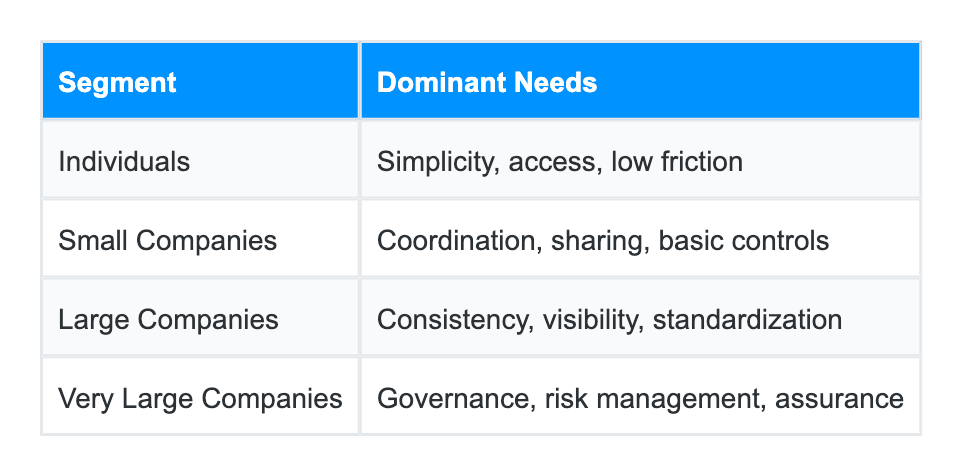
    From there, clarity comes when you apply one lens at a time. Apply user count, and the base dominates. Apply revenue, and value concentrates at the top. Apply needs, and simplicity gives way to coordination and governance. Apply complexity, and it steadily increases as you move upward. The structure stays the same; only the perspective changes.

    This also explains why conversations often feel disorienting. When a discussion starts with revenue and someone introduces risk, it can feel like a derailment—unless both are being applied to the same underlying structure. With a fixed context, adding a new lens doesn’t break the conversation; it deepens it.

    In abstract terms, this is what the Segmentation Pyramid enables. It fixes the context, makes asymmetry visible, and provides a stable surface on which different perspectives can be applied. The pyramid itself isn’t the insight. It’s what allows insights to appear without breaking coherence.

    From Stumbling to Structure: Why the Pyramid Emerged

    The pyramid didn’t arrive as a deliberate design choice. It emerged once segmentation and asymmetry were clear. When you arrange entities by scale—individuals, small groups, large organizations, institutions—you naturally get a broad base and a narrow top. The shape isn’t imposed; it reveals itself.

    Looking back, the pyramid had been present in my thinking long before I noticed it. Physical pyramids exist because the shape works: a wide base, a narrowing top, stability through distribution. Maslow’s pyramid applied the same intuition to human needs. The testing pyramid did it for quality.

    What connects these isn’t symbolism. It’s variance. A pyramid lets one variable change smoothly across layers. Look at count, and the base is large while the top is small. Look at complexity, and the direction flips—simple at the base, dense and constrained at the top. The same shape holds both readings.

    Squares suggest uniformity. Stacks suggest equivalence. The pyramid makes difference visible. That’s why it became the natural container once the idea took shape.

    Exploring Examples Across Functions (Tabular Views)

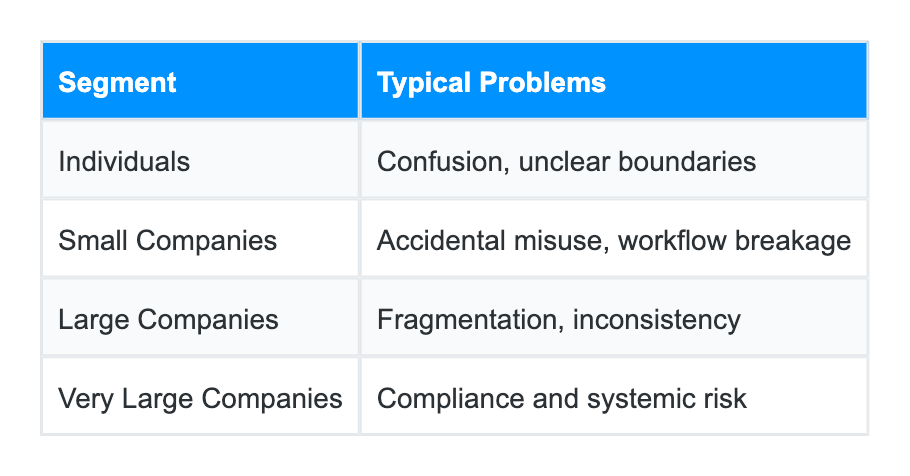
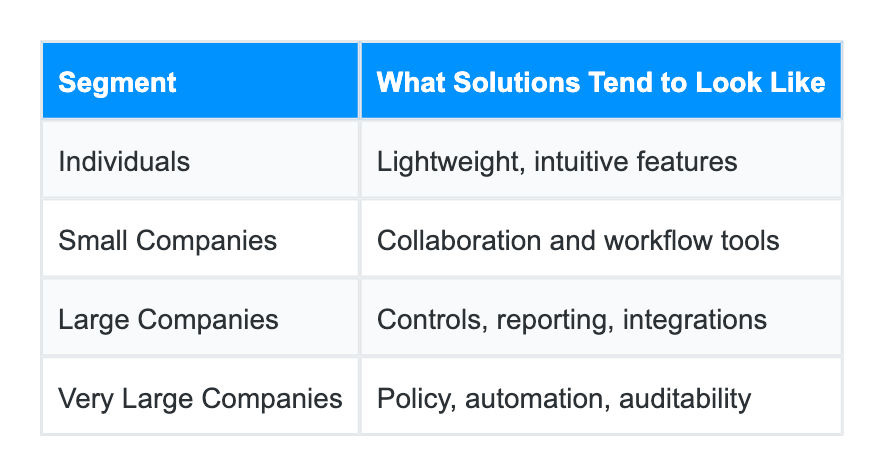
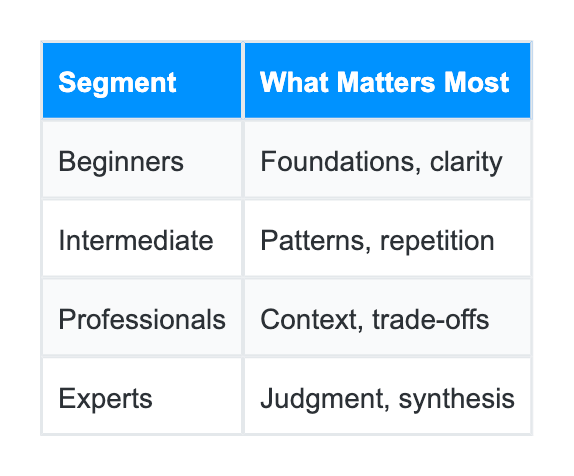
    Ideally, each of the examples below would be drawn as a pyramid. For readability—and because I didn’t want to wrestle with ASCII triangles and text alignment—I’ve used tables instead. The shape stays the same in spirit; the format is just more forgiving.

    Example 1: Understanding a Business Through Customer Segments

    Lens: Customer Needs

    Customer Needs vs Customer Segment

    Lens: Problem Space

    Customer Problems vs Customer Segment

    Lens: Solutions / Features

    Customer Feature vs Customer Segmentation

    This framing alone explains why roadmap debates often feel circular: people are optimizing for different segments without saying so.

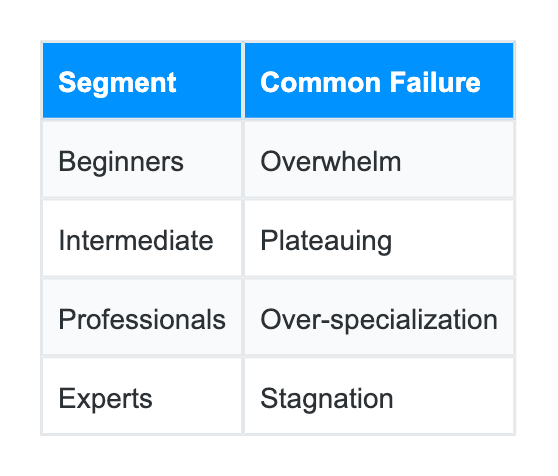
    Example 2: Learning and Skill Development

    Lens: Learning Needs

    Learning Needs vs Learner Maturity

    Lens: Failure Modes

    Learning Failures vs Learner Maturity

    Here, what looks like a content problem is often a segmentation mismatch.

    Conclusion — Documenting a Thought in Motion

    This isn’t a silver bullet, and it isn’t meant to be one. It’s simply a way of thinking that reduced some friction for me while dealing with complexity. Writing it down is less about fixing an answer and more about creating a reference point—something to return to, test, and refine.

    In that sense, this is documentation for myself as much as for fellow journey persons. Capturing a thought allows it to be checked against experience and adjusted as needed. I also expect this lens to break in places—and that, too, will be useful.

    For now, this is just a snapshot of a thought in motion, written down so it can evolve as new challenges appear.

    References

  • Cross-Functional Insights: Applying DuPont Analysis to Accelerate Personal Development

    Cross-Functional Insights: Applying DuPont Analysis to Accelerate Personal Development

    In the world of business, efficiency and profitability are key metrics that determine success. However, what if the analytical tools used to measure business performance could be applied to personal development? This post explores the idea of cross-functional thinking by applying the DuPont analysis, a well-known business efficiency model, to accelerate personal growth.

    Understanding RoE and DuPont Analysis

    What is RoE?

    Return on Equity (RoE) is a measure of a company’s profitability relative to shareholders’ equity. It indicates how efficiently a company is using its equity base to generate profits. The formula for RoE is:

    RoE = Net Income(Profit) / Shareholders’ Equity

    What is DuPont Analysis?

    The DuPont analysis breaks down RoE into three distinct components to provide deeper insights:

    1. Profit Margin: Measures how much profit a company makes for each dollar of sales. It’s calculated as: Profit Margin = Net Income / Sales
    2. Asset Turnover: Measures how efficiently a company uses its assets to generate sales. It’s calculated as: Asset Turnover = Sales / Total Assets
    3. Equity Multiplier: Reflects the company’s financial leverage. It’s calculated as: Equity Multiplier = Total Assets / Shareholders’ Equity

    The DuPont formula combines these components to explain RoE:

    RoE = Profit Margin × Asset Turnover × Equity Multiplier

    This breakdown helps in understanding the underlying factors driving RoE, offering a comprehensive view of a company’s financial health.

    The Concept of Cross-Functional Thinking

    Cross-Functional Applications Cross-functional thinking involves borrowing successful strategies from one domain and applying them to another. This innovative approach can yield unique insights and significant breakthroughs. In this case, we apply the DuPont analysis model to personal growth.

    Applying DuPont Analysis to Personal Development

    1. Skill Mastery as Profit Margin

    Just as profit margin reflects the efficiency of converting sales into profit, skill mastery represents how effectively you convert your abilities and efforts into personal achievements. Enhance your core skills, gain new competencies, and continuously improve your performance. This can be measured by the quality of your work, recognition, promotions, and feedback from peers and supervisors.

    2. Efficiency and Productivity as Asset Turnover

    Similar to asset turnover, which measures asset utilization efficiency, this component evaluates how well you use your skills and resources to achieve personal milestones. Optimize your time management, streamline your workflows, and increase your productivity. This can be demonstrated through project completions, meeting deadlines, and achieving key performance indicators (KPIs).

    3. Network and Influence as Equity Multiplier

    Just as the equity multiplier reflects financial leverage, your network and influence represent your personal leverage. Build and maintain professional relationships, seek mentorship, and actively participate in industry events. Leverage your network to gain opportunities, insights, and support. Assess this by the size and quality of your professional network, opportunities gained through connections, and your industry reputation.

    The Formula for Personal Development

    Combining these components provides a comprehensive formula for personal development:

    Personal Development = Skill Mastery × Efficiency & Productivity × Network & Influence

    By systematically improving each area, you can drive your personal success similarly to how companies drive financial performance through DuPont analysis.

    Practical Steps and Tips

    Skill Mastery:

    • Identify key skills needed for your role and aspirations.
    • Seek training, certifications, and continuous learning opportunities.
    • Regularly request feedback and work on areas of improvement.

    Efficiency and Productivity:

    • Use tools and techniques to manage your time effectively.
    • Set clear goals and priorities.
    • Continuously evaluate and refine your workflows for better efficiency.

    Network and Influence:

    • Attend industry conferences, webinars, and networking events.
    • Join professional associations and online communities.
    • Engage in thought leadership by writing articles, speaking at events, and sharing knowledge.

    Conclusion

    Applying business models like DuPont analysis to personal development can unlock new pathways to success. By thinking creatively about cross-functional applications, you can achieve significant growth.

  • Scaling Software Engineering: A Journey of Continuous Evolution

    Scaling Software Engineering: A Journey of Continuous Evolution

    In today’s world of software development, scaling a team while maintaining quality, collaboration, and agility can be a daunting task. However, by building a well-thought-out structure and continuously adapting it, we’ve successfully scaled our engineering practices. While we leverage agile methodologies, we’ve also tailored them to our unique needs, ensuring we’re not just scaling agile, but scaling software engineering in a way that fits our organization’s vision.

    Our Agile-Driven Structure

    At the core of our scaling strategy is a combination of agile practices and a structure that ensures both autonomy and alignment. We use the Spotify model with modifications to make it work for our context. Our teams consist of developers, product owners, scrum masters, managers, and principle engineers, all aligned with the squad’s goals.

    Managers play a critical role in coordinating and supporting their teams, addressing both technical and interpersonal needs. Meanwhile, principle engineers guide teams on best practices related to architecture and work estimation. The agile teams are responsible for planning and executing work at a regular cadence to consistently deliver results.

    The structure is designed to be flexible yet efficient. Squads typically consist of eight members: six developers, one product owner, and one scrum master. We balance feature development with maintenance to manage tech debt while keeping pace with new features. Each squad focuses on delivering value regularly, ensuring a steady pace while avoiding burnout.

    Proactive Problem-Solving and Continuous Collaboration

    Scaling is not just about executing tasks; it’s about proactively solving problems, collaborating during development, and ensuring alignment before releasing software. This structure empowers us to anticipate challenges and proactively address them, ensuring that we’re not merely reacting to issues as they arise.

    With clear guidelines and regular touch points, we maintain a culture of trust but verify, where code undergoes thorough peer reviews and checks before being released. This practice helps us bake quality into the development process. We also adopt shift-left practices, using GitFlow branching to enforce standards like lints, unit tests, and security checks.

    Fostering a People Centric Culture

    Behind every technical achievement is a team member contributing their best. To support our people, leadership works closely with individual contributors to align their personal aspirations with organizational goals. Our org actively invest in learning and development by offering both time and budget for courses that require time off, and we regularly assess team morale through pulse checks.

    This approach allows us to scale not just software engineering, but also personal growth. Every team member has the opportunity to improve their skills and feel supported in their development journey.

    Building a Culture of Quality and Continuous Improvement

    While we’ve built a robust structure that supports scaling, it’s crucial to acknowledge that mistakes are inevitable — often due to human error rather than flaws in the process. Even the best systems can’t completely eliminate mistakes, especially in a fast-paced environment.

    What we’ve learned is that strong processes and a supportive culture significantly reduce errors and increase our chances of success. Yet, we also understand that no system is perfect. By continuously improving both process and culture, we can minimize errors and learn from them when they occur. Leadership fosters an environment where mistakes are seen as opportunities to learn and evolve, which allows us to adapt more effectively.

    Quality at Every Step

    Ensuring software quality isn’t just about testing late in the development cycle; it’s integrated throughout. Our teams are empowered with a comprehensive testing framework, including unit tests, API automation, end-to-end automation, and manual testing. We’re experimenting with the test automation pyramid to ensure the right balance of testing at each layer.

    Documentation is key to team alignment. We use ADRs, epics, user stories, high-level designs, and README files to ensure everyone is on the same page. As part of our continuous improvement efforts, we’re moving toward a monorepo setup from a multi-repo configuration to improve transparency, ease of maintenance, and documentation accessibility. This shift enhances visibility and collaboration across teams, fostering a more cohesive engineering culture.

    Leadership and Scaling

    As we continue to grow, the role of leadership becomes increasingly critical. Our leadership group operates its own sprint, staying aligned with the teams while proactively addressing challenges, shifting requirements, and team needs. Leadership is deeply engaged in discussions about infrastructure, talent management, and risk mitigation. This collaborative and transparent approach helps us manage scale effectively while prioritizing the team’s well-being.

    The leadership group works closely with the teams, using tools like SWOT analysis and the skill-will matrix to evaluate talent gaps, proactively address risks, and identify opportunities for growth.

    Overcoming Challenges and Growing Together

    While we’ve faced challenges in scaling — such as balancing feature development with managing technical debt or ensuring cross-team collaboration — each obstacle has been an opportunity to refine our processes. For example, we initially found that teams were spending too much time on new feature development, leading to a growing backlog of tech debt. We adjusted by implementing a more deliberate prioritization strategy, ensuring that both new features and debt management were given the attention they deserved.

    As we continue to grow, we must remain agile — not only in our development processes but also in how we adapt our organizational culture. The ability to learn from mistakes and continuously improve is key.

    Conclusion: A Journey of Scaling and Evolving

    Ultimately, our journey of scaling software engineering is one of continuous evolution. We are not static in our approach; we strive to adapt and improve with each iteration. By leveraging agile principles, investing in our people, and maintaining a flexible yet structured process, we’ve built a scalable and adaptable engineering organization.

    Our structure allows us to grow while ensuring that quality, collaboration, and support are always at the forefront. And while we face challenges along the way, we continue to learn and improve — proving that with the right balance of process, culture, and leadership, scaling engineering success is not only possible but sustainable.

    As you embark on your own scaling journey, remember that success lies in continuous evolution — embracing change, learning from mistakes, and investing in both your people and your processes.

  • Beyond Code: A Journey in Resilience, Leadership, and Innovation

    Beyond Code: A Journey in Resilience, Leadership, and Innovation

    Building a cross-platform desktop app isn’t just about writing code — it’s about leading a team through the chaos of shifting requirements, evolving technologies, and technical roadblocks. Here’s how we navigated that journey and what we learned along the way.

    In this article, I’ll share our story of how we overcame technical and leadership challenges, the pivotal decisions we made, and how we continuously pushed ourselves to improve both the app’s performance and the team’s workflow.

    The Challenge: Creating a Robust Cross-Platform App

    With growing demand for a desktop solution that works seamlessly on both Windows and macOS, we faced a critical decision: How could we deliver a high-quality app without duplicating effort for each platform? After deliberation, we chose .NET Core for cross-platform support. Paired with Electron for the user interface and Vue.js for the frontend, we created a product that ran on both platforms without sacrificing performance or user experience. Communication between the app’s components was handled via gRPC, ensuring seamless interaction between the core and UI layers. For the core app, we implemented the actor model using Akka.NET, which provided the reliability and fault tolerance we needed.

    Midway through development, we received a crucial requirement change: decoupling the UI from the core app. This shift would allow us to release UI updates independently of the full app — an essential flexibility for enterprise settings, where app upgrades may be infrequent. We aligned this change with our planned migration from Vue 2 to Vue 3, in response to Vue 2’s upcoming end-of-life in December 2023. Implementing these adjustments in parallel modernized our app architecture, improved stability, and kept us on track.

    Our Approach: Innovating While Managing Risks

    As development progressed, we realized that success wasn’t just about technology — it was also about how we managed the project. With multiple teams working on different aspects of the app — core app development, UI, build systems, and testing — alignment and transparency were essential.

    One of our key innovations was optimizing the build system. Initially, our build times were long, causing frustration among developers. By reusing unchanged binaries, we achieved up to 70% faster builds, drastically improving our developer experience. This saved time and energy, allowing us to stay focused on solving key problems rather than waiting for builds to complete.

    Overcoming Roadblocks: Technical Challenges and Quick Pivoting

    Midway through development, we encountered a significant issue with offset-based pagination. As the app scaled, we started noticing data inconsistencies, with some users experiencing missing or skipped data. This created confusion and undermined the user experience, especially as we approached our beta release. The team quickly regrouped, and after brainstorming, we decided to pivot to cursor-based pagination. This solution resolved the data skip issue, ensuring a more reliable and consistent experience for users, and allowed us to stay on schedule.

    We also closely monitored our progress using internal metrics to track app stability and performance. Our initial target was to ensure the app met a high standard of reliability, and despite facing challenges, we exceeded our expectations at launch. Since then, the team has been dedicated to continuous improvement, working towards even higher performance benchmarks.

    Leadership in Action: Stakeholder Communication

    A crucial part of our success was maintaining constant alignment with stakeholders. One example that stands out is the Go/No-Go meeting we scheduled before the release. This was the first time I had participated in such a meeting, and it quickly became clear that we were under prepared. While the meeting didn’t go as smoothly as we had hoped, we took it as an opportunity to reflect and improve our approach for the next one.

    For the second Go/No-Go meeting, we came fully prepared. We ensured all the necessary data points were ready — performance metrics, risk assessments, and a clear timeline for any remaining issues. This preparation allowed us to align all stakeholders, gain their confidence, and secure approval for the final release. With that, we were able to successfully push the app to production with full support.

    Post-Release: Continuous Improvement and Monitoring

    After the release, we knew the real work began — ensuring the app continued to perform well in production. The first few days were critical. We released the app to 20% of users in the first 5 days to catch any platform-specific issues. Once those were resolved, we rolled it out to the remaining 80% over the next week, addressing edge cases in real time.

    Post-launch, we tracked key performance indicators that served as a measure of the app’s success. While our initial target was set at a high standard, the app exceeded expectations at launch. We’re now focused on continuously enhancing these metrics, striving for even higher levels of performance. This proactive approach ensures that we stay ahead of potential issues, consistently improving stability and delivering a better user experience.

    Looking Ahead: Building a Legacy of Resilience

    The journey of building this cross-platform app has shaped not only our product but also us as professionals. As a leader, I’ve learned that success is never a straight line. It’s about pivoting quickly, making tough decisions, and keeping the team motivated, even when the road ahead seems unclear. The innovations we implemented — whether in build optimizations, pagination improvements, UI decoupling, or the Vue migration — were critical to our success. They saved us time and reduced frustration, enabling us to deliver a high-quality product on time.

    As we continue to innovate and push boundaries, we’re more committed than ever to building products that not only meet user needs but also help us grow as engineers and leaders.

  • Beyond the Code: How Biases Impact Software Engineering

    Beyond the Code: How Biases Impact Software Engineering

    In software engineering, as in many disciplines, decisions made during the development process are influenced by cognitive biases — subconscious mental shortcuts that impact judgment. While psychology and behavioral insights are often applied in fields like finance and marketing, they remain under explored in software development. This article examines how cognitive biases can affect each phase of the Software Development Life Cycle (SDLC), influencing project outcomes, team dynamics, and decision quality.

    Understanding Biases and Blind Spots

    Biases are mental shortcuts that help us process information quickly but often at the cost of accuracy. Common biases include confirmation bias, where individuals favor information that aligns with pre-existing beliefs, and overconfidence bias, which leads individuals to overestimate their abilities or knowledge. These biases impact not only individual decision-making but also collaborative efforts across engineering teams.

    Biases in the SDLC

    Requirements Gathering: Confirmation Bias and Blind Spots

    During the requirements gathering phase, product and UX teams invest significant time in user validation. However, confirmation bias can affect research, leading teams to favor data that confirms their assumptions. This bias can ultimately shape requirements that don’t fully address user needs, resulting in less impactful products.

    Development Phase: Overconfidence and Neglect of Testing

    In the development phase, overconfidence or complacency can cause developers to overlook acceptance criteria or bypass unit tests, assuming their code is foolproof. Similarly, architects may be biased toward using new technologies without fully assessing long-term maintainability. These biases can contribute to technical debt or gaps in functionality.

    Testing and Deployment: Availability Bias and Anchoring

    Testing often suffers from availability bias, where testers might focus more on readily identifiable issues, neglecting less obvious but critical scenarios. Anchoring bias may also emerge, where initial assumptions about the project influence testing scope and priorities, potentially leading to incomplete test coverage.

    Retrospectives: Confirmation and Loss Aversion Bias

    In Agile retrospectives, confirmation bias can cause teams to focus on reinforcing past approaches rather than addressing overlooked challenges. Loss aversion bias can also prevent teams from fully embracing necessary changes, as there’s a tendency to favor established practices over exploring uncertain improvements.

    Leadership Decisions: Familiarity and Status Quo Bias

    Leadership may also fall prey to biases such as the status quo bias, where they favor familiar methods or tools over new alternatives, even if those alternatives could address emerging challenges. This can create a disconnect between leadership vision and team realities, impeding meaningful guidance.

    Using the Six Thinking Hats to Overcome Biases

    Edward de Bono’s Six Thinking Hats framework provides a structured approach for teams to view problems from multiple perspectives, helping counteract cognitive biases. Here’s how each hat can be applied to enhance decision-making in software engineering:

    • White Hat (Facts and Information): Focuses on objective data, countering biases by grounding discussions in facts rather than assumptions.
    • Red Hat (Feelings and Emotions): Allows team members to express intuitions and emotions openly, helping to identify any underlying emotional biases.
    • Black Hat (Caution and Critique): Encourages critical thinking, which is crucial for overcoming overconfidence and considering potential pitfalls.
    • Yellow Hat (Benefits and Optimism): Balances the black hat’s critical approach, promoting constructive optimism that keeps teams from being overly cautious.
    • Green Hat (Creativity and Alternatives): Fosters brainstorming and new ideas, helping teams avoid confirmation bias and expand beyond initial solutions.
    • Blue Hat (Process Control): Manages the thinking process, ensuring that all perspectives are considered and reducing the influence of dominant voices.

    This framework can be especially useful in Agile ceremonies like sprint planning and retrospectives, helping teams discuss ideas more holistically and make well-rounded decisions that account for various biases.

    Conclusion

    Biases are natural but often hidden influences on team dynamics, product design, and engineering decisions. Recognizing these biases is the first step to mitigating their impact on software development outcomes. By understanding how biases play out across the SDLC, teams can become more aware of potential pitfalls and make deliberate choices to counteract them.

    Next Steps

    To tackle biases in your team, document biases that emerge during discussions. Encourage members to recognize influences like confirmation bias and overconfidence. Use the Six Thinking Hats framework in meetings for structured decision-making. By regularly reflecting on biases and trying new strategies, your team can develop a more effective and unbiased approach to software development.

  • Acting Fast and Slow: Navigating Bottlenecks in Software Development

    Acting Fast and Slow: Navigating Bottlenecks in Software Development

    In the dynamic landscape of software development, teams are constantly seeking ways to enhance efficiency and deliver high-quality products. Inspired by Daniel Kahneman’s Thinking, Fast and Slow, we recognize the importance of balancing quick, instinctive actions with more deliberate, thoughtful approaches. By understanding the distinct phases of software development, we can better identify bottlenecks and determine when to act swiftly or take a step back for careful consideration. As resources are finite, maximizing our return on investment requires a keen awareness of where constraints lie and the appropriate responses needed — whether they demand immediate attention or a more thoughtful approach.

    In this article, we explore how Little’s Law can guide software development teams in identifying bottlenecks across various stages. By knowing when to act quickly and when to take a measured approach, teams can reduce work-in-progress (WIP), improve cycle times, and ultimately enhance the quality of their software delivery.

    Key Stages in Software Development

    Requirement Gathering/Problem Analysis

    • Fast Action: When critical requirements are missing or ambiguous, quickly clarifying them prevents further delays.
    • Slow Action: Understanding complex requirements (e.g., involving multiple stakeholders) requires careful data collection and exploration to avoid misalignment later in development.

    Estimation (Feasibility, Desirability, Usability)

    • Fast Action: When the scope is well understood and straightforward, quick estimations can help move the project forward.
    • Slow Action: For projects with high uncertainty or innovation, rushing estimations without sufficient analysis of desirability or feasibility can lead to gross underestimations or costly rework.

    Work Breakdown (Technical Refinement)

    • Fast Action: If the breakdown involves known technologies and a stable scope, fast action on technical refinement can streamline the workflow.
    • Slow Action: In projects involving new technologies or architectural decisions, fast decisions might lead to technical debt. Slowing down to analyze the technical complexities helps mitigate long-term issues.

    Implementation

    • Fast Action: Fixing immediate technical blockers (e.g., broken builds, failing unit tests) keeps development flowing.
    • Slow Action: Complex integration issues or architectural decisions should be approached cautiously. Rushing through implementation without considering the system-wide impact can lead to inefficiencies and increased WIP.

    Testing

    • Fast Action: Quick fixes for clear bugs or minor code issues should be implemented to maintain the feedback loop.
    • Slow Action: If the system faces recurring issues in critical areas, slowing down to thoroughly analyze test cases, automate tests, or reevaluate coverage is necessary.

    Stakeholder Feedback

    • Fast Action: When stakeholders identify minor adjustments or low-risk requests, quick implementation can maintain momentum.
    • Slow Action: Major feedback, such as changes in product direction or core functionality, should be assessed carefully to prevent feature creep or misaligned priorities.

    Release

    • Fast Action: For regular, low-risk updates, rapid release cycles ensure continuous improvement and fast delivery of value.
    • Slow Action: In major releases or product rollouts, especially those affecting many users or critical systems, a slower, more deliberate release plan ensures that potential risks are mitigated.

    KPI Review and Next Steps

    • Fast Action: When KPIs clearly show underperformance in specific areas (e.g., increased defect rates or slow performance), immediate corrective actions can prevent further degradation.
    • Slow Action: Strategic reviews of long-term metrics such as user satisfaction or team productivity require thoughtful analysis and careful consideration of future steps. Rushed decisions may overlook underlying causes.

    At each stage, bottlenecks arise that demand critical thinking. Rushing through complex stages can lead to rework, while delaying quick fixes can prolong unnecessary inefficiencies. Little’s Law helps guide us through this decision-making process by focusing on how WIP (work in progress) impacts overall throughput and cycle time.

    Applying Little’s Law to Bottlenecks in Software Development

    Now that we’ve outlined the different stages, let’s explore how Little’s Law comes into play:

    Little’s Law says that the number of things you have working on at once (Work in Progress, or WIP) is equal to how many things you finish in a certain time (throughput) multiplied by how long each thing takes to complete (cycle time).

    In simple terms, if you have too many tasks (WIP), it takes longer to finish them (cycle time). By keeping WIP low and managing how quickly tasks get done, you can speed up the overall process.

    L = λ × W

    Where:

    L = Work in Progress (WIP),

    λ = Average throughput rate (the rate at which work items are completed),

    W = Average cycle time (how long a task takes).

    Why Little’s Law Matters

    Understanding Little’s Law is crucial because each stage of the development process impacts the overall delivery schedule. When teams act quickly to address bottlenecks — by reducing WIP and maintaining a steady throughput — they can improve cycle times and ensure timely delivery of value.

    Conversely, taking too long to address issues can lead to increased WIP and delays, ultimately affecting project timelines and stakeholder satisfaction. By knowing when to act fast and when to slow down for careful consideration, teams can optimize their processes and enhance their delivery outcomes.

    Stage Wise Application

    Requirement Gathering/Problem Analysis: Reducing WIP by gathering clear requirements up front ensures that the average cycle time doesn’t increase later due to misaligned expectations. Acting fast in clarifying ambiguities avoids delays in downstream processes.

    Estimation: Hastily done estimations can inflate WIP as tasks get stuck in later stages due to underestimation. Slowing down to carefully analyze feasibility ensures smoother throughput.

    Work Breakdown: Poorly defined tasks lead to bloated WIP during implementation. Taking time to refine technical details upfront reduces rework and improves flow.

    Implementation: Piling on too many parallel tasks (increased WIP) without reducing cycle time only leads to longer delivery times. Here, applying Little’s Law helps recognize when to focus efforts on completing fewer tasks quickly, rather than starting too many.

    Testing: Too much untested code (increased WIP) adds risk to the project. Focusing on smaller testing batches and resolving key issues quickly is vital for maintaining throughput.

    Stakeholder Feedback: If too many feedback items are taken up without prioritization, WIP grows, slowing down overall delivery. Acting on critical feedback while postponing low-priority changes is crucial to maintaining system flow.

    Release: Releasing too frequently without considering the overhead of multiple deployments can increase WIP in post-release maintenance. Conversely, not releasing frequently enough and delaying feedback incorporation can result in a “big bang” release, where sudden reactions to accumulated feedback create overwhelming pressure. Careful timing, informed by Little’s Law, ensures that WIP remains manageable while balancing the need for timely value delivery and thoughtful responses to stakeholder input

    KPI Review and Next Steps: Rushing to act on short-term KPIs can result in actions that don’t align with long-term goals. Slowing down to interpret data holistically reduces the risk of acting on noise rather than true signals.

    Conclusion: Finding the Right Pace

    In software development, understanding when to take swift action and when to engage in thoughtful analysis is essential for success. Each stage of the development process presents unique challenges, and applying the principles of Little’s Law helps teams effectively identify and address bottlenecks.

    The key takeaway is that not all challenges are the same — some may require immediate attention, while others benefit from a more reflective approach. By cultivating a balanced mindset and a strategic framework for decision-making at each stage, teams can enhance their efficiency, reduce cycle times, and deliver higher-quality software.

    Embracing this adaptive approach will empower teams to meet their goals while fostering a culture of continuous improvement and innovation.

  • The Insight Quotient: Balancing Information, Knowledge, and Wisdom

    The Insight Quotient: Balancing Information, Knowledge, and Wisdom

    In today’s fast-paced world, we’re bombarded by a constant stream of information — data points, news alerts, social media updates, and sensory stimuli — overwhelming us as we try to differentiate between what’s meaningful and what’s just noise.

    But long before the digital age, humanity developed a way to process information. Over millennia, our minds evolved to gather and interpret sensory input, solve problems, and — at our most evolved — foresee challenges before they arise. The journey from information to knowledge and eventually wisdom forms the foundation of how we navigate the world today.

    In this article, we explore these three pillars — information, knowledge, and wisdom — their distinct purposes, and the mindsets required to thrive in each space.

    Information: The Foundation of Awareness and Reaction

    Purpose

    At its core, information encompasses everything we sense — what we see, hear, touch, and feel. It includes raw data from the external world and our internal reactions to it. Information is our first line of awareness, enabling us to react to our environment, seize opportunities, and avoid potential dangers.

    Evolutionary Context

    Throughout history, humans have relied on gathering information for survival. Early humans, for instance, used sensory input to identify food sources or detect threats. This ability to observe and react is foundational, shaping our evolution and enabling us to adapt, learn, and grow.

    Mindset Required

    • Awareness: Stay mindful of your surroundings, paying attention not just to data but to sensory cues that provide important context.
    • Openness: Embrace both the logical and intuitive aspects of information, being open to what your senses tell you.
    • Calibrated Response: Balance reaction times — distinguishing when immediate action is necessary and when a pause is warranted.

    Challenge

    Today’s information overload can feel overwhelming, with countless sources competing for attention. The real challenge is learning to filter and prioritize meaningful data over distractions.

    Knowledge: Applying Information Through Experience and Learning

    Purpose

    Knowledge emerges when we interpret and apply information. It connects fragmented data into a coherent picture, allowing us to solve problems and make informed decisions. While information enables reaction, knowledge empowers us to act thoughtfully and with purpose.

    Evolutionary Context

    Human progress has always depended on turning raw information into practical knowledge. From cultivating crops to building tools, our ancestors relied on learning from experience, passing down accumulated wisdom to future generations.

    Mindset Required

    • Curiosity: A drive to ask questions and deepen understanding.
    • Experimentation: Willingness to test ideas, learn from failure, and refine approaches.
    • Contextual Thinking: Recognizing that knowledge needs the right context to be effective.

    Challenge

    In a rapidly changing world, knowledge must be continually refreshed. Staying adaptable requires a commitment to lifelong learning and the ability to unlearn outdated information.

    Wisdom: The Art of Foresight and Discernment

    Purpose

    Wisdom goes beyond knowledge — it’s the ability to foresee challenges before they arise and make choices that avoid potential pitfalls. Where knowledge solves problems, wisdom prevents them.

    A Story of Three Friends

    Imagine three friends walking down a path. The first friend sees a pothole in the distance, recognizes the danger, and steps around it, warning the others. The second friend, noticing the first friend’s warning, crosses safely. The third friend, ignoring both the warning and the pothole, falls in.

    The first friend embodies wisdom — anticipating the problem and helping others avoid it. The second friend represents knowledge — applying the information given to avoid harm. The third friend, despite access to the same information, lacks both knowledge and wisdom, falling into the trap.

    Mindset Required

    • Discernment: Wisdom involves not only seeing the danger but recognizing its significance and taking proactive steps to avoid it.
    • Patience: It requires the patience to assess situations carefully before acting.
    • Ethical Judgment: Wisdom is also about helping others, as the first friend shared the warning with his peers.

    Challenge

    Because wisdom often prevents problems before they occur, it can be difficult to measure. In fast-paced environments, wise decisions can go unnoticed — until their absence leads to consequences.

    The Information-Knowledge-Wisdom Continuum

    We can imagine a 3D plane with information, knowledge, and wisdom as axes:

    • X-axis (Information): Represents raw data and sensory input.
    • Y-axis (Knowledge): Represents the application of information through learning and experimentation.
    • Z-axis (Wisdom): Represents foresight, discernment, and ethical judgment.

    A point on this 3D plane reflects an individual’s or system’s “Decision Power” or “Insight Quotient (IQ)” — their ability to integrate information, knowledge, and wisdom to make better decisions.

    • Those who gather vast amounts of information but have limited knowledge or wisdom may be over-informed yet under-prepared for complex decisions.
    • In contrast, someone balanced across all three dimensions makes decisions that are not only informed but also insightful and wise.

    Developing Decision Power / Insight Quotient (IQ)

    To thrive, individuals and organizations must balance all three pillars. Here’s how:

    • Information: Cultivate curiosity. Seek out new data but avoid overload by focusing on actionable insights.
    • Knowledge: Engage in continuous learning. Apply information in real-world contexts, experiment, and learn from mistakes.
    • Wisdom: Develop foresight. Reflect on past experiences, consider the ethical dimensions of decisions, and anticipate future challenges.

    By harmonizing these dimensions, you can elevate your Decision Power or Insight Quotient (IQ) and enhance your decision-making capabilities.

    Conclusion

    In a world teeming with information, the challenge isn’t just processing data but converting it into knowledge and, eventually, wisdom. These three pillars — information, knowledge, and wisdom — are not separate stages but interconnected dimensions that, when balanced, empower us to make truly insightful decisions.

    By embracing all three, you can increase your Decision Power, avoid unnecessary pitfalls, and navigate life with clarity, making choices that are not only informed but also wise.