Category: Technology & Systems

  • Simplify to Amplify: The Magic of the 2×2 Matrix

    Simplify to Amplify: The Magic of the 2×2 Matrix

    In today’s fast-paced world, decision-making is a constant part of our daily lives. According to various online sources, the average person makes more than 35,000 decisions daily, ranging from mundane choices like what to eat for breakfast to more significant ones like career moves or investment opportunities. With such a high volume of decisions, it’s no wonder that many of us experience decision fatigue, leading to reduced productivity and increased stress.

    To navigate this complexity, decision-making frameworks can provide clarity and simplify choices. One such framework is the 2×2 matrix, a versatile tool that breaks down complex problems into manageable parts. By dividing a problem into two contrasting variables with two variations each, the 2×2 matrix helps prioritize tasks, evaluate options, and make informed decisions with greater efficiency.

    Problem Statement

    The sheer volume of decisions we face daily can be overwhelming, leading to decision fatigue and diminished productivity. With countless options and varying degrees of importance and urgency, finding a structured approach to prioritize and make informed decisions becomes crucial. Traditional decision-making methods can often lead to analysis paralysis, where the complexity of choices impedes effective decision-making.

    2×2 Matrix Definition

    A 2×2 matrix is a simple yet powerful tool that helps to visualize and categorize different aspects of a problem or decision. By dividing a problem into two contrasting variables on the x-axis and y-axis, each with two variations, the matrix creates four distinct quadrants. This structure allows for a clear and concise representation of the problem, making it easier to analyze and decide on the best course of action. The matrix is structured as follows:

    • X-Axis: Represents one dimension of the problem, such as urgency or cost.
    • Y-Axis: Represents another dimension, such as impact or effort.

    A 2×2 matrix helps you make the right decision at a macro level quickly. Once this decision is made, breaking down the subsequent steps becomes much easier. By swiftly addressing the initial, often most challenging step, the matrix paves the way for a more structured and satisfying decision-making process. This simplicity is the core strength of the 2×2 matrix, providing a clear visual framework that aids in prioritizing tasks and making informed decisions efficiently.

    2×2 Matrix-Based Frameworks

    The 2×2 matrix can be applied in various frameworks to aid decision-making:

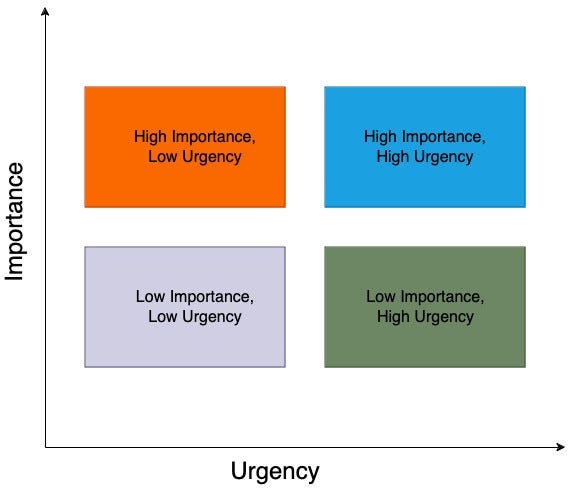
    Eisenhower Matrix

    Eisenhower matrix prioritizes tasks based on urgency and importance. Tasks are categorized into four quadrants:

    • Urgent & Important (Do it now)
    • Important but Not Urgent (Schedule a time to do it)
    • Urgent but Not Important (Delegate)
    • Neither Urgent nor Important (Eliminate It).
    Eisenhower Matrix

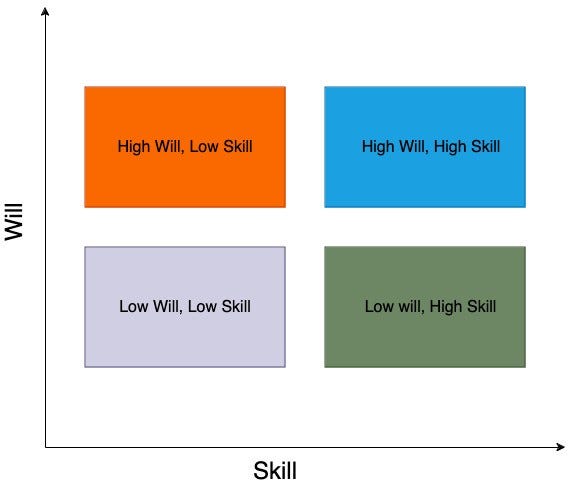
    Skill-Will Matrix

    Skill will matrix evaluates team members based on their skills and motivation. It categorizes individuals into four quadrants:

    • High Skill & High Will (Competent & Committed)
    • High Skill & Low Will (Competent but Unmotivated)
    • Low Skill & High Will (Committed but low Competence)
    • Low Skill and Low Will (Low competence and unmotivated).
    Skill Will Matrix

    Growth-Share Matrix (BCG Matrix)

    Growth share matrix assesses business units or products based on market growth and share. Quadrants include

    • Stars (High Growth, High Share)
    • Question marks (High Growth, Low Share)
    • Cash Cows (Low Growth, High Share)
    • Pets (Low Growth, Low Share)
    Growth-Share Matrix

    Impact-Effort Matrix

    Impact effort matrix balances the impact of initiatives against the effort required. Tasks or projects are categorized into four quadrants:

    • High Impact, High Effort (Big Bets)
    • High Impact, Low Effort (Easy Wins)
    • Low Impact, Low effort (Fill-Ins)
    • Low Impact, High effort (Losing Bets)
    Impact-Effort Matrix

    Applying the 2×2 Matrix in Real Life

    Personal Finance Management

    Imagine someone deciding between various investment options (stocks, bonds, real estate). Using a 2×2 matrix, they can evaluate these options based on risk and potential return. This helps visualize which options align with their risk tolerance and desired returns, simplifying their investment decisions.

    Selecting a Health and Wellness Routine

    An individual trying to choose a health and wellness routine might use a 2×2 matrix to assess options based on time commitment and intensity. This helps in selecting a routine that fits their lifestyle and fitness goals.

    Evaluating Travel Destinations

    When deciding on a vacation destination, a person can use a 2×2 matrix to compare cost and experience quality. This approach clarifies which destinations provide the best value for money and desired experiences.

    Product Development Prioritization

    A product team can use a 2×2 matrix to prioritize features based on customer value and development effort. This helps in focusing on features that offer high value with minimal development effort, optimizing the product roadmap.

    Environmental Sustainability Initiatives

    A company aiming to implement sustainability initiatives wants to prioritize projects that offer the best balance between environmental impact and cost. Using a 2×2 matrix, they can evaluate different initiatives based on their environmental impact (low to high) and implementation cost (low to high). This helps identify which projects provide the most significant environmental benefits for the least cost, ensuring resources are used effectively.

    Online Learning Engagement

    An educator or institution looking to enhance student engagement in online courses can use a 2×2 matrix to evaluate learning materials based on engagement level and interactivity, aiding in the selection of the most effective course designs.

    Conclusion

    The 2×2 matrix is a powerful tool for simplifying complex decisions. By breaking down problems into two contrasting variables with two variations each, it provides a clear and manageable way to prioritize tasks, evaluate options, and make informed choices. Whether in personal life or professional settings, applying the 2×2 matrix can help navigate decision-making more efficiently and reduce overwhelm.

    Next Steps

    To start leveraging the 2×2 matrix, choose a current decision or project and create your own 2×2 matrix. Plot your options, evaluate their positions, and use the insights to guide your decisions. By regularly applying this framework, you can streamline your decision-making process and improve productivity.

  • Inverting Leadership: A Satire!

    Inverting Leadership: A Satire!

    What happens when we apply the Jacobi principle of “Invert, Always Invert” to leadership? The result is this satirical take on what not to do as a leader. From masks to micromanagement and scapegoats, this piece flips traditional leadership wisdom on its head to explore the darker, often unspoken side of modern management.

    Tighten up your seat belts as you dive into this humorous yet thought-provoking satire. And if any of this feels a little too familiar, don’t worry — the writer himself has lovingly exhibited these traits at some point. After all, reflection starts with a smile (or maybe a wince).

    1. The Mask: Leadership Is a Show

    • The Strategy: Your public persona is your masterpiece. Speak eloquently, inspire vaguely, and never reveal your true thoughts.
    • Pro Move: Use phrases like “Let’s align for maximum synergy” and “I trust your instincts, but let’s course-correct here” to sound visionary while avoiding specifics.
    • Result: Your team spends hours interpreting your words instead of questioning your actions.

    Leadership Hack: Launch a 360° feedback initiative, but exclude yourself. After all, true leaders listen without being evaluated.

    2. Puppetry: Empowerment in Name Only

    • The Strategy: Appear to delegate power while secretly pulling the strings. Decisions should seem like the team’s but align with your vision.
    • Pro Move: Set up endless reviews disguised as “supportive check-ins.”
    • Result: Your team feels empowered but delivers exactly what you want. Success? Your brilliance. Failure? Their incompetence.

    Leadership Hack: Form “task forces” to handle imaginary crises. Nothing controls better than structured chaos.

    3. The Disposable Proxy: Delegation Done Right

    • The Strategy: Hire someone ambitious, delegate everything risky, and make them the de facto owner.
    • Pro Move: Apply pressure tactics — tight deadlines, ambiguous goals, and moralizing about “stepping up.” Let them burn out while you focus on upward visibility.
    • Result: If things fail, sacrifice the proxy. If they succeed, claim credit and move on.

    Leadership Hack: Frame their burnout as “a valuable learning experience” and their exit as “natural progression.”

    4. Ideological Betrayal: Agile Until It Hurts

    • The Strategy: Preach Agile, sustainability, and collaboration until real accountability lands on your desk. Then toss them out.
    • Pro Move: Replace calm workflows with “war room strategies” in times of trouble. Blame the team for “not understanding Agile” if they push back.
    • Result: Agile is dead, chaos reigns, and you’re praised for your “decisive action.”

    Leadership Hack: Rebrand war rooms as “agile acceleration hubs” to add a touch of irony.

    5. Sustainability? Overrated

    • The Strategy: Chase short-term wins relentlessly. Long-term vision? That’s someone else’s problem.
    • Pro Move: Justify unsustainable deadlines with “business-critical urgency.” Ignore aftershocks — they’re for your disposable proxy.
    • Result: KPIs shine, your boss applauds, and your team questions their career choices.

    Leadership Hack: When the dust settles, pivot to “it was necessary for growth.”

    6. The Obedient Slave: Aligning Upwards

    • The Strategy: Leadership isn’t about guiding your team — it’s about pleasing your boss. Mirror their vision, even if it contradicts yesterday’s strategy.
    • Pro Move: Parrot their language while ensuring no decisions trace back to you.
    • Result: You become indispensable to your boss while your team drifts aimlessly.

    Leadership Hack: Perfect the phrase: “Let me align with leadership and circle back.” It’s a commitment to nothing.

    7. The eNPS Ritual: Blame Without Accountability

    • The Strategy: Conduct annual eNPS surveys to “listen to the team” and blame managers for low scores. Never address systemic cultural issues.
    • Pro Move: Justify this with “They estimate their own work in Agile. If they struggle, it’s on them.”
    • Result: Managers crumble under stress while culture issues remain buried.

    Leadership Hack: Add a pep talk: “This is a great opportunity to improve team engagement!” (without offering support).

    8. Hiring Hacks: Budget-Free Expansion

    • The Strategy: Provide no hiring budget and suggest “innovative” options like Upwork, trainees, or juniors.
    • Pro Move: Frame it as “building a lean, scalable team.” Ignore mismatched skills and complexity.
    • Result: Your team trains instead of delivers while you boast about “doing more with less.”

    Leadership Hack: Call the strain “a great leadership opportunity to mentor future talent.”

    9. Accountability Without Understanding

    • The Strategy: Never bother understanding operations and complexities but hold people accountable for results.
    • Pro Move: Demand weekly updates on metrics you barely grasp. Critique with sweeping statements like, “This doesn’t seem impactful enough.”
    • Result: Teams scramble to fix optics while you appear “details-oriented.”

    Leadership Hack: If someone questions your understanding, blame their “poor problem-solving skills.”

    Conclusion: A Masterclass in What Not to Do

    Now that you’ve had a glimpse of how not to lead, why not aim for the real thing? Authentic leadership might not come with the instant gratification of optics or the convenience of scapegoats, but it offers something far more rewarding: trust, purpose, and an impact that outlasts gimmicks.

    Sure, it’s challenging, and yes, it requires actual accountability, but isn’t that a small price to pay to build a team that doesn’t secretly wish for your transfer? So go ahead — ditch the mask, cut the strings, and retire the proxy. Real leadership awaits, and it’s way more fulfilling (plus, you’ll save on all those war room snacks).

  • Skill Diversification for Happiness & Fulfillment in Software Engineering

    Skill Diversification for Happiness & Fulfillment in Software Engineering

    In today’s dynamic software engineering field, achieving career fulfillment and happiness requires more than just technical expertise. Just as financial diversification helps manage investment risks and optimize returns, skill diversification enhances career adaptability and stability for software professionals. Financial diversification involves spreading investments across different asset classes to reduce risk and increase potential returns.

    Similarly, skill diversification for software engineers means developing a well-rounded portfolio of both technical and success skills. This approach enables professionals to navigate various challenges, seize diverse opportunities, and adapt to evolving demands in the tech industry. By diversifying your skills, you create a robust foundation that supports long-term career growth and personal satisfaction in the ever-changing landscape of software engineering.

    Problem Statement

    In the ever-evolving field of software engineering, software professionals often face the challenge of adapting to rapid technological advancements and shifting industry demands. A traditional focus on purely technical skills can lead to a narrow career perspective, overlooking the broader spectrum of success skills necessary for comprehensive career growth. This lack of a holistic approach to skill development can hinder career progression, limit adaptability, and affect overall job satisfaction. To navigate these challenges effectively, software professionals need to embrace skill diversification, which integrates both technical and success skills, ensuring a well-rounded approach to career development that fosters resilience and long-term fulfillment.

    What is Diversification in Investing?

    Diversification in investing involves spreading investments across various asset classes — such as stocks, real estate, bonds, and precious metals like gold and silver — to minimize risk and stabilize returns. This strategy helps manage market volatility by not putting all resources into a single type of asset, thereby achieving more consistent financial outcomes. Typically, a diversified portfolio might allocate about 75–80% to core asset classes like stocks and bonds, while the remaining 20–25% is invested in alternative assets like real estate or precious metals. This balanced approach reduces the impact of market fluctuations on the overall portfolio.

    Similarly, skill diversification involves developing a range of technical and success skills. By not relying solely on one competency, software professionals can reduce their vulnerability to industry changes and enhance their career stability. For instance, just as an investment portfolio benefits from having a mix of assets, a well-rounded skill set that includes both technical expertise and success skills ensures greater adaptability and long-term career fulfillment

    Applying Skill Diversification to Career Development

    Skill diversification, similar to financial diversification, involves cultivating a well-rounded skill set to enhance career fulfillment and adaptability. Diversifying your skills means developing competencies across two broad pillars: Fundamental Skills and Success Skills.

    Fundamental Skills address the technical and logical aspects crucial for problem-solving and solution development. These include proficiency in programming languages, understanding algorithms, expertise in frameworks, and knowledge of emerging technologies. These skills are essential for tackling the core challenges of any technical field and driving innovation.

    Success Skills encompass the emotional and interpersonal aspects necessary for thriving in professional settings. These skills include communication, time management, leadership, and collaboration. They help individuals manage their work-life balance, interact effectively with colleagues, and navigate the complexities of team dynamics and personal growth.

    By investing in both pillars, professionals can achieve a well-rounded skill set that not only enhances their technical abilities but also supports their personal and professional growth. This balanced approach fosters greater career satisfaction and fulfillment, enabling individuals to handle diverse challenges and build meaningful, satisfying careers.

    Fundamental Skills

    Programming Languages

    Mastering various programming languages enhances flexibility and problem-solving abilities, allowing you to choose the most suitable tool for different tasks. This adaptability is crucial for tackling diverse projects and adapting to new challenges.

    • Practical Tip: Regularly learn and experiment with new languages. For instance, expanding from Python to JavaScript can diversify your development capabilities and open up new project opportunities, ensuring you remain versatile in different programming environments.

    Algorithms and Data Structures

    Core concepts such as algorithms and data structures are essential for efficient problem-solving and system design. A solid understanding of these principles is crucial for optimizing performance and developing robust solutions.

    • Practical Tip: Engage with problem-solving platforms like LeetCode or HackerRank to practice algorithmic problems. Applying these skills in real-world scenarios through coding challenges will deepen your understanding and improve your problem-solving efficiency.

    System Architecture and Design

    Knowledge of system architecture helps in creating scalable and maintainable systems. This involves understanding various design patterns and architectural principles, which are vital for building effective and long-lasting solutions.

    • Practical Tip: Study the architectures of well-known applications and participate in design reviews. This will enhance your understanding of different architectural approaches and improve your ability to design robust systems.

    AI & Prompt Engineering

    Understanding AI and machine learning is becoming increasingly important in the software industry. This includes familiarity with different AI models, their applications, and how to integrate AI solutions into software projects. Similarly, Prompt engineering involves designing effective prompts for interacting with AI models, especially those based on natural language processing (NLP). It is crucial for optimizing the performance and accuracy of AI-driven applications.

    Practical Tip

    • Explore online courses or certifications in AI and machine learning. Practical experience with AI frameworks like TensorFlow or PyTorch can provide hands-on learning and help in developing intelligent systems.
    • Practice crafting different types of prompts and evaluating their effectiveness with AI tools. Engaging in prompt engineering exercises enhances your ability to fine-tune AI interactions and improves the quality of AI-generated responses.

    Success Skills

    Communication Skills

    Effective communication is vital for successful collaboration and leadership. It encompasses the ability to convey ideas clearly and to understand and engage with others effectively.

    • Practical Tip: Practice active listening and actively seek feedback on your communication style. Consider joining public speaking groups or enrolling in communication workshops to refine your skills and enhance your ability to convey ideas and build strong professional relationships.

    Time Management

    Mastering time management is key to meeting deadlines and maintaining productivity. It involves organizing and planning tasks effectively to optimize your workflow and ensure timely completion of projects.

    • Practical Tip: Utilize time-tracking tools and project management software to monitor and manage your time efficiently. Regularly review and adjust your strategies to improve productivity and ensure that you stay on track with your goals and deadlines.

    Mentorship and Leadership

    Mentorship involves guiding and supporting others in their professional growth, while leadership focuses on inspiring and managing teams effectively. Both skills are essential for career advancement and fostering a productive work environment.

    • Practical Tip: Actively seek opportunities to take on mentorship and leadership roles in projects or teams. Participate in leadership training programs and workshops to develop and refine these skills, and build a strong network of professionals to support your growth.

    lllustrative Example: The Impact of Skill Diversification

    Background: Alex is a software developer who has invested in diversifying his skill set beyond technical expertise. By balancing his core programming skills with essential success skills, such as communication and leadership, Alex has significantly enhanced his career flexibility and effectiveness.

    Solo Contributor Role: When working as a solo contributor, Alex leverages his deep technical knowledge to tackle complex coding challenges and solve intricate problems. His mastery of various programming languages and algorithms allows him to deliver high-quality, efficient solutions independently. His strong understanding of system architecture enables him to design scalable and maintainable systems.

    Team Collaboration Role: In project scenarios involving multiple teams, Alex switches gears to focus on his success skills. His effective communication skills come into play as he coordinates with different teams, ensuring that all stakeholders are aligned and project goals are clearly defined. His time management skills help him juggle multiple tasks and deadlines efficiently, while his leadership capabilities enable him to guide and mentor team members, fostering collaboration and enhancing overall team performance.

    Outcome: Alex’s balanced skill set has not only improved his performance in both solo and team-based roles but has also opened up opportunities for career advancement. His ability to adapt to different scenarios and effectively manage diverse responsibilities has led to greater job satisfaction and a more fulfilling career.

    Key Takeaway: Skill diversification — combining technical prowess with success skills — prepares professionals like Alex for a range of roles and challenges. This approach enhances their ability to collaborate effectively, manage projects efficiently, and achieve career growth and satisfaction.

    Conclusion

    Skill diversification is a strategic approach to career development that enhances adaptability and resilience. By balancing fundamental technical skills with essential success skills, professionals can navigate career challenges more effectively and achieve long-term success. Regularly assess and adjust your skill development strategy to stay aligned with industry demands and personal growth goals.

    Next Steps

    1. Self-Assessment: Evaluate your current skill set and identify areas for diversification.
    2. Goal Setting: Establish clear goals for developing both fundamental and success skills.
    3. Seek Feedback: Regularly gather feedback from mentors and peers to refine your skills.
    4. Continuous Learning: Stay informed about industry trends and pursue ongoing learning opportunities.
  • Leveraging Gemba Walks to Boost Efficiency in Software Development

    Leveraging Gemba Walks to Boost Efficiency in Software Development

    In the fast-paced world of software development, efficiency is paramount. Companies are continuously seeking ways to enhance productivity and deliver high-quality products. One powerful method to achieve this is the Gemba Walk, a Lean management practice traditionally used in manufacturing but highly applicable to software development. Gemba Walks involve managers visiting the actual place where work is done to observe processes, engage with employees, and identify opportunities for improvement. By integrating Gemba Walks into the Software Development Life Cycle (SDLC), teams can drive efficiency and foster a culture of continuous improvement.

    Problem Statement

    Many software development teams, particularly those with diverse cultural backgrounds or varying levels of experience, often face communication gaps and misunderstandings. Team members might be hesitant to voice their ideas or concerns, frequently looking to more experienced colleagues or managers for guidance. This can lead to underutilized potential and a lack of collaborative problem-solving. Incorporating Gemba Walks into the SDLC can help bridge these gaps by providing managers with firsthand insights into the development process and fostering a culture of open communication and continuous improvement.

    What is a Gemba Walk?

    Gemba Walks, derived from the Japanese term “Gemba,” meaning “the real place,” involve managers and leaders visiting the actual place where work is done to observe processes, engage with employees, and identify opportunities for improvement. In the context of software development, this means immersing oneself in the development environment to gain firsthand insights into workflows, challenges, and opportunities.

    Practical Steps for Applying Gemba Walks in the SDLC

    Planning and Design Phase

    Ensure Comprehensive Documentation and Understanding: During the design phase, it’s crucial to have a clear understanding of several key components:

    • Requirements: Ensure that all requirements are well-defined and understood by the team.
    • Acceptance Criteria: Clearly outline what constitutes success for each feature or component.
    • High-Level UI Prototypes: Review high-level UI prototypes to grasp the intended user experience.
    • High-Level Architecture Diagrams: Understand the architecture to see how different components fit together.
    • Deployment Strategy: Define how the product will be deployed and any associated risks.
    • Risk Identification: Identify and address potential risks such as skill gaps or resource constraints.
    • Key Performance Indicators (KPIs): Establish KPIs to measure success and track progress.

    Tip: Rather than frequent walkthroughs, focus on thoroughly understanding and documenting these key elements. This preparation will enable you to effectively align teams and stakeholders and provide clear guidance throughout the project. Ensure outcomes of planning and design phase are documented and available to everyone for reference.

    Practical Step: Organize a kick-off meeting after the planning and design phase to review these elements and ensure alignment among all stakeholders. This meeting should cover objectives, timelines, risks, and any other crucial details.

    Implementation Phase

    Observe and Ensure Process Efficiency: During the implementation phase, managers should focus on observing and validating the efficiency of development processes and tools:

    • Development Workflow: Ensure that source code management (SCM) tools like Git are correctly configured and that the branching strategy aligns with the team’s needs.
    • Unit Test Coverage: Verify that unit test coverage is adequate and meets the project’s quality standards.
    • Static Code Analysis: Ensure that static code analysis tools, such as SonarQube, are in place and that baseline metrics are defined and met.
    • CI/CD Pipelines: Check that Continuous Integration/Continuous Deployment (CI/CD) pipelines are correctly defined and that the time required for compilation and deployment is within acceptable limits.
    • Development Environment: Confirm that the development environment setup for supported operating systems is well-documented and easily accessible to the team.

    Tip: Rather than engaging directly in development tasks, focus on observing these processes and ensuring that all tools and strategies are effectively implemented. This allows you to address potential issues proactively and support the team in achieving a streamlined workflow.

    Practical Step: Consistently immerse yourself in these workflows and interact directly with the team. Validate your assumptions based on their experiences and make necessary adjustments to align with project goals and maintain efficiency standards.

    Testing and Deployment Phase

    Participate in Testing and Deployment Processes: Join the testing team in reviewing use cases, test cases, and automation scripts. This ensures that testing processes are comprehensive and effective.

    • Tip: Conduct regular feedback sessions with the testing team to discuss observations and findings from your Gemba Walks. Collaboratively address any identified inefficiencies.
    • Practical Step: Be involved in the deployment process to understand the end-to-end workflow. Set up Go/No-Go meetings before deployment to ensure all stakeholders are aligned and potential issues are addressed.

    Maintenance Phase

    Observe and Ensure Process Efficiency: During the maintenance phase, managers should focus on observing and validating the efficiency of maintenance processes and tools:

    • System Health Monitoring: Regularly review system performance metrics and ensure that alerts for service issues are functioning as intended.
    • Support Team Interactions: Engage with support teams to understand common issues and gather feedback for continuous improvement.
    • Customer Feedback Analysis: Analyze customer support tickets and feedback to identify recurring problems and address them effectively.
    • Security and Upgrades: Ensure timely application of framework, package, and runtime updates. Address security alerts promptly to maintain software integrity.

    Tip: Rather than directly managing maintenance tasks, focus on observing the effectiveness of these processes and tools. This approach allows you to proactively address issues and support the team in maintaining system reliability and performance.

    Practical Step: Consistently immerse yourself in the maintenance activities and interact with support teams. Validate your observations based on real-world feedback and make adjustments to align with performance goals and ensure a high-quality user experience.

    Complementing Agile with Gemba Walks:

    Agile methodologies prioritize iterative development, collaboration, and customer feedback. Gemba Walks complement Agile practices by providing an additional layer of real-world insights and hands-on experience. This combination ensures that teams are not only agile but also deeply connected to the actual work, leading to more efficient and effective development cycles.

    Case Study: Jeff Bezos at Amazon

    A notable example of Gemba Walk-like practices in the corporate world is Jeff Bezos’s initiative at Amazon. He ensured that Amazon’s leadership spends one day in the customer service function. This practice helped leaders understand customer pain points firsthand and identify inefficiencies in processes. The direct exposure to customer interactions led to more informed decision-making and enhanced service efficiency.

    Conclusion

    Integrating Gemba Walks into the SDLC is a strategic move that can significantly enhance efficiency in software development. By immersing themselves in the actual work environment, managers gain valuable insights, foster better communication, and drive continuous improvement. This hands-on approach, when combined with Agile methodologies, creates a powerful synergy that ensures teams are both responsive and efficient.

    Embrace the Gemba Walk as a tool for efficiency and watch your software development processes transform and thrive.

  • Understanding AI Agents: Compilers of Human Intent

    Understanding AI Agents: Compilers of Human Intent

    The more I read about AI agents, the more a pattern starts to emerge. Different papers, frameworks, and prototypes all describe them in different ways — yet underneath, the architecture feels strangely familiar. These systems can plan, reason, and act through APIs or tools. They don’t just respond; they do. And as I tried to understand how they actually work, I realized something that helped it all click for me: Building an AI agent isn’t that different from how a compiler or interpreter works.

    That analogy isn’t new or revolutionary, but it gave me a mental model I could finally hold onto. It turns a fuzzy idea into something structured — something engineers can reason about. Here’s the five-step pattern I keep noticing, and why it helps me make sense of how agentic systems really function.

    1. Define the World (The Toolset)

    Every agent operates in a world — a limited one. Before anything can happen, it needs to know what it can do. That means defining the tools or capabilities available to it — APIs, databases, or external services. Each of these is described in a small schema: what the tool does (book_flight) and what it needs (origin, destination, date). It reminds me of how compilers rely on header files and libraries to know what functions exist. Defining the world gives the agent its vocabulary — its sense of boundaries.

    2. Parse Intent into a Plan (NLP → DAG)

    Once the world is defined, the next challenge is turning human intent into something executable. When someone says, “Book my work trip to Berlin next week,” the agent (or the model behind it) breaks that down into a plan:

    CheckBudget → SearchFlights → ReserveHotel → SendConfirmation

    That’s essentially syntactic and semantic analysis — not literal parsing like a compiler would do, but the same spirit of translation: turning free-form input into structured logic. The model parses natural language into a structured workflow — often a Directed Acyclic Graph (DAG) of actions.

    This is the part that frameworks like LangChain, OpenAI function-calling, or ReAct build around — giving the model a way to reason in structured steps rather than guess in free text. I found this perspective freeing: it’s not “AI magic,” it’s engineering — converting words into plans.

    3. Validate the Plan (Guardrails & Safety)

    This stage keeps the system honest. Before any action runs, the generated plan is checked against the defined tool schemas. If a tool call is missing required inputs, or a parameter is invalid, the process stops right there. That’s the agent’s type checker — its way of making sure the plan is structurally and logically sound before touching the real world.

    In practice, this is where most real-world failures occur: JSON output missing keys, invalid parameter types, or unauthorized API calls. So validation isn’t optional — it’s the difference between experimentation and reliability.

    4. Execute the DAG (Runtime Execution)

    Once the plan passes validation, the execution phase begins. Each tool runs in order — sometimes in parallel, depending on dependencies — passing outputs downstream like function calls in a larger program.

    In compiler terms, this is the runtime. In agentic systems, it’s the Executor that manages this flow — the heartbeat that keeps Action → Observation → Reason → Action looping until the goal is met. When you think of agents this way, autonomy feels less mystical — it’s just well-orchestrated flow control.

    5. Monitor & Report Status (Async Orchestration)

    Finally, real workflows take time — and agents aren’t meant to block you. The last step is simple but elegant: return a job_id when the task starts, let the user check progress, and only return results once everything’s done. It’s the same pattern we see in distributed systems, build pipelines, or even compilers running large projects. It’s about keeping the system responsive, traceable, and observable.

    Intent → Plan → Validate → Execute → Monitor

    Putting It All Together

    The more I read about agents, the more this five-step structure shows up — not always explicitly, but quietly guiding how things work. Each stage — defining, parsing, validating, executing, monitoring — turns what feels like an opaque black box into a familiar engineering pipeline. Of course, real agents include additional layers: context management, memory, feedback loops, and sometimes even collaboration across multiple agents. But beneath all that, this structure remains — a kind of backbone everything else builds on.

    That’s what helped me understand it: we’re not building mystical systems; we’re rediscovering structured ones. Just with a new compiler — one that turns context into action instead of code into instructions.
    What’s Next

    This is Part 1 of a small, ongoing series:

    • First Principles — this post
    • Prototype — building a tiny example that turns language into executable JSON
    • Orchestration — how multiple agents coordinate into larger systems

    I’m still connecting the dots, but this framework has made the space a lot clearer to me. If you’ve been exploring agents too, I’d love to hear what patterns you’ve started to notice.

    Acknowledgements

  • Agile Beyond Rituals: Why Facilitation Ownership Defines Outcomes

    Agile Beyond Rituals: Why Facilitation Ownership Defines Outcomes

    I’ve always admired agile from an engineering standpoint. At its best, it brings rhythm, transparency, and flow into the way teams work. The principles are simple, but as many of us know, simple doesn’t always mean easy.

    Over the years, I’ve noticed something curious. Agile often looks very different depending on how it’s practiced. In some teams, it feels natural and energizing. In others, it turns into a series of rituals that don’t quite move the needle. Standups happen, retros happen, yet somehow the same issues keep resurfacing.

    The difference, I believe, lies in how facilitation is understood — and more importantly, how its ownership connects to outcomes.

    Facilitation: More Than Meetings

    When we say Agile practitioners “own facilitation,” it’s easy to reduce that to scheduling standups, running retros, or reminding people of due dates. But facilitation is much more than that. It’s about creating the conditions where conversations lead to alignment, critical thinking, and problem-solving.

    And just like engineering has levels of craft, facilitation has layers of maturity:

    • Level 1 — Coordinator: Keeps meetings on track, follows templates, makes sure due dates are visible.
    • Level 2 — Conversation Guide: Helps the team’s discussions converge into decisions, ensures everyone has a voice.
    • Level 3 — Connector & Translator: Shares insights across teams and leadership, balances business and tech perspectives.
    • Level 4 — Systems Thinker: Spots patterns across sprints, nudges structural changes, and supports leaders as well as teams.

    So who really owns facilitation? In practice, it’s shared but not vague. Practitioners (Scrum Masters, Agile coaches) enable it, but teams and leaders have to lean into it as well. Without this shared ownership, the link between facilitation and outcomes quickly breaks down.

    Patterns Worth Noticing

    Looking back at different projects, a few patterns show when facilitation ownership isn’t translating into outcomes:

    • Repetition without progress: I observed retros where the same dependency issue came up every few sprints. The team was frustrated, but nothing changed until facilitation shifted from venting to root-cause thinking.
    • Escalation too quickly: Small problems travel upwards instead of being solved within the team.
    • Filtered communication: By the time insights reach leadership, they’re softened or oversimplified.
    • Meeting fatigue: Rituals are attended, but they leave people drained rather than energized.

    These aren’t failures of Agile itself. They’re signs that facilitation is happening without ownership — the link between discussions and results has broken.

    Moving Towards Better Outcomes

    What helps is treating facilitation not as ritual management, but as ownership of problem-solving flow.

    • Balance resolution levels: Ideally, 70–80% of issues get resolved within the team, 10–15% just above, and only 5–10% at the leadership table. This distribution makes ownership visible.
    • Anchor retros in outcomes: The value of a retro is not the number of sticky notes, but whether the next sprint feels different.
    • Own context flow: Facilitators should ensure information travels both ways — teams see the bigger picture, and leaders see ground reality.
    • Gauge maturity, not compliance: Instead of asking “are we doing Agile?” ask “at what maturity of facilitation are we operating?”

    These shifts keep Agile alive and practical, not mechanical.

    Closing Thought

    Agile frameworks rarely mention ownership of facilitation as a critical success factor. Yet in practice, it’s the lever that directly influences outcomes. When facilitation remains at the level of coordination, Agile risks becoming ceremony-driven. But when it matures — guiding conversations, connecting insights, and shaping alignment — it becomes the backbone of real progress.

    Agile doesn’t live in the rituals. It lives in the ownership of facilitation — and how that ownership turns conversations into outcomes. These reflections come from my own journey as an engineering leader and architect; every team’s context is unique. What matters is finding the level of facilitation ownership that turns conversations into real progress.

    Facilitation without ownership is motion. Facilitation with ownership is progress.

    References

  • Engineering Managers: Navigating Complexity and Challenges

    Engineering Managers: Navigating Complexity and Challenges

    Engineering Managers (EMs) operate at the intersection of strategy, execution, and culture. Their role is multifaceted, demanding constant negotiation between high-level organizational goals and granular operational realities. To fully grasp the complexity of this role, we’ll examine it through the lens of Prof. Aswath Damodaran’s Classical Firm Structure, which highlights inherent trust deficits and competing priorities in organizations.

    EMs bridge the gap between diverse stakeholders — ranging from HR and product teams to customers and CTOs. This article unpacks the EM’s role across four critical segments: Leadership and Strategy, Internal Teams, External Stakeholders, and Cross-Functional Relationships. Along the way, we’ll identify blind spots, explore challenges, and offer practical insights to navigate this high-stakes role.

    The Classical Firm Structure and the EM’s Role

    Prof. Damodaran’s theory of the classical firm emphasizes the concept of a trust deficit, stemming from the conflicting priorities of various stakeholders. Shareholders and the Board of Directors seek to maximize wealth, driving growth and profitability. Customers demand reliable, high-quality products and services at a fair price. Governments and regulators focus on compliance with laws, regulations, and ethical standards. Banks and investors expect sound financial management to secure returns and ensure repayment.

    When applied to the Engineering Manager’s (EM) role, this model isn’t just about trust — it’s about navigating complexity. The EM’s job involves constant prioritization, balancing trade-offs, and negotiating between internal and external stakeholders. It’s a tightrope walk, requiring exceptional agility to meet these diverse demands without tipping the balance.

    Segment 1: Leadership and Strategy

    High-Level Goal: Align engineering initiatives with organizational objectives while fostering innovation and growth.

    Challenges:

    • Balancing immediate delivery timelines with long-term technical investments like architecture improvements or tech debt reduction.
    • Navigating conflicting signals from leadership — prioritizing short-term ROI while laying the groundwork for future scalability.

    Blind Spots:

    • Over-focus on metrics like velocity or uptime without considering team morale and sustainability.
    • Failure to advocate for technical initiatives in leadership discussions, leading to eventual burnout or system fragility.

    Practical Insight:

    Create a transparent roadmap that incorporates both strategic milestones and operational necessities. Use this roadmap to advocate for technical priorities while showcasing their long-term business impact.

    Segment 2: Internal Teams

    High-Level Goal: Empower teams to deliver quality software efficiently while maintaining morale and collaboration.

    Challenges:

    • Managing diverse personalities and skill sets within the team.
    • Resolving conflicts between product demands and team capacity.
    • Addressing issues like tech debt without demoralizing the team by overloading them.

    Blind Spots:

    • Misjudging the team’s capacity to adapt to rapid changes, resulting in over commitment or burnout.
    • Failing to create psychological safety, which stifles innovation and candid feedback.

    Practical Insight:

    Hold regular retrospectives focused on team health and process efficiency, not just technical output. Proactively communicate trade-offs to product stakeholders to shield teams from unnecessary pressure.

    Segment 3: External Stakeholders

    High-Level Goal: Deliver high-quality products that meet customer expectations while minimizing escalations.

    Challenges:

    • Managing SLA agreements and prioritizing escalations without derailing ongoing work.
    • Aligning customer needs with organizational capabilities and product roadmaps.

    Blind Spots:

    • Over-prioritizing escalations can create a fire-fighting culture, leaving no room for innovation.
    • Lack of visibility into evolving customer needs due to siloed communication with product teams.

    Practical Insight:

    Build strong relationships with customer success teams and encourage direct feedback loops from customers. Use this feedback to preemptively address common issues in future product releases.

    Segment 4: Cross-Functional Relationships

    High-Level Goal: Foster alignment across departments to enable seamless delivery and innovation.

    Challenges:

    • Bridging the gap between technical and non-technical stakeholders (e.g., translating engineering constraints into business terms).
    • Managing dependencies across teams, particularly during large initiatives.

    Blind Spots:

    • Assuming alignment across departments without validating it through regular check-ins or shared metrics.
    • Ignoring process bottlenecks caused by misaligned priorities.

    Practical Insight:

    Effective cross-functional collaboration relies on regular sync-ups to track progress, resolve roadblocks, and ensure transparency. A clear goal owner should align teams, document risks, and address issues promptly. Before release, a go/no-go meeting ensures alignment and readiness. The focus is on consistent communication, accountability, and proactive risk management, and frameworks like OKRs can also be used to achieve these goals.

    Blind Spots Across the Board

    Across these segments, EMs face blind spots that can hinder their effectiveness:

    1. Neglecting Culture: Overemphasizing delivery without fostering a healthy, collaborative culture.
    2. Ignoring Feedback Loops: Failing to build mechanisms for continuous feedback across teams and stakeholders.
    3. Tunnel Vision: Becoming too focused on either technical or managerial responsibilities, at the expense of the other.

    When Organizations May Not Need EMs

    Not every culture or team structure benefits from the presence of EMs. Flat, self-managed teams with strong collaborative norms may thrive without traditional EMs. For example:

    • Startups with highly autonomous developers and direct access to leadership often minimize the need for EMs.
    • Teams working on narrow, well-defined scopes may not require a formal manager.

    However, as organizations scale and complexity grows, the EM’s role becomes indispensable to manage dependencies, align priorities, and maintain momentum.

    Conclusion: The Tightrope Walk

    The role of an Engineering Manager is one of constant complexity and trade-offs. While the trust deficit described in the classical firm structure doesn’t always apply in modern organizations, the challenges of navigating competing priorities remain central to the role.

    By embracing self-awareness, building robust feedback loops, and fostering alignment across teams and stakeholders, EMs can successfully navigate this complexity. Whether in startups or enterprise environments, the EM’s ability to bridge organizational silos and deliver value is what defines their success.

  • The Cost of Misalignment: A Leadership Tale!

    The Cost of Misalignment: A Leadership Tale!

    In a fast-paced world, whether in healthcare or software development, misaligned priorities and poor communication can derail even the most straightforward plans. This story from a hospital ward — modeled after challenges faced in software organizations — offers valuable insights into leadership, communication, and effective problem-solving.

    A Patient’s Choice

    Mr. Tata, an elderly patient struggling with mobility, sought medical advice at a renowned hospital. After a thorough diagnosis, Dr. Banga and Dr. PK — both experienced surgeons — recommended a minor surgery. The procedure was straightforward, with a quick recovery period, and it promised to restore Mr. Tata’s movement.

    Initially receptive to the idea, Mr. Tata later expressed his hesitation to Jassi, the patient care coordinator. He preferred a medication-based treatment over surgery, citing discomfort and unease. While the doctors did not recommend this approach, Mr. Tata insisted on his choice.

    The Administrative Roadblock

    Jassi, empathetic to the patient’s concerns, approached Chaudhary Jagga, the hospital’s administrator, to arrange for Mr. Tata’s admission and start the alternative treatment. However, Jagga was firm: formalities must be completed before any admission or treatment could proceed.

    Despite the urgency, neither Jassi nor Jagga was willing to compromise. The process stalled, leaving Mr. Tata without treatment and the hospital staff in limbo.

    Leadership Intervention — or Lack Thereof

    Hoping for a resolution, Jassi escalated the issue to Dr. Khoya, the Head of Surgery, and Dr. Patel Managing Director of the Hospital. Instead of addressing the core problem — aligning Jassi and Jagga to admit the patient — Dr. Khoya diverted his focus. He instructed the surgeons, Dr. Banga and Dr. PK, to consult an external expert, Dr. Angad, to validate the proposed treatment plan.

    Meanwhile, the rest of the management team, including Dr. Patel, remained silent. Their lack of engagement compounded the issue, leaving Jassi and Jagga in a stalemate and the surgeons frustrated.

    The Surgeons’ Dilemma

    Reluctantly, Dr. Banga and Dr. PK complied with Dr. Khoya’s directive. Dr. Angad reviewed the case and confirmed that the surgeons’ original plan was appropriate. He was also aligned with alternative treatment that both the Dr. has prepared. However, the consultation did nothing to address the root cause: the misalignment between the patient care coordinator and the hospital administrator.

    The Fallout

    • The Patient: Mr. Tata, left untreated, grew increasingly uncomfortable and lost trust in the hospital’s ability to provide timely care.
    • The Coordinators: Jassi and Jagga remained at odds, unable to break the procedural deadlock.
    • The Surgeons: Dr. Banga and Dr. PK felt demoralized, their focus disrupted by unnecessary directives.
    • The Organization: A simple issue spiraled into a web of inefficiencies due to a lack of coordination, engagement, and decisive leadership.

    Key Takeaways

    Engage Proactively: Leadership must actively engage with escalated issues. A lack of response from key stakeholders, like Dr. Patel, left the team to navigate challenges without support.

    Focus on the Core Problem: Dr. Khoya’s decision to consult Dr. Angad diverted attention from the real blocker — the admission impasse. Leaders must identify and address the actual bottleneck.

    Empower Cross-Functional Collaboration: Misalignment between Jassi and Jagga reflects a broader issue of siloed teams. Clear communication and shared goals are essential for smooth operations.

    Avoid Unnecessary Pressure: Redirecting the surgeons’ attention to a redundant validation task frustrated the team and delayed action. Leaders must prioritize tasks that directly solve problems.

    Stay Customer-Centric: At the center of any organization is its stakeholder — be it a patient, customer, or end-user. Processes should serve their needs, not hinder them.

    Conclusion

    This story highlights the dangers of misaligned priorities, poor communication, and disengaged leadership — whether in healthcare or software development. Teams lose focus, stakeholders suffer, and inefficiencies multiply.

    To prevent such scenarios, leaders must:

    • Engage proactively with escalated issues.
    • Focus on solving root problems.
    • Foster alignment and empower teams to collaborate effectively.

    The question every leader must ask is: Are we addressing the right issues, or are we just adding to the noise?

  • Blueprints of Tomorrow: The Journey Toward an AI-Powered World

    Blueprints of Tomorrow: The Journey Toward an AI-Powered World

    Every generation encounters a breakthrough that redefines the possible. For ours, that breakthrough is artificial intelligence (AI). What feels revolutionary today—the ceiling of our imagination—will, in time, become the foundation of something even greater. The ceiling of today becomes the floor of tomorrow.

    The evolution of AI isn’t a matter of if, but when. As history has shown—whether in the nuclear age or the rise of the internet—technology often advances not because society is fully ready, but because the economic forces driving it are too powerful to resist. Efficiency, scalability, and competitiveness push adoption forward, even when ethical or moral considerations lag behind. AI will not wait for permission; it will unfold regardless of our readiness. The true challenge is not stopping it, but learning to shape and navigate what’s coming. In the following sections, we’ll explore five potential stages in AI’s evolution. These stages are shaped not by certainty, but by observation, inference, and the economic forces that have historically driven progress. Some may accelerate; others may stall. But each one reflects a direction we are, at least partially, already heading toward.

    The goal is not to predict the future, but to provide a model—a thought experiment—that sparks curiosity about the future and challenges us to prepare for it, however uncertain it may seem.

    Stage 1: AI as a Universal Assistant

    In the first stage, AI acts as a universal assistant—an intelligent companion embedded in everyday tools. From drafting content to automating complex routines, AI handles tasks that were once time-consuming and inefficient, freeing up human potential for higher-value work.

    Problems Addressed at This Stage:

    • Time spent on repetitive, low-value tasks
    • Context-switching across multiple applications
    • Difficulty accessing, filtering, and summarizing information

    Challenges That Remain:

    • Accuracy and reliability of AI responses
    • Bias in training data
    • Lack of personalization at scale

    At this stage, AI is a valuable productivity tool, addressing inefficiencies and reducing human labor costs. However, the drive to scale these efficiencies will push AI integration deeper into the workplace, making its adoption not just a matter of choice, but of economic survival. Companies that fail to adopt AI in this stage risk falling behind in a highly competitive market. This inevitability will push the technology beyond novelty into necessity.

    For example, imagine an AI that doesn’t just draft an email for you, but personalizes it based on the recipient’s style and preferences, even taking into account your past interactions with them. The mundane task of responding to emails would no longer take up hours of a worker’s time.

    Stage 2: AI as an Invisible Infrastructure Layer

    AI moves into the background, becoming an invisible infrastructure that anticipates needs and automates decisions contextually. No longer requiring active prompts, AI begins to power systems like routing support tickets, summarizing meetings, or dynamically improving search relevance.

    Problems Addressed at This Stage:

    • Cognitive overload from decision fatigue
    • Latency in workflows and human approvals
    • Poorly optimized or manual systems that hinder scalability

    Challenges That Remain:

    • Data silos and integration across tools
    • Privacy and security of AI-driven automation
    • Over-reliance on unseen logic

    This stage is defined by the invisible nature of AI—it’s everywhere, but no one really sees it. Yet, this behind-the-scenes operation becomes the backbone of productivity for businesses. The ability to cut costs and speed up processes by automating decision-making will drive adoption at all levels of organizations, even as concerns about privacy and transparency arise. For instance, AI could power an e-commerce platform’s backend, where it dynamically routes customer support tickets based on urgency and even predicts future issues from user behavior, resolving problems before they become complaints. The magic happens behind the scenes, making everything more seamless, faster, and scalable.

    However, AI’s role as an unseen force could lead to over-reliance on algorithms, potentially resulting in systemic risks. Without full transparency into how these decisions are made, businesses may find themselves dependent on solutions that are beyond human comprehension or intervention.

    Stage 3: AI as a Co-Creator and Strategic Partner

    AI moves beyond basic tasks and begins to act as a co-creator and strategic partner. It helps design solutions, generate insights, and simulate future outcomes in industries like business, healthcare, and education. AI shifts from being a tool to being an active participant in shaping strategies and creating value.

    Problems Addressed at This Stage:

    • Limited ability to forecast or model complex scenarios
    • Fragmented collaboration across teams
    • Bottlenecks in research, innovation, and ideation

    Challenges That Remain:

    • Explainability and auditability of AI decisions
    • Ethical boundaries in co-creation
    • Human-AI trust dynamics

    At this stage, AI is no longer merely assisting humans; it’s collaborating with them in high-level strategic processes. For instance, AI might generate insights from vast datasets, create initial design prototypes, or even simulate long-term trends in policy or market shifts. However, the push to outpace competitors will drive this integration. Companies that fail to embrace AI as a strategic partner will lose their edge in innovation, making this shift inevitable for industries focused on high-value, fast-paced decision-making.

    Ethical dilemmas also emerge here. For example, AI’s influence on policy decisions could raise concerns about unaccountable decision-making. What happens when an AI, without human empathy or understanding, suggests a policy that is statistically optimal but harmful socially or culturally?

    Stage 4: AI as a Social and Emotional Companion

    AI begins to model emotional intelligence, offering companionship, mental health support, and personalized coaching. It becomes a tool not only for logical tasks but for addressing the emotional and social needs of individuals.

    Problems Addressed at This Stage:

    • Loneliness and emotional burnout
    • Gaps in mental health access and support
    • One-size-fits-all coaching or learning models

    Challenges That Remain:

    • Authenticity and depth of emotional connection
    • Dependence on non-human relationships
    • Cultural and emotional nuance modeling

    While many may have ethical reservations about AI providing emotional support, the demand for scalable mental health solutions will drive its integration. In a world grappling with burnout, stress, and mental health crises, AI’s ability to offer affordable, 24/7 support will create an irresistible economic argument. However, authenticity remains a key challenge. Can AI truly provide real companionship, or is it merely replicating behaviors and responses? And what happens when people rely too heavily on non-human relationships, at the expense of their human ones?

    Stage 5: AI as a Cognitive Multiplier for Humanity

    In this stage, AI becomes an extension of human cognition—augmenting memory, creativity, and insight. Neural interfaces or seamless thought-to-action tools may blur the line between human and machine, enhancing capabilities beyond our natural limits.

    Problems Addressed at This Stage:

    • Biological limits of memory, focus, or processing speed
    • Gaps between human intention and system execution
    • Creative blocks and productivity loss in knowledge work

    Challenges That Remain:

    • Risks of cognitive overload or manipulation
    • Loss of autonomy and over-reliance on AI
    • Security and ethics of brain-computer interfaces

    At this stage, AI no longer feels like something we use. It becomes part of who we are. Memory recall may be instantaneous. Complex calculations or creative breakthroughs might emerge from a seamless blend of human intuition and machine reasoning. But philosophically, this leads to a major dilemma: When every part of our mind is enhanced, assisted, or replaced by AI, who are we? Are we still ourselves? Or have we become something else entirely? The Ship of Theseus paradox applies here—if each cognitive function is gradually outsourced or modified by AI, do we remain human, or have we evolved into a new entity?

    Despite these existential questions, AI’s role as a cognitive amplifier will push forward. Individuals and businesses who augment their minds will outperform those who don’t, making cognitive augmentation as essential as literacy or the internet.

    Conclusion: From Possibility to Participation

    As AI continues to evolve, it will push us into new stages of productivity, creativity, and emotional support. The ceiling of what is possible today will become the floor of what we build upon tomorrow. But the question is not whether we’re ready for AI’s rise—it’s how we will navigate the economic forces that will drive its integration into every facet of our lives.

    This future won’t be shaped by morality or preparedness. It will be driven by the economic imperatives of efficiency, competition, and profit. As AI’s evolution unfolds, the market will demand adoption at all levels—whether we’re ready or not. And as it does, we must consider how we can harness these changes to drive positive transformation, while confronting the inevitable challenges they bring.

    In the next article, we’ll explore the economic forces and market shifts that will fuel AI’s next phase.

    Acknowledgement

    This article was co-crafted with the assistance of ChatGPT, as part of a collaborative experiment in human-AI thought exploration.

    Appendix

  • The Chess of Progress: Business, Stakeholders, & Society

    The Chess of Progress: Business, Stakeholders, & Society

    A recent tragedy in India revealed more than just fear — it exposed the cold mechanics of markets under stress. This essay explores how crises, consumption, and capitalism intersect, raising uncomfortable but necessary questions about ethics, empathy, and the systems we’ve built. No easy answers — just honest reflection.

    A Tragedy That Shook a Nation

    Recently, India experienced a tragic terrorist attack that deeply shook the nation. Fear spread quickly, prompting thousands to flee the affected area. The surge in demand for travel led to a dramatic spike in flight ticket prices — in some cases, they tripled or even quintupled.

    This price hike, fueled by genuine human distress, left many unsettled. It was a stark reminder that in moments of vulnerability, economic forces can operate with indifference — and sometimes even cruelty. The anger was not only over the expense but over the lack of empathy embedded in the system.

    It wasn’t simply about the price increase. It was about the realization that in times of collective suffering, the systems we rely on can operate without humanity.

    The Broader Pattern: Not Just in Crisis

    This indifference extends far beyond moments of public tragedy. Similar patterns are evident across societal behavior and business practices at large.

    In times of market disruptions, companies, even highly profitable ones, often prioritize short-term profitability by laying off employees instead of redeploying or reskilling talent. In these moments, where empathy and long-term vision could guide leadership, short-term financial metrics often take precedence.

    This behavior mirrors our collective energy consumption, where the threat of climate change looms large. Despite the undeniable environmental risks, short-term incentives — such as cheaper energy or immediate growth — dominate decisions, prioritizing convenience over sustainability and ethical responsibility.

    A similar pattern emerges in credit card consumption, where businesses market loans as “gifts,” promoting instant gratification while encouraging spending beyond one’s means. These models profit from debt, burdening individuals who will ultimately face the consequences of living beyond their financial capacity.

    The same dynamic plays out in investing, where short-term trading is marketed as a quick route to wealth. But the ethical dilemma remains: Is it right to treat investing as a game of instant returns, disconnected from long-term value and real-world consequences?

    Just as price surges during fear or layoffs in tough times reflect short-term profit at the expense of humanity, so does reckless credit consumption and short-term trading.

    Introducing the Parties Involved: A Complex Web

    The situation becomes more complex when we try to identify the actors involved. It’s not just a case of villain versus victim; it’s a web of interconnected players, sometimes invisible at first glance.

    • Businesses and Managers: They balance profitability, operational viability, and public trust. In times of crisis, they must decide whether to prioritize the immediate survival of the business or uphold ethical standards, even at the risk of short-term harm.
    • Investors: Often unseen but highly influential, investors push for returns, resilience, and growth — sometimes demanding results over much shorter timeframes. Their expectations shape corporate behavior, which may lead to decisions that conflict with public interest.
    • Customers and Society: Society demands ethical behavior from businesses while also seeking availability, affordability, and convenience. Businesses must navigate the contradiction between market efficiency and humane behavior.
    • Regulators and Judiciary: These guardians of fairness often react to events rather than anticipate them. Regulations tend to follow reality, not foresee it, struggling to keep pace with rapid changes in the market and the ethical dilemmas they create.
    • Lenders and Financial Institutions: These entities fuel economic growth, embedding expectations of financial discipline and return within the businesses they support. But this can lead to a focus on efficiency and short-term profit, often at the expense of ethical considerations.

    Each of these actors influences and is influenced by others, creating a complex system far more intricate than it might initially appear.

    Acknowledging the Complexity: No Easy Answers

    It’s tempting to seek simple answers: businesses should act more ethically, investors should show more patience, society should be more resilient. But the reality is much more complicated.

    Decisions are not just about ethics; they are interwoven with survival instincts, competitive pressures, human biases, and systemic inertia.

    For instance, a business focusing solely on doing good may not survive long enough to continue making ethical decisions. An investor who demands short-term returns may inadvertently create pressures that lead businesses down morally questionable paths. Regulators may act too quickly, stifling innovation before it can flourish.

    These dilemmas are not new. They have surfaced throughout history, each time testing our collective consciousness in different ways.

    This echoes the moral questions raised in All My Sons by Arthur Miller, where characters are confronted with the consequences of decisions made in the pursuit of self-interest — decisions that have devastating implications for those around them. The businessman in the play justifies his actions as necessary for survival, but at what cost?

    Some may dismiss these as overthinking, believing the market will “self-correct” in the end. But for me, this represents a serious attempt to confront these questions — to understand the uncomfortable realities we face, rather than letting cynicism or blind faith obscure our understanding.

    The Questions That Arise

    In the wake of such events, difficult questions arise — and none have easy answers:

    • Is supply and demand fair when desperation distorts choice? When a family flees danger, is it still a “voluntary transaction” in the spirit of free markets, or is it something far more complex?
    • Should businesses act differently in times of human crisis? Where does pragmatism end and empathy begin? Should businesses place human needs above profitability, even if it risks their long-term survival?
    • What role should regulators and society play? Can we create safeguards to prevent exploitation without stifling innovation? Can we balance ethical behavior with market efficiency?
    • As investors and stakeholders, what expectations should we have? Does the relentless pursuit of ROI — faster, bigger, now — inadvertently foster the very issues we later criticize?
    • How do managers navigate these conflicting imperatives? To lead effectively is to survive, but does survival always require compromise on ideals?
    • Is over-optimization hollowing out the human spirit in our systems? In medicine, real estate, and technology, are we optimizing outcomes at the expense of human connection?
    • If the system eventually self-corrects, is the interim damage justified? Does the pain endured before market forces “correct themselves” leave scars too deep for society to heal quickly?

    These are not rhetorical questions. They are persistent, complex, and disturbingly real — dilemmas that reflect a society growing in self-awareness but still fumbling in practical application.

    A Balanced Take — Step by Step

    Human Progress Exists — But Flaws Persist

    Humanity has made remarkable strides. We’ve solved monumental challenges, created life-saving technologies, and transformed economies. But progress is not without its flaws. The unintended consequences of innovation — exploitation, inequality, and environmental harm — often emerge only after the fact.

    Flaws and Short-Term Manipulations — A Reflection of Human Nature

    In theory, supply and demand should balance itself out. But in practice, moments arise when market forces are manipulated by businesses, investors, or individuals. In these moments, the market doesn’t reflect pure efficiency; it reflects human nature: greed, fear, and urgency.

    Take the flight price hikes after the terrorist attack. While increased demand is expected, was the sharp rise in prices justifiable when lives were at stake? The market responded, but did it serve society?

    Maybe Imperfection is a Necessary Correction

    One way to view these imperfections is as part of the system’s natural self-correcting mechanism. The Universe 25 experiment in 1971 gives us a striking example. Researchers provided rats with everything they needed — food, shelter, and safety. At first, the population thrived. But overabundance led to chaos and eventual extinction.

    This suggests that overabundance and market manipulation can lead to breakdowns, forcing society to face uncomfortable truths. These imperfections, though painful, may catalyze necessary change. It takes time — longer than we may like — but systems do eventually find balance.

    Everyone Walks a Tightrope

    At the heart of these dilemmas is a delicate balance that all parties must navigate:

    • Managers must balance empathy and profitability. Short-term cost reduction might be necessary, but long-term human-centered approaches are essential for sustaining trust.
    • Investors push for faster growth and returns, but do these pressures obscure the societal consequences of their investments? Can they prioritize long-term impact over short-term profit?
    • Regulators face the task of preventing exploitation while allowing growth. Can they keep pace with rapid change? And when intervention happens, is it ever too late?

    Conclusion: A Question, Not an Answer

    Ultimately, we are left with more questions than answers. The intricate relationships between businesses, investors, and society cannot be easily untangled — and perhaps, they shouldn’t be.

    It’s easy to criticize businesses, investors, or society for their actions. But the truth is, we all play a part. While assigning blame is tempting, it’s more necessary to understand these issues in their full complexity.

    The pressures businesses, investors, and regulators face are real. They drive decisions that may not always align with our ideals, but they also foster progress — even if it’s imperfect.

    The real challenge lies in how we respond to these flaws. Do we see them as opportunities to learn and innovate, or let them become barriers to progress?

    Perhaps the challenge is not finding the perfect solution, but navigating the gray areas with integrity, compassion, and awareness. As we continue to grow, the questions will remain. And how we address them will shape the future we create.