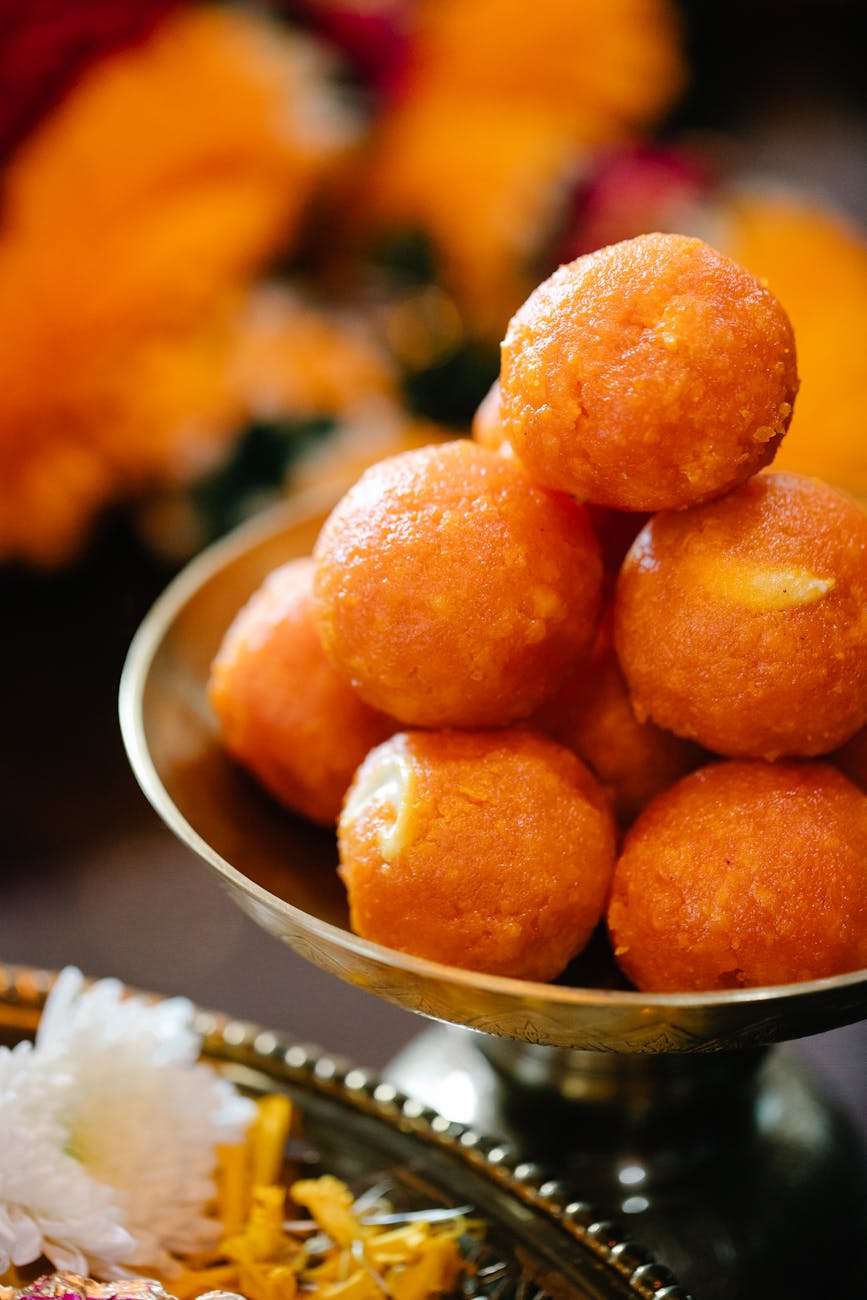
In a modest town, life flowed at its own steady pace. The marketplace was lively but ordinary — a cloth seller here, a vegetable stall there, and yes, a few halwais scattered across the streets. They sold the usual sweets: jalebis, barfis, laddoos. Nothing extraordinary.
Among them was Mithu, a boy who grew up in the backroom of his family’s sweet shop. His grandmother had named him at birth, saying fondly, “This one will speak sweet.” The name stuck, and so did the sweets. His family had been halwais for generations — known enough to survive, but never remembered.
But Mithu was restless. He didn’t want to be just another halwai. He wanted to be the one people spoke of first, the shop they told visitors about. He wanted to make laddoos so good that customers would come back even when there was no festival.
That was the problem. Laddoos were simple — besan, ghee, sugar. Every halwai used the same ingredients. And during Diwali, every shop sold out anyway.
As Mithu quietly observed, the pattern became clear: during Diwali week, his family sold 40–50 kilos a day, peaking at 80–100 on Diwali itself. But on ordinary days, sales collapsed to just 8–10 kilos. The laddoo had no loyalty. So Mithu set himself a mission:
To make a laddoo so good that people would seek it out in every season.
The First Failures
He began experimenting. Some batches were too oily. Others crumbled in the hand. One looked perfect, but when he bit into it, it felt heavy, almost lifeless.
He changed proportions — more ghee one day, less the next. He roasted the besan longer, then shorter. He tried sugar with finer crystals, then coarse grains, then jaggery.
He even changed packaging — from plain brown paper to a neat cardboard box with the shop’s name printed in bold.
And he asked questions. “Too sweet? Too heavy? Would you buy it again?” Customers gave polite smiles, sometimes half-truths, sometimes brutal honesty. Mithu scribbled their answers on scraps of paper, storing them in a tin under the counter.
But the results were disappointing. Festivals brought brief joy — 70 or 80 kilos sold on Diwali — only for demand to collapse again. Most weeks, he sold no more than 8–10 kilos.
One evening, staring at trays of unsold laddoos, Mithu muttered, “Why can’t every day be like Diwali?”
A Father’s Reminder
His father, who had been watching, smiled sadly. “It once was, beta.” Mithu looked up, surprised.
“Your great-great-grandfather made laddoos people never forgot. Customers came from nearby towns just to buy from him. On ordinary days, he sold 120 to 150 kilos. During Diwali week, 600 or 700 a day. On Diwali itself, sometimes a thousand. For his customers, every day at his shop felt like Diwali.”
Mithu’s chest tightened. His proudest peak — 80 kilos on Diwali — was what his ancestor sold on an ordinary day. His father placed a hand on his shoulder. “He didn’t wait for festivals. He built laddoos people wanted every day. That’s why they trusted him.”
That night, Mithu opened his diary and wrote:
“Don’t make laddoos for the tide. Make laddoos people will sail to, even when the waters are still.”
Lessons from the Bazaar
By the third year, Mithu’s laddoos were finally good. Regulars approved. During Diwali, his shop overflowed. Shelves emptied by noon, neighbors queued up, and Mithu worked late into the night.
But after the season ended, silence returned. Customers vanished. His heart rose and fell with the sales.
One evening at a tea stall, traders argued about grain prices. A grey-bearded man laughed:
“जो गिरा है, कल उठेगा. जो ऊपर गया है, कल गिरेगा।”
Meaning: What has fallen will rise tomorrow. What has risen will fall.
Everyone chuckled. Mithu smiled too, but something clicked. He had lived that truth in his shop. Sales rose, collapsed, rose again. Boom, bust, repeat.
That night, he wrote in his diary:
“Don’t get carried away in highs. Don’t collapse in lows. Steady hands make steady laddoos.”
From then on, Mithu stopped panicking at every cycle. With patience, his steady approach slowly began to show results.
Slow Growth
Progress came gradually. His first two years had been hopeless — daily sales of 8–10 kilos, festival peaks of 70–80. But as he tinkered, the numbers inched upward. Daily sales crept to 12–15 kilos, festival peaks to 80–100. The next year, 20–25 kilos a day, festivals 120–150.
By his fifth year, Mithu was selling 40–50 kilos on an ordinary day, and during Diwali week 300–400. It was nowhere near his ancestor’s thousand kilos, but the tide was turning. And Mithu felt it — the laddoo was changing, and so was he.
A Blessing from the Past
It was around this time, during a long-overdue cleaning of the storeroom, that his servant brought him a fragile notebook, its cover faded, edges eaten by time.
“Babuji, I found this in a box. Perhaps it belonged to the old sahib.”
Inside were his ancestor’s notes. Not recipes, but reminders:
- “Prepare your ingredients in advance before the festival rush.”
- “Respect your suppliers, pay them on time.”
- “Fulfil promises made to your helpers.”
- “Greet each customer as a guest in your home.”
- “And above all, strive to be the best version of yourself.”
Mithu sat still. It felt less like reading instructions and more like receiving a blessing. The words didn’t hand him success — they confirmed the path he was already walking.
Patience in failure. Steadiness in the tide. Awareness of patterns. Respect for people. And the commitment to keep showing up, one laddoo at a time.
For the first time, Mithu felt not just like a halwai, but part of a lineage. A story still unfolding.
The Timeless Laddoo
Mithu’s laddoos had finally become what he had dreamed of — a laddoo worth remembering, a laddoo people sought out even when there was no festival. But more than a sweet, it was a journey of cycles — failure and patience, markets and tides, history and memory.
And in that journey, he discovered something deeper: every generation must walk its own path. His great-great-grandfather, his father, and now himself — each had their own struggles, their own mistakes, their own ways of chasing the perfect laddoo.
The principles stayed the same. The journeys were always unique. Just as in laddoos, so in life, in work, in leadership.
The secret isn’t in chasing the grand moment. It is in showing up, improving, and carrying forward the principles — one step at a time.
 Quiet Reflections